
When a production defect, equipment failure, or workplace incident occurs, the first explanation is often the easiest one to see: an operator made an error, a machine malfunctioned, or a procedure was not followed. But stopping at the first visible cause can leave other contributing factors undiscovered. A recurring problem may involve several conditions working together, making it necessary to examine the event from different angles. This is where Root Cause Analysis (RCA) becomes important. The 4M Factors in Root Cause Analysis include Man, Machine, Method, and Material provide a structured way to examine the different factors that may have contributed to an event.
The value of the 4M approach lies in its ability to move an investigation beyond individual blame and toward a broader examination of the process. It encourages investigators to look at the people involved, the equipment being used, the way the work was performed, and the materials entering the process. By considering these four areas systematically, teams can identify contributing factors that may otherwise be overlooked and develop corrective actions based on evidence rather than assumptions.
What Are the 4M Factors in Root Cause Analysis?
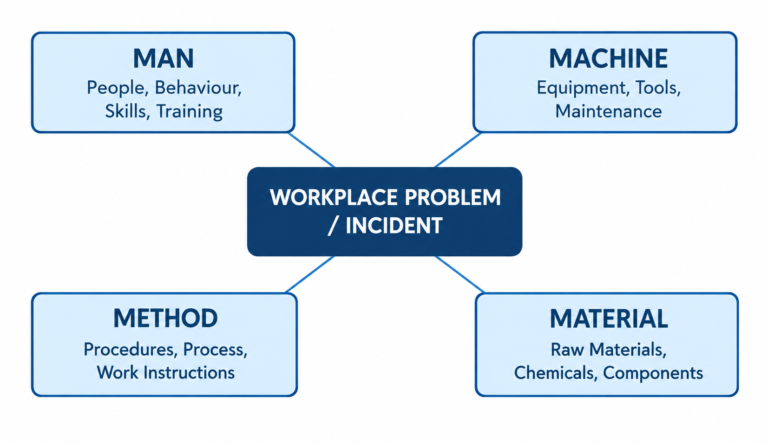
The 4M Factors in Root Cause Analysis are four categories used to organize an investigation: Man, Machine, Method, and Material. Rather than jumping to a single explanation, investigators use the four categories as a checklist, working through each one systematically to see whether it played a role in the event. This matters because the first explanation offered after an incident, whether it is “the operator missed a step” or “the machine failed,” is frequently only one part of a larger picture.
Focusing on a single, obvious cause tends to produce a shallow investigation. An operator error may have occurred because a procedure was unclear. A machine may have failed because a maintenance interval was extended under production pressure. The 4M analysis approach forces a wider view before conclusions are drawn.
| 4M Factor | What It Covers | Investigation Focus |
| Man | People, behaviour, skills, training and competency | Human actions and conditions influencing performance |
| Machine | Equipment, tools and technology | Condition, maintenance, settings and safety controls |
| Method | Procedures, processes and workflows | Sequence, instructions, process controls and deviations |
| Material | Raw materials, components and consumables | Quality, specification, condition, storage and traceability |
Man - People, Behaviour, Skills and Human Factors
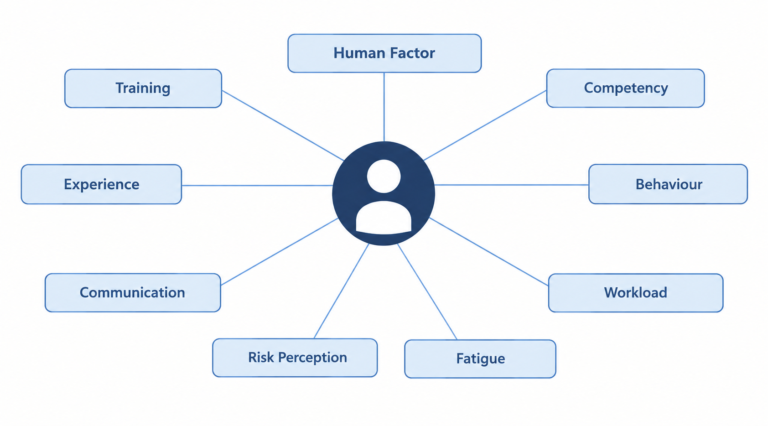
The Man category covers everyone involved in a task, not only the person who happened to be operating equipment when an event occurred: operators, supervisors, maintenance personnel, contractors, and support staff all fall within this factor. It also extends beyond a single individual to include training, competency, experience, communication, and behaviour under real working conditions.
Training and Competency
An investigation into training should go further than confirming that a session took place. It should establish whether training was required for the specific task, whether it was actually delivered, whether the content was task-specific rather than generic, whether comprehension was verified, and whether refresher training had lapsed. “Lack of training” is rarely a sufficient conclusion on its own; it needs to be traced back to what, specifically, was missing and why.
Behaviour and Human Factors
Human behaviour is a required part of any Man-factor investigation, and it deserves particular care. Work habits, complacency, familiarity with a task, perceived risk, time pressure, and fatigue all shape how a task is actually performed on the floor, often quite differently from how it is documented. Unsafe or unexpected behaviour should not automatically be treated as the root cause. The more useful question is why the behaviour occurred in the first place. That behaviour may trace back to unclear procedures, inconsistent supervision, unrealistic workload, production pressure, gaps in training, poorly designed equipment, or breakdowns in communication between shifts.
Experience and Knowledge
New employees are an obvious focus for investigators, but experienced employees carry their own risks. Long familiarity with a task can dull hazard awareness, and experience with an older process does not guarantee awareness of a recently modified one. Both ends of the experience spectrum deserve equal scrutiny.
Communication
Miscommunication between operators, supervisors, maintenance, quality, and EHS functions is a frequent contributing factor, particularly around shift handovers. A condition noted by one shift that is not clearly communicated to the next can directly set up a recurring incident.
Workload, Fatigue and Time Pressure
Staffing shortfalls, extended shifts, and production-driven time pressure influence decision-making in ways that are easy to overlook once an incident has already occurred and hindsight makes the “correct” action seem obvious. These conditions should be documented as part of the investigation, not treated as background noise.
How to Investigate the Man Factor
- Was the employee trained and assessed as competent for this specific task?
- Was the procedure followed as written, and if not, why
- What communication took place before, during, and after the task?
- What was the staffing level and workload at the time?
- Had similar deviations occurred previously without correction?
Machine - Equipment, Tools and Technology
The Machine factor covers considerably more than production equipment. It includes forklifts, conveyors, material-handling equipment, lifting equipment, hand tools, automated systems, and safety-related equipment such as guards and interlocks. Investigation should examine equipment condition, maintenance history, preventive maintenance adherence, prior breakdowns, inspection records, calibration status, current machine settings, guarding, emergency stop function, and whether the equipment was suitable for the task being performed.
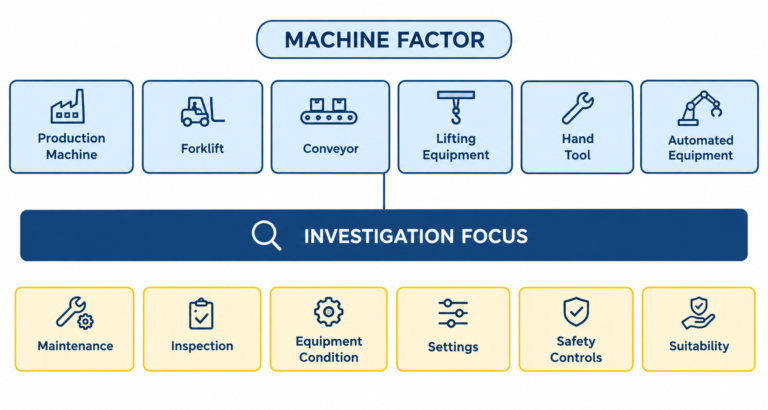
A forklift incident illustrates why this factor should not default to “operator error.” A thorough review would examine brake condition, steering response, maintenance and inspection history, visibility from the operator’s position, load condition and stability, the operating environment at the time, and whether the specific forklift was appropriate for that load and aisle configuration. An incident that looks like operator error on the surface can just as easily trace back to a maintenance gap or an equipment-suitability issue. The Machine factor is broader than forklifts alone, however, and an investigation should give equal weight to conveyors, lifting equipment, and automated systems where they are relevant.
Method - Procedures, Processes and Workflows
The Method factor covers standard operating procedures, work instructions, process design, sequence of operation, inspection methods, and approval processes. A central part of this investigation is comparing what the documented procedure says with what actually happens on the shop floor, because the two frequently diverge over time.
Simplification of the Sequence of Operation
A process is sometimes simplified over months or years, often for good reason, but the simplification can unintentionally remove safety checks, quality checks, verification steps, isolation steps, or other controls that were originally built into the sequence for a specific reason. A shortcut adopted informally by one shift can, over time, become the de facto standard without ever being formally reviewed.
Consider a packaging line where an intermediate inspection step was gradually skipped because it slowed throughput during a busy period, and the shortcut simply persisted afterward. Months later, a batch of mislabeled products reaches a customer. The immediate cause is the mislabeling, but the underlying cause is a sequence that lost a control step without formal review.
- Was the original sequence deliberately changed, or did it drift informally?
- Were any steps removed, and was that removal reviewed and approved
- Does the documented procedure still match what is actually performed?
- Were critical controls retained in the revised version?
Employee Shifting, Process Changes and Change Management
Employees are regularly moved between jobs, workstations, departments, and production lines to cover absences or meet demand. Movement of this kind introduces risk when an employee is unfamiliar with the equipment, procedures, hazards, or responsibilities of the new assignment. Investigation should examine whether training gaps existed, whether competency was verified before the assignment began, and what level of supervision was provided during the transition.
This connects naturally to Change Management, sometimes called Management of Change (MOC). Changes involving personnel assignments, processes, equipment, or operating conditions generally warrant a risk evaluation before implementation, rather than being treated as routine reassignments. A formal MOC step at the point of change is often the control that would have prevented the incident in the first place.
Material - Raw Materials, Components and Consumables
The Material factor covers raw materials, components, parts, chemicals, consumables, and other inputs used in a process. Investigation focuses on whether the material was correct, met specifications, and remained suitable for use. It also considers quality, condition, storage, handling, identification, and traceability.
Material Quality and Condition
Check whether the material itself contributed to the problem.
- Correct specification or grade used?
- Quality requirements met?
- Damaged, contaminated, expired, or degraded?
- Any variation affecting the process?
Storage, Handling and Identification
Examine whether storage or handling affected the material and whether it was properly identified.
- Required storage conditions maintained?
- Damage or contamination during handling?
- Correct labeling and identification?
- Batch or lot traceability maintained?
- Risk of material mix-up?
Supplier and Traceability
Where relevant, review:
- Incoming inspection records
- Supplier quality records
- Batch or lot information
- Certificates of conformity
- Material source and traceability
How Multiple Factors Interact: A Work-at-Height Example
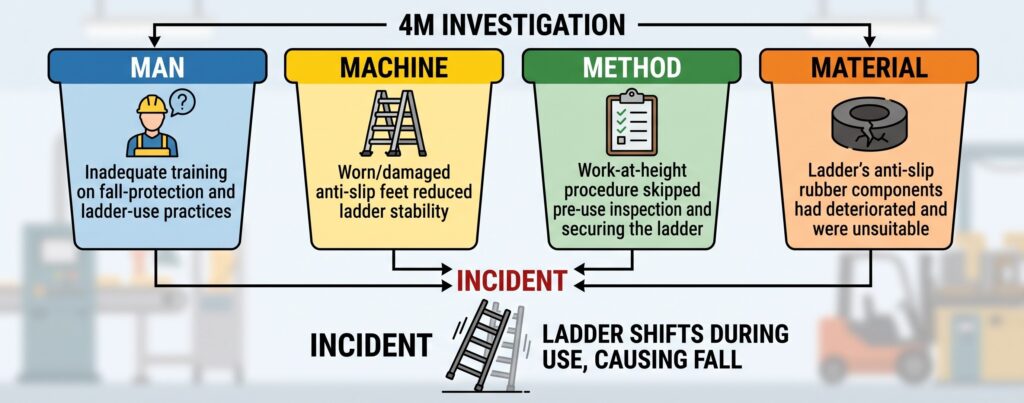
Consider a worker performing maintenance on a 3-metre-high production platform. The worker falls while accessing the platform because the access ladder shifts during use. A 4M investigation may identify contributing factors across several categories:
- Man: The worker had not been adequately trained on the required fall-protection and ladder-use practices.
- Machine: The ladder had worn or damaged anti-slip feet, reducing its stability.
- Method: The work-at-height procedure required a pre-use ladder inspection and securing the ladder, but these steps were not completed.
- Material: The ladder’s anti-slip rubber components had deteriorated and were no longer in suitable condition.
This example shows why a root cause investigation should not stop at the immediate cause. The unstable ladder explains how the fall occurred, but examining Man, Machine, Method, and Material can reveal the combination of conditions that allowed the incident to happen.
How the 4M Factors Work Together
A repeated production defect demonstrates how the four categories often interact rather than acting independently. Man might involve inadequate setup training. Machine might involve inconsistent machine settings between operators. Method might involve unclear setup instructions. Material might involve variation between raw material batches. Any one of these alone might not produce a defect, but in combination they can.
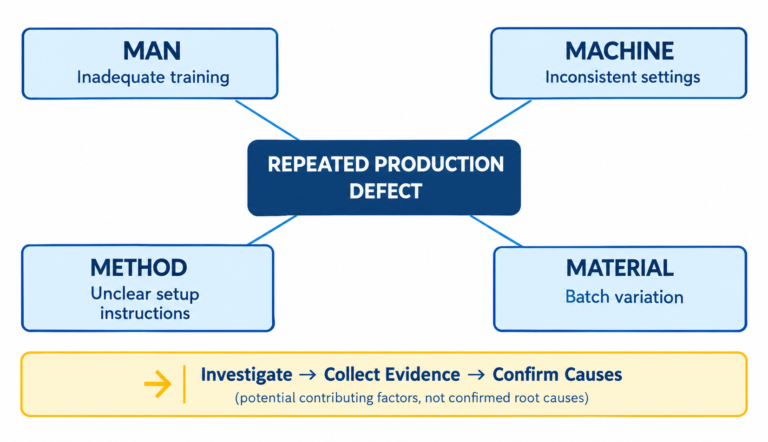
These four items should be treated as potential contributing factors, not automatically confirmed root causes, until evidence establishes which factor actually contributed, how it contributed, and whether it functioned as a root cause or as a secondary contributing factor. It helps to keep a clear distinction between a symptom, an immediate cause, a contributing factor, and a root cause, with corrective action following only once that chain has been traced with evidence rather than assumption.
How to Use the 4M Framework During an RCA Investigation
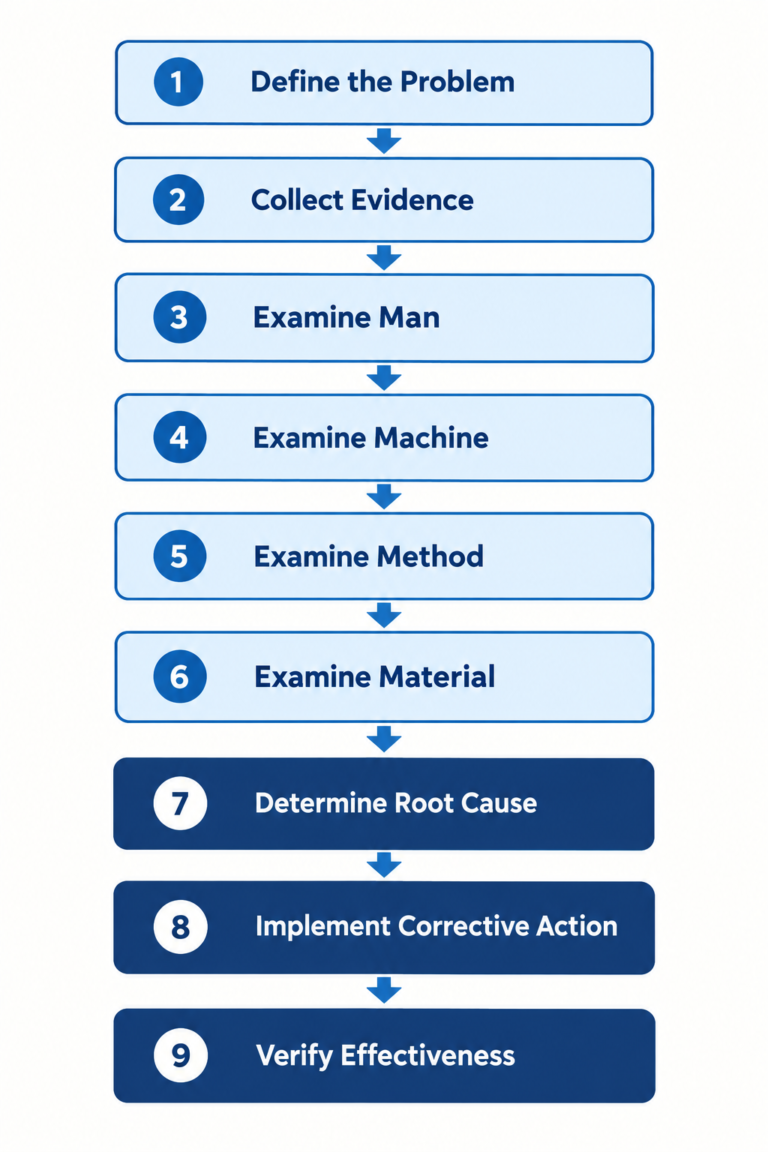
Step 1: Define the Problem
Establish specifically what happened, where, when, what was affected, and what the impact was. A vague problem statement produces a vague investigation.
Step 2: Collect Evidence
Gather interviews, photographs, CCTV footage where available, incident reports, maintenance records, inspection records, training records, machine data, work instructions, and material records.
Step 3: Examine All Four Factors
Work through Man, Machine, Method, and Material systematically rather than stopping once a plausible explanation appears.
Step 4: Determine Actual Causes
Assumptions are not sufficient; each potential cause needs to be supported by the evidence collected.
Step 5: Establish Corrective and Preventive Actions
Actions such as targeted training, procedure revision, engineering controls, equipment modification, improved maintenance scheduling, material controls, process changes, or adjusted supervision should address the identified cause rather than simply treating the symptom.
Step 6: Verify Effectiveness
A corrective action that is implemented but never checked provides no assurance that the underlying problem was actually resolved. Follow-up verification confirms whether the recurrence risk has genuinely been reduced.
Digital tools such as Incident Management Software can support several of these steps in practice, particularly incident reporting, evidence collection, structured investigation using methods such as 5 Whys, CAPA assignment and tracking, notifications, and visibility into recurring risk trends across a facility. Centralizing investigation records in one system makes it easier for EHS teams to track corrective and preventive actions through to completion rather than losing them in spreadsheets or email threads, though the software supports the investigation process rather than replacing the judgment involved in it.
Common Mistakes When Using the 4M Framework
Blaming the employee immediately. Employee action is rarely a complete explanation on its own and should be examined in the context of training, procedures, supervision, and workload.
Investigating only one factor. Stopping at Man or Machine alone risks missing contributing factors sitting in Method or Material.
Confusing symptoms with root causes. A jammed conveyor is a symptom; the reason material buildup was allowed to accumulate undetected is closer to the actual cause.
Making assumptions without evidence. Conclusions should be grounded in records, interviews, direct observation, and data rather than the most convenient explanation.
Ignoring interactions between factors. Man, Machine, Method, and Material regularly influence one another, and treating them as fully independent categories can obscure how an incident actually developed.
External and Environmental Factors
Not every event is fully explained within the four categories. Floods, severe weather, natural disasters, and other external disruptions can contribute to or cause an incident independent of Man, Machine, Method, or Material. These factors should be considered alongside a 4M investigation where relevant, without becoming the primary focus of an analysis that is otherwise about internal manufacturing conditions.
Is 4M the Only Root Cause Analysis Method?
Root Cause Analysis includes several established methods beyond 4M Analysis, and the appropriate choice often depends on the nature and complexity of the event under investigation. 5 Whys works well for tracing a linear chain of causation through repeated questioning. Fishbone (Cause-and-Effect) Analysis provides a visual way to map multiple potential cause categories at once. Fault Tree Analysis is suited to more complex events involving multiple interacting failure paths.
These methods are not mutually exclusive, and investigation teams frequently combine them, using one to structure the initial investigation and another to verify or cross-check findings at a later stage. No single method is inherently superior; the objective throughout remains the same regardless of which framework is applied: understanding the actual causes and contributing factors behind an event and establishing corrective and preventive actions that address them.
Conclusion
The 4M Factors in Root Cause Analysis, Man, Machine, Method, and Material, give manufacturing teams a structured way to look beyond the first explanation that presents itself after an incident, defect, or process deviation. Man covers people and behaviour in context rather than as an automatic point of blame. Machine extends across the full range of equipment on a shop floor. Method examines whether documented procedures still match actual practice, particularly after informal simplification or personnel changes. Material covers the raw inputs and consumables that feed a process, including the information systems, such as SDS documentation, that surround them.
Used properly, the framework identifies potential contributing factors that must then be confirmed or ruled out with evidence, distinguishing genuine root causes from simple symptoms along the way. Corrective and preventive actions that follow should target the confirmed cause, with their effectiveness checked afterward rather than assumed. Combined where appropriate with methods such as 5 Whys, Fishbone analysis, or Fault Tree Analysis, and supported by consistent incident-management records, the 4M approach gives investigation teams a practical way to reduce the chance that today’s defect or incident becomes next month’s repeat event.


