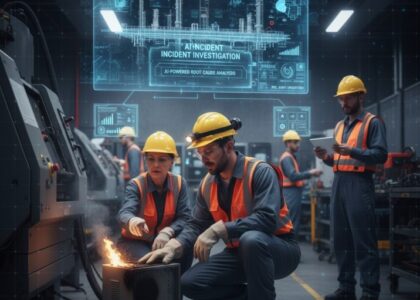
Industrial operations are becoming increasingly complex, with multiple activities occurring simultaneously across different work zones. In such environments, a small oversight can escalate into a major incident. Traditional Permit to Work (PTW) systems—often paper-based and heavily dependent on manual checks—are simply not equipped to manage today’s fast-paced operational demands. AI-powered PTW systems provide the intelligence, automation, and real-time insights required to ensure safe execution of high-risk tasks while maintaining operational efficiency. By leveraging artificial intelligence, organizations can modernize their safety processes, reduce human error, and move toward a more predictive model of risk prevention.
The Evolution of Permit to Work: From Manual to Intelligent:
For decades, PTW processes relied on manual supervision, handwritten documentation, and face-to-face approvals. These methods, while familiar, are slow, inconsistent, and prone to mistakes. Workers often face delays in obtaining permits, and critical safety controls may be overlooked due to human fatigue or time pressure. AI transforms this landscape by introducing automated validation checks, intelligent permit routing, and digital consistency across all sites. Instead of relying solely on individual experience, AI ensures that every permit follows standardized procedures, reducing variability and improving accuracy. This evolution creates a more reliable and efficient PTW system that supports real-time operations while significantly reducing administrative burden.
1)Manual PTW systems are slow, inconsistent, and prone to human error.
2)AI enables automated validation, intelligent routing, and standardized permit accuracy.
3)AI-powered PTW makes the process faster, more reliable, and operationally efficient.
Smarter, Faster Workflows with Intelligent Automation
Manual PTW systems often struggle with delays, backlogs, and miscommunication. Approvers may not be available; documents may be misplaced, and errors in permit entries may cause repeated corrections. AI-powered systems streamline this entire workflow by automating repetitive tasks such as filling in permit details, cross-checking information, notifying approvers, and monitoring permit timelines. The system also provides real-time visibility into permit status, allowing teams to coordinate work more efficiently. This reduces downtime, speeds up approvals, and ensures that no critical step is missed. With intelligent automation, PTW becomes a smooth, seamless process that supports both safety and operational productivity.
Predictive Safety: Anticipating Risks Before They Become Incidents
One of the greatest advantages of AI is its ability to detect patterns and predict future risks. AI models analyze thousands of permits, incident records, environmental readings, and contractor performance data to identify subtle trends that may indicate potential danger. For example, certain tasks may consistently show high-risk behaviors, or specific locations may repeatedly generate hazardous conditions. AI alerts safety teams to these patterns, enabling proactive intervention before an incident occurs. This predictive capability shifts PTW from a reactive process to a forward-looking safety strategy, allowing organizations to prevent accidents instead of merely responding to them.
Why AI-Powered PTW Systems Are the Future of Industrial Safety
Moving beyond paper checklists to truly predictive, intelligent operational control.
1. Predictive Risk Assessment
- Dynamic Conflict Check (SIMOPS): Automatically identifies dangerous overlaps in time and space, preventing critical co-location incidents.
- Environmental Context: AI factors in real-time weather, equipment status, and staffing levels to refine the risk score of the pending permit.
2. Digital Enforcement & Control
- Automated LOTO Verification: Enforces digital adherence to Lockout/Tagout procedures, eliminating human oversight in energy isolation.
- Geo-fenced Validity: Permits are only valid within specific, digitally mapped areas, reducing unauthorized movement and scope creep.
3. Unprecedented Efficiency
- Rapid, Guided Workflow: AI guides users through complex permit creation, ensuring all mandatory steps and attachments are complete before submission.
- Irrefutable Audit Trail: Automatically logs every sign-off, decision, and system check, providing full regulatory compliance documentation instantly.
4. Learning & Improvement
- Data-Driven Training: Automatically flags common approval bottlenecks or frequently missed hazards to inform targeted training needs.
- System Self-Correction: The AI continuously learns from successful and unsuccessful permits to refine risk scoring models over time.
AI-Powered PTW is not just digitization; it is the integration of data science and safety regulation to eliminate catastrophic risk.
Why AI-Powered Permit To Work Is the Future
AI-powered Permit To Work systems offer unmatched accuracy, speed, and control—qualities essential for modern industrial safety. Organizations adopting these systems experience fewer errors, faster workflows, stronger compliance, and improved safety culture. Workers feel supported by intelligent tools that simplify their tasks, while safety managers gain better visibility and data-driven decision-making capabilities. AI ensures consistency across all work sites, eliminates manual bottlenecks, and creates a safer environment by addressing risks early and intelligently. In a world where safety regulations are tightening and operational complexity is increasing, AI-powered PTW stands out as the future-ready solution industries need.
Conclusion
AI-powered Permit to Work systems represent a major leap forward in industrial safety. By transforming manual processes into intelligent, automated workflows, organizations can significantly reduce risk while improving operational efficiency. With better hazard identification, faster approvals, predictive insights, and seamless integration across safety functions, AI enables companies to stay ahead of risks rather than react to them.