
Visitor Management Systems help organizations improve workplace security, safety, and compliance by replacing manual visitor registration with a more secure and efficient process. Despite advances in workplace technology, many organizations still rely on paper visitor logs that provide limited visibility and control. Businesses regularly welcome vendors, contractors, auditors, consultants, and other guests, making it important to know who is entering the facility, why they are visiting, and how long they remain on-site. A Visitor Management System (VMS) provides organizations with the tools needed to verify visitors, manage access, maintain accurate records, and support compliance requirements.
The Problem with Manual Visitor Logs
The paper register had a decent run. But it was never designed for the demands that modern organizations now face.
When a guest signs in by hand, reception staff write down whatever that person provides. If a compliance officer asks to pull visitor records from the previous quarter, the answer often involves searching through archived folders and manually reviewing records.
These limitations can create challenges for organizations trying to maintain strong security and compliance standards. A Visitor Management System addresses these issues through automated registration, digital records, and improved visitor visibility.
How Visitor Management Systems Verify Visitor Identity
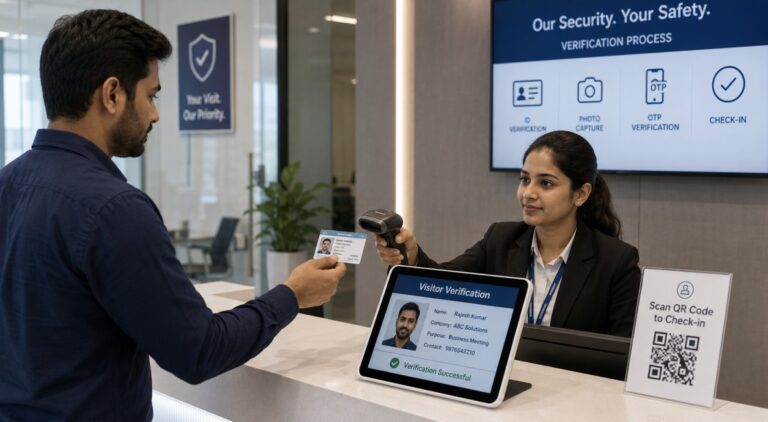
A VMS gets to work well before a guest reaches the front desk. Through advance registration, the system can run verification using photo capture, digital ID validation, QR code scanning, or one-time password confirmation.
The individual who presents themselves at your reception desk is confirmed against a verified record — documented and on file. This approach is not about viewing every visitor with suspicion. The goal is precision — clear, verified documentation of every visit from the very first interaction. Knowing who entered, at what time, and for what purpose puts the organization firmly in control of its own facility.
How Visitor Management Systems Improve Visitor Visibility
In many organizations, visibility into visitor activity becomes limited once a guest completes the sign-in process. This can make it difficult to maintain accurate occupancy and access records throughout the visit.
A Visitor Management System provides real-time visibility into visitor activity across the facility. Security and reception teams can view current visitor information, host details, visit duration, and access permissions from a centralized dashboard. Having this information readily available helps organizations maintain better oversight, improve visitor accountability, and respond more effectively when operational or security-related situations arise.
How Visitor Management Systems Support Compliance Records
When a regulatory body or customer requests visitor data from the past few months, the last thing any organization wants is a scramble through filing cabinets.
A VMS logs every visit automatically — check-in and check-out times, host details, visit purpose, signed acknowledgments, and approval records. All of it is stored digitally and retrievable within seconds. Organizations that run a VMS move through inspections with confidence. Those still relying on paper often spend more time explaining gaps than demonstrating actual compliance.
OSHA Compliance and the Role Visitor Management Plays
Workplace safety requirements extend well beyond employees — and a VMS supports compliance with several key OSHA standards.
OSHA 29 CFR 1910.38 — Emergency Action Plans
A Visitor Management System records visitor activity throughout the day, helping organizations maintain accurate occupancy information and improve visibility into who is currently present on-site.
Instead of relying on paper registers or manual headcounts, authorized personnel can quickly review visitor information when responding to an emergency. This level of visibility can be particularly valuable in large facilities where multiple visitors, contractors, and vendors may be present at the same time.

OSHA 29 CFR 1910.1200 — Hazard Awareness at Entry
Visitors and contractors may not be familiar with the hazards present within a facility. During registration, a Visitor Management System can provide safety guidance, restricted area information, and workplace precautions to help visitors understand site requirements before access is granted.
OSHA 29 CFR 1910.132 — Protective Equipment Communication
Different work environments may have specific safety requirements that visitors must follow before entering operational areas. By displaying PPE instructions during the check-in process and recording acknowledgment electronically, a Visitor Management System helps reinforce safety awareness and support compliance efforts.
Restricting Access to Sensitive Zones
Not all visitors need access to all areas. Server rooms, research labs, production floors, and executive sections often hold sensitive data, valuable equipment, or critical systems that require a higher level of protection.
A VMS allows administrators to assign specific access levels based on visitor category, the declared purpose of the visit, and host authorization. A courier collecting a package does not receive the same clearance as a licensed IT technician performing server maintenance. Access permissions can be verified automatically during check-in, helping organizations enforce security policies consistently across all visitor interactions.
Scheduling Ahead and Notifying Hosts Instantly
Modern VMS platforms allow employees to pre-register visitors, define visit details in advance, and automatically notify hosts when visitors arrive. Automated notifications help keep hosts informed of visitor arrivals, improving coordination and creating a smoother check-in experience for both visitors and employees.
Capturing Policy Acknowledgments Without the Paperwork
When this is handled on paper, signed forms end up in a drawer and are rarely consulted again. A VMS collects these confirmations electronically during check-in and links each one directly to that visitor’s session record — timestamped and retrievable. If a signed acknowledgment ever needs to be produced during a dispute or an audit, it takes seconds to locate.
Screening Against Restricted Access Records
Some situations require organizations to prevent specific individuals from entering — someone whose clearance was withdrawn, a person connected to a past security incident, or anyone flagged on an internal watchlist.
A VMS can automatically cross-reference new visitor registrations against these restricted records before access is considered. When a potential match appears, security staff receive a discreet alert — before any access decision is made. This screening runs quietly in the background during every check-in, without disrupting the experience for legitimate guests.
Faster Entry for Pre-Registered Visitors
Long queues at reception affect productivity on both sides of the desk and leave a poor impression on guests.
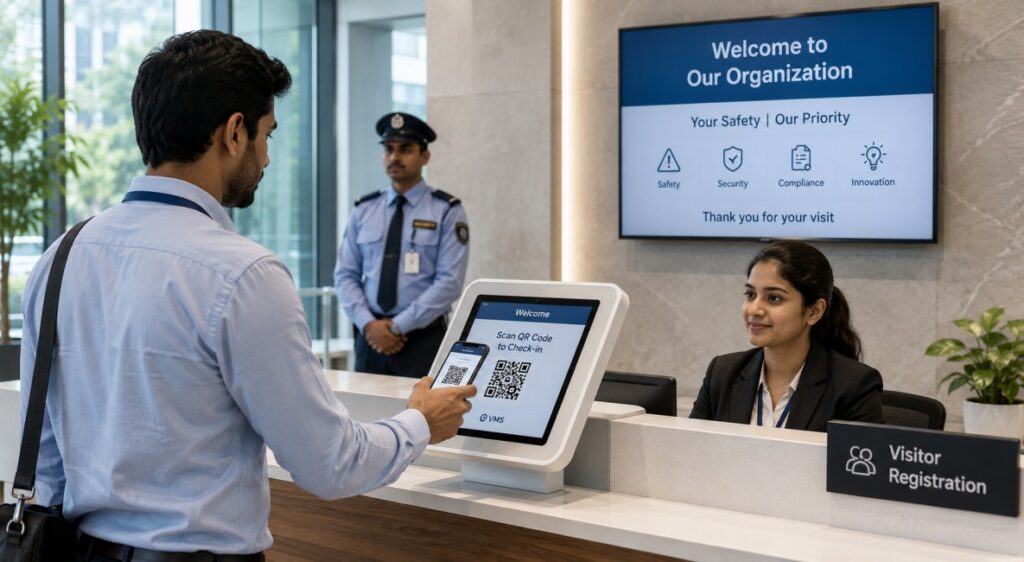
When visitors register through a VMS before their visit, most of the check-in process is already complete. On arrival, a quick QR scan confirms their identity and records their entry. No forms to fill in at the desk, no manual verification, no waiting. The process is smooth and efficient — and every security control remains fully active.
Visitor Management Systems for Contactless Check-In
The COVID-19 pandemic highlighted the importance of minimizing physical contact in workplace environments. Traditional visitor registration methods often required guests to sign paper registers, share pens, exchange documents, and spend time waiting at reception desks, increasing unnecessary contact points.
A Visitor Management System enables a safer and more efficient alternative through contactless visitor registration. Visitors can pre-register before arrival, receive a QR code on their mobile device, and complete check-in by simply scanning the code at the entrance. The system automatically notifies the host, records visitor details, and generates a visitor badge without manual paperwork.
This approach not only helped organizations maintain business continuity during the COVID-19 period but also improved overall security, reduced reception congestion, and enhanced the visitor experience. Today, contactless visitor management remains a best practice for organizations looking to provide a modern, secure, and efficient entry process.
What a Visitor Badge Actually Communicates
A printed visitor badge does more than display a name. It shows which areas the visitor is cleared to enter, identifies the employee they are meeting, and indicates how long the visit is authorized to last.
During an emergency evacuation, badges become critical tools for safety coordinators. They help confirm who is still inside and whether every visitor has been safely accounted for. That small piece of identification carries far more operational weight than most organizations realize until they actually need it.
Visitor Management Systems for Safety Awareness
Many visitors enter facilities without fully understanding site-specific safety requirements, restricted areas, or emergency procedures. A Visitor Management System can automatically present safety videos, visitor guidelines, and emergency instructions during the check-in process.
Before receiving access, visitors can watch a short safety briefing video covering important site rules, evacuation procedures, PPE requirements, and restricted zones. The system records completion, ensuring that every visitor receives consistent safety information before entering the facility.
This helps organizations improve safety awareness, reduce risks, and demonstrate compliance with workplace safety requirements.

Protecting Visitor Privacy from the Start
Paper registers create a privacy exposure that is easy to overlook. Every new arrival can see the full list of names, companies, and contact details left by everyone who signed in before them. Depending on the sensitivity of your visitors or their meetings, that level of uncontrolled exposure is a real problem.
A digital VMS stores all visitor data in a secure, access-controlled environment. Personal information is visible only to authorized staff and is managed in line with data protection obligations. It is a straightforward improvement — one that most organizations genuinely appreciate once they have experienced both approaches.
Unified Oversight Across Multiple Locations
For organizations running several sites, maintaining consistent visitor management practices across all of them is a real operational challenge. Different locations develop different habits over time, and those habits quietly undermine organization-wide compliance standards.
Cloud-based visitor management systems place every site on a single unified platform. Compliance and security teams can review occupancy data, access logs, and acknowledgment records across all locations from one interface — without needing to be physically present at each site. Consistency is enforced. Gaps become visible before they become problems.
Conclusion
Visitor management has grown well beyond a front-desk task. Every decision made at entry — who receives access, what they acknowledge, how their presence is tracked — reflects directly on an organization’s commitment to security, safety, and regulatory accountability.
A Visitor Management System brings structure and clarity to a process that most workplaces have historically left to chance. The paper register served its purpose for a long time. For organizations serious about operating at a higher standard, a modern VMS is no longer a nice-to-have — it is a practical necessity.


