Centralized Compliance Monitoring
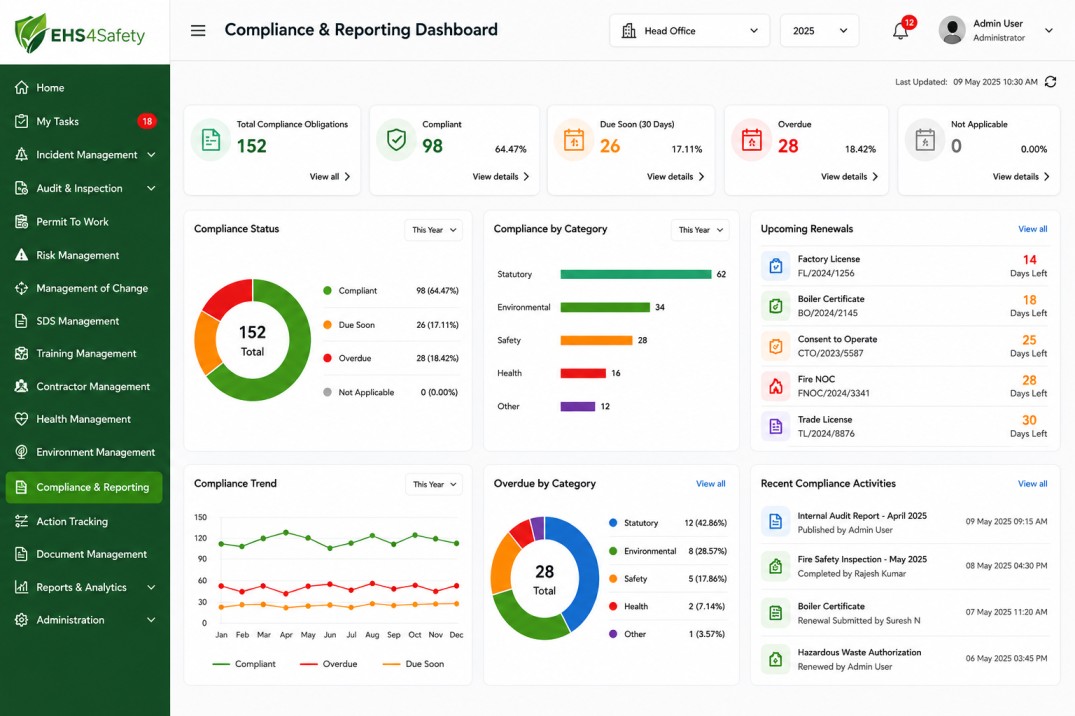
Organizations can monitor compliance status across multiple HSE processes through a single dashboard, helping management identify overdue actions, upcoming renewals, open findings, and regulatory obligations in real time.
Audit-Ready Documentation
Compliance records generated from inspections, incident investigations, permits, training programs, and risk assessments are automatically maintained within a centralized repository, simplifying internal and external audits.
Regulatory Reporting
The system supports the generation of statutory reports, compliance summaries, audit reports, inspection reports, incident statistics, training compliance reports, and management dashboards, reducing manual reporting effort.
Action & Closure Tracking
Compliance findings identified through audits, inspections, incidents, or observations can be tracked through closure, ensuring accountability and continuous improvement.
Real-Time Management Visibility
Interactive dashboards provide key performance indicators (KPIs), compliance trends, overdue activities, audit status, corrective action progress, and regulatory performance metrics to support informed decision-making.
Continuous Compliance Improvement
By consolidating data from all HSE activities, organizations can identify recurring issues, monitor performance trends, reduce compliance risks, and strengthen governance across operations.

Global Compliance Frameworks
Influencing Modern HSE Strategies
As businesses expand across countries, industries, and operational environments, compliance management has become significantly more complex. Organizations are expected to comply with a combination of occupational safety regulations, environmental requirements, risk management standards, chemical safety directives, and sustainability reporting obligations.
To achieve consistent compliance across facilities and jurisdictions, organizations often align their Health, Safety, and Environmental (HSE) programs with internationally recognized standards and regulatory frameworks. These frameworks provide the foundation for managing workplace risks, improving operational performance, protecting employees, and meeting stakeholder expectations.
| Standard / Regulation | Geographic Scope | Business Focus |
|---|---|---|
| OSHA General Industry Standards (29 CFR Part 1910) | United States | Establishes workplace safety requirements across industrial, manufacturing, warehousing, and operational environments |
| OSHA Construction Standards (29 CFR Part 1926) | United States | Defines safety expectations for construction projects, contractors, and site-based activities |
| OSHA Hazard Communication Standard (29 CFR 1910.1200) | United States | Strengthens chemical safety awareness through labeling, hazard communication, employee training, and SDS accessibility |
| OSHA Control of Hazardous Energy (29 CFR 1910.147) | United States | Reduces maintenance-related risks through effective energy isolation and lockout/tagout procedures |
| OSHA Permit-Required Confined Spaces (29 CFR 1910.146) | United States | Establishes safeguards for personnel working within enclosed or potentially hazardous workspaces |
| OSHA Process Safety Management (29 CFR 1910.119) | United States | Enhances operational controls for facilities managing highly hazardous chemicals and critical processes |
| ISO 45001:2018 | International | Provides a structured framework for occupational health, workplace safety, and continual performance improvement |
| ISO 14001:2015 | International | Supports environmental stewardship through systematic management of environmental aspects and impacts |
| ISO 9001:2015 | International | Promotes process consistency, operational efficiency, and continuous quality improvement |
| REACH Regulation (EC 1907/2006) | European Union | Governs the safe use, registration, evaluation, and control of chemical substances throughout their lifecycle |
| CLP Regulation (EC 1272/2008) | European Union | Standardizes the classification, labeling, and communication of chemical hazards across member states |
| Seveso III Directive | European Union | Focuses on preventing major industrial accidents and improving preparedness for high-consequence events |
| Industrial Emissions Directive (IED) | European Union | Encourages environmentally responsible industrial operations through emission control and monitoring requirements |
| Corporate Sustainability Reporting Directive (CSRD) | European Union | Expands transparency and accountability for sustainability performance, ESG metrics, and corporate disclosures |
| Waste Framework Directive | European Union | Promotes resource efficiency, waste reduction strategies, recycling initiatives, and circular economy practices |
| EU Occupational Safety and Health Framework Directive | European Union | Supports a harmonized approach to occupational risk management, workforce safety governance, and preventive safety culture across European operations |