Introduction
In occupational health and safety, a near miss is defined as an unplanned event that did not result in injury, illness, or damage but had the potential to do so under slightly different circumstances. OSHA expands this further: a near miss includes any unsafe condition, unsafe act, or sequence of events that nearly resulted in a workplace incident.
While it may seem counterintuitive to report events that caused no harm, near misses are, in fact, the most powerful leading indicators available to any EHS professional. For over 15 years working across high-hazard industries including construction, manufacturing, oil and gas, and logistics, I have witnessed firsthand how organisations that take near miss reporting seriously dramatically outperform those that do not.
The data is unambiguous. For every serious injury or fatality, hundreds of near miss events went unnoticed, unreported, or uninvestigated. A robust Near Miss Reporting System does not merely record events. It transforms raw field observations into actionable intelligence that prevents injuries, protects workers, and builds a stronger safety culture across the organization.
Why Organizations Need a Near miss Reporting System
1. Early Hazard Detection
Traditional safety programs are largely reactive. A digital Near Miss Reporting System flips this model entirely. When workers can report hazardous conditions through a mobile app in real-time, EHS teams gain visibility into risks before they escalate into recordable incidents.
2. Preventing Serious Incidents
Every serious workplace injury or fatality is preceded by dozens, sometimes hundreds, of unreported or unactioned near misses. Key reasons why prevention fails include:
- Near misses go unreported due to fear of blame
- Paper-based systems create friction that discourages reporting
- Reports are submitted but investigations are never completed
- Root causes are identified but corrective actions are never closed
Key Insight
Implementing a structured near miss reporting process creates the early warning system organizations desperately need. A slip on a wet floor that goes unreported today becomes a fractured femur next month.
3. Regulatory Compliance Support
Regulatory bodies including OSHA, HSE (UK), and ISO 45001 expect organizations to maintain documented processes for hazard identification and incident investigation. A digitized Near Miss Reporting System provides:
- Auditable, timestamped records of all reported events
- Documented investigation outcomes and root cause findings
- Evidence of corrective and preventive action closure
- Reporting participation data by site, department, and shift
4. Safety Culture Strengthening
Cultures where workers feel psychologically safe to report near misses without fear of blame are demonstrably safer. A system that is easy to use, anonymous where needed, and visibly acted upon by leadership sends a clear signal of organisational commitment. Reporting rates are one of the strongest cultural diagnostics available in EHS management today.
Benefits of a Digital Near Miss Reporting System
Improved Hazard Visibility Across Operations
Digital near miss software aggregates reports across sites, shifts, and business units, providing EHS leadership with a consolidated view of where hazards are clustering. Geographic heatmaps, department-level filtering, and trend dashboards make it possible to prioritize resources with precision rather than intuition. No more guessing where the next incident will occur.
Strengthened Root Cause Analysis
Modern near miss software embeds analytical frameworks like the 5 Whys, Fishbone (Ishikawa) diagrams, and Bow-Tie analysis directly into the workflow. This ensures root causes, not just surface symptoms, are identified and addressed. Superficial investigations that conclude with worker error without examining systemic contributors are one of the leading causes of repeat incidents across all industries.
Faster CAPA Closure
One of the most common failure modes in safety management is the accumulation of open corrective actions. A digital platform enables:
- Automated task assignment to named responsible parties
- Due date tracking with escalation alerts for overdue items
- Mobile push notifications that keep assignees accountable
- Management dashboards showing open versus closed CAPA status in real time
Reduction in Incident Recurrence
Organizations with mature near miss reporting programs consistently demonstrate lower incident recurrence rates. Near miss analysis identifies root causes of systemic failures such as inadequate procedures, equipment deficiencies, supervision gaps, and training shortfalls. Corrective actions address these at their source rather than treating symptoms.
Better Safety KPI Monitoring
A digital Near Miss Reporting System generates the data infrastructure required for leading indicator tracking. Key metrics include:
- Near Miss Frequency Rate (NMFR)
- Near miss-to-incident ratio
- CAPA closure rates by department and site
- Reporting participation rates by shift and team
- Expected Time to Action (ETA) from report to CAPA assignment
Enhanced Employee Engagement in Safety Programs
Frontline workers who report near misses and observe that their reports are investigated and acted upon become active participants in the safety system rather than passive subjects. Mobile-first reporting interfaces, acknowledgment workflows, and visible corrective action updates translate directly to higher engagement, higher reporting rates, and ultimately safer operations.
Fast and Easy Near Miss Reporting with QR Technology
QR code based reporting makes near miss reporting simple, fast, and accessible for every employee. By scanning a QR code placed at workstations or high-risk areas, workers can instantly report hazards or near misses using their mobile devices. This speeds up reporting, improves accuracy, and helps safety teams take quick action before incidents occur.
Workflow: How a Near Miss Reporting System Works
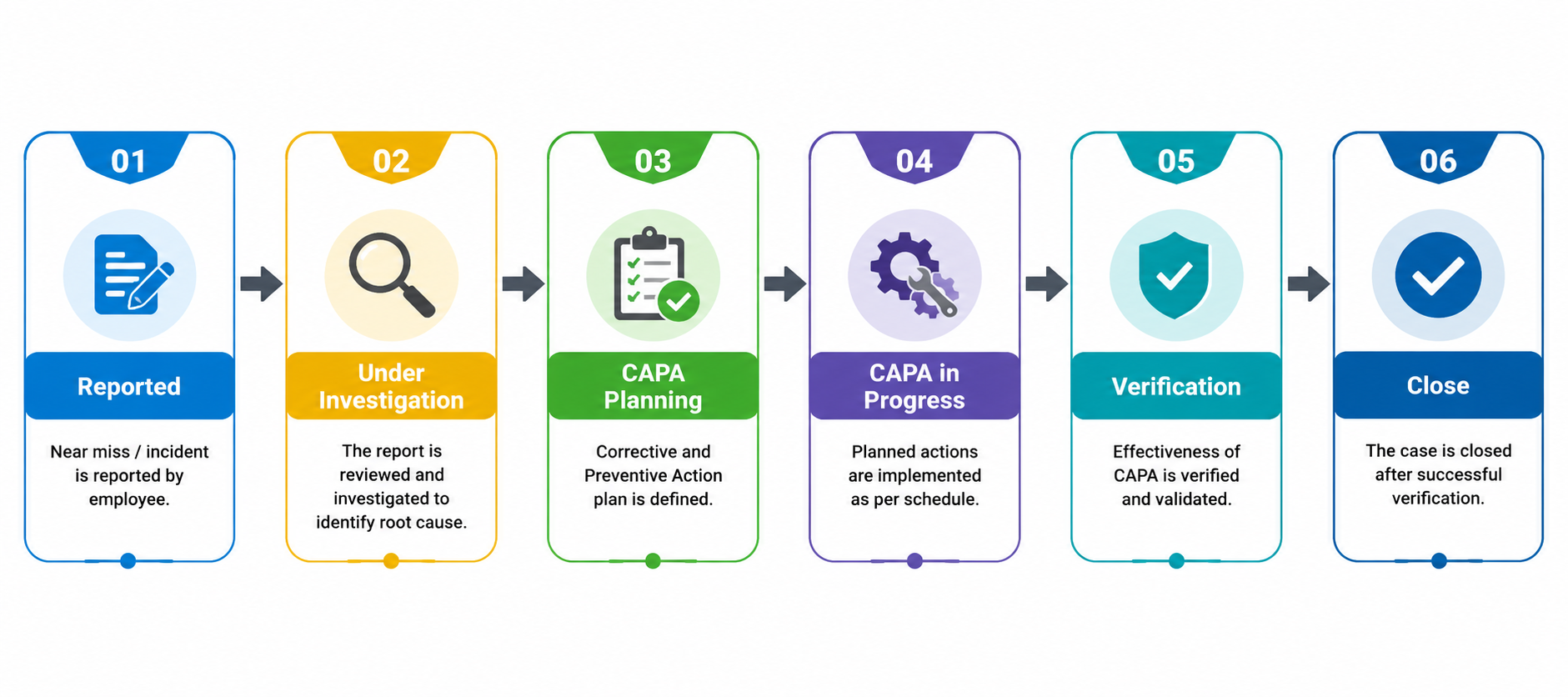
A best-in-class Near Miss Reporting System follows a structured, end-to-end workflow that ensures every reported event is investigated, actioned, verified, and formally closed.
1 | Incident Details Capture The worker logs the near miss via mobile app or web portal, capturing event type, location (GPS or manual), date and time, description, contributing factors, photographic evidence, and immediate actions taken. |
2 | 5 Whys Root Cause Analysis The assigned investigator works through the 5 Whys methodology embedded in the platform. Each why is documented, encouraging investigators to move beyond surface-level causes. The output is a validated root cause statement that drives the corrective action plan. |
3 | CAPA Actions Based on root cause findings, corrective and preventive actions are defined and classified by type: engineering control, administrative control, PPE requirement, procedure revision, or training intervention. |
4 | Action Assignment and Tracking CAPA items are assigned to named responsible parties with due dates. The system generates automated reminders, escalation alerts for overdue items, and real-time management dashboards showing open versus closed action status. |
5 | Effectiveness Verification After closure, the EHS Manager or site supervisor confirms the corrective action was implemented as intended and is achieving the desired outcome. This prevents paper closure where actions are marked complete without actual on-ground implementation. |
6 | Close Once effectiveness is verified, the record is formally closed with a complete audit trail including the initial report, investigation findings, CAPA items, verification evidence, and closure timestamp. |
Key Performance Indicators (KPIs)
Near Miss and Incident-Related KPIs (Leading Indicators)
KPI | Description | Target |
Near Miss Frequency Rate (NMFR) | Near misses per 200,000 hours worked | Trending upward initially (active culture) |
Near Miss-to-Incident Ratio | Ratio of near misses to recordable incidents | Greater than 10:1 |
CAPA Closure Rate | % of CAPA items closed within target timeframe | 90% or above |
CAPA Overdue Rate | % of CAPA items past due date | Below 10% |
Expected Time to Action (ETA) | Avg. days from report to first CAPA assignment | Under 2 days (high severity) |
Root Cause Identification Rate | % of near misses with documented root cause | 100% |
Repeat Near Miss Rate | % of near misses in same category within 12 months | Trending downward |
Accident and Lagging Indicator KPIs
KPI | Description | Target |
Total Recordable Incident Rate (TRIR) | (Recordable incidents x 200,000) / hours worked | Industry-specific benchmarks |
Lost Time Injury Frequency Rate (LTIFR) | Lost time injuries per 1M hours worked | Trending toward zero |
Severity Rate | Lost workdays per 200,000 hours | Trending downward |
DART Rate | Days Away, Restricted, or Transferred per 200,000 hrs | Below industry benchmark |
First Aid Case Count | Count of first aid events requiring treatment | Monitored for trends |
Near Miss Theories: The Scientific Foundation
Understanding why near miss reporting matters begins with the theoretical frameworks that underpin modern safety science.
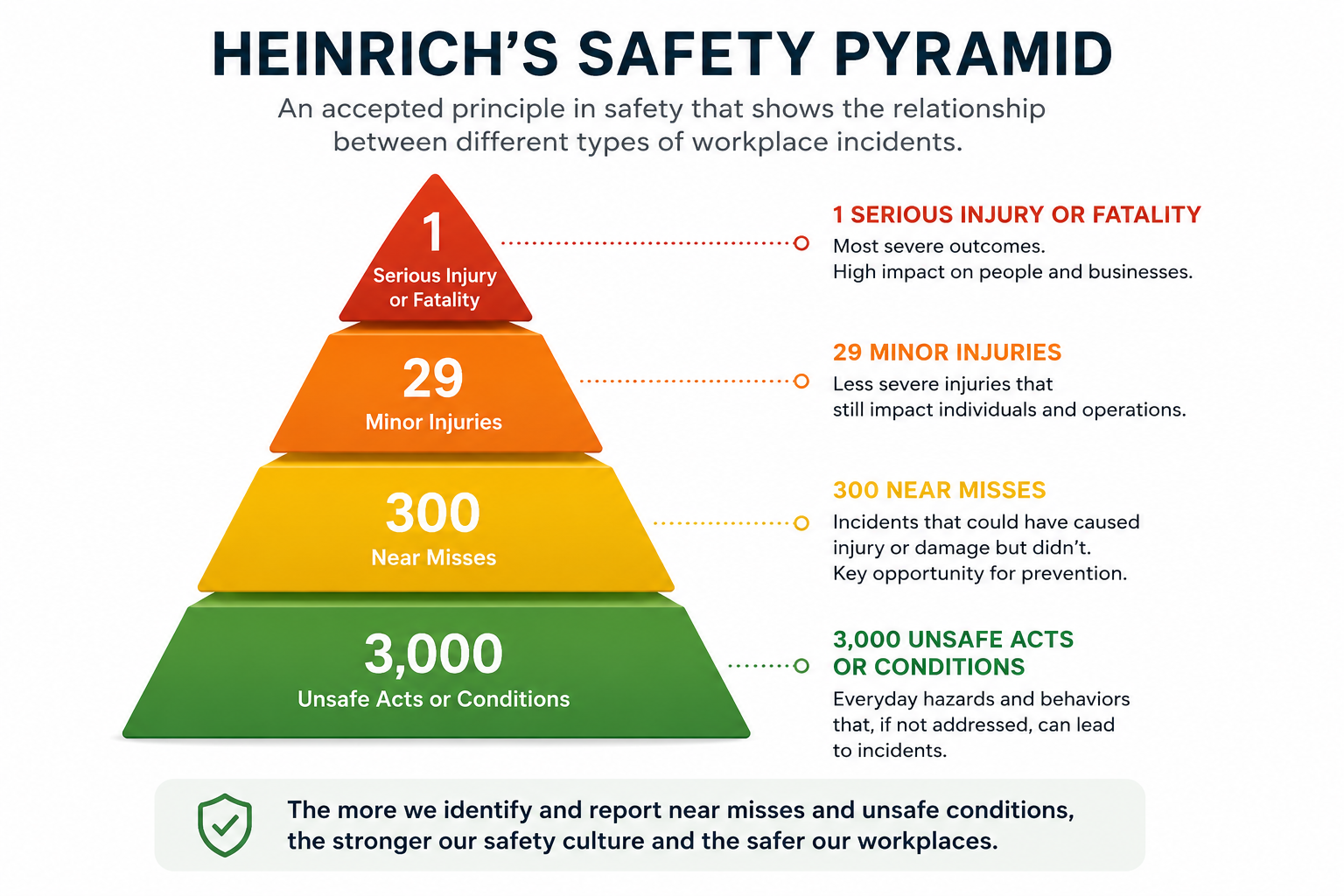
1. Heinrich's Safety Pyramid (The Triangle Theory)
Key Takeaway
Intervening at the base of the pyramid is exponentially cheaper and more humane than managing injuries at the apex. Every near miss report is an opportunity to prevent the next fatality.
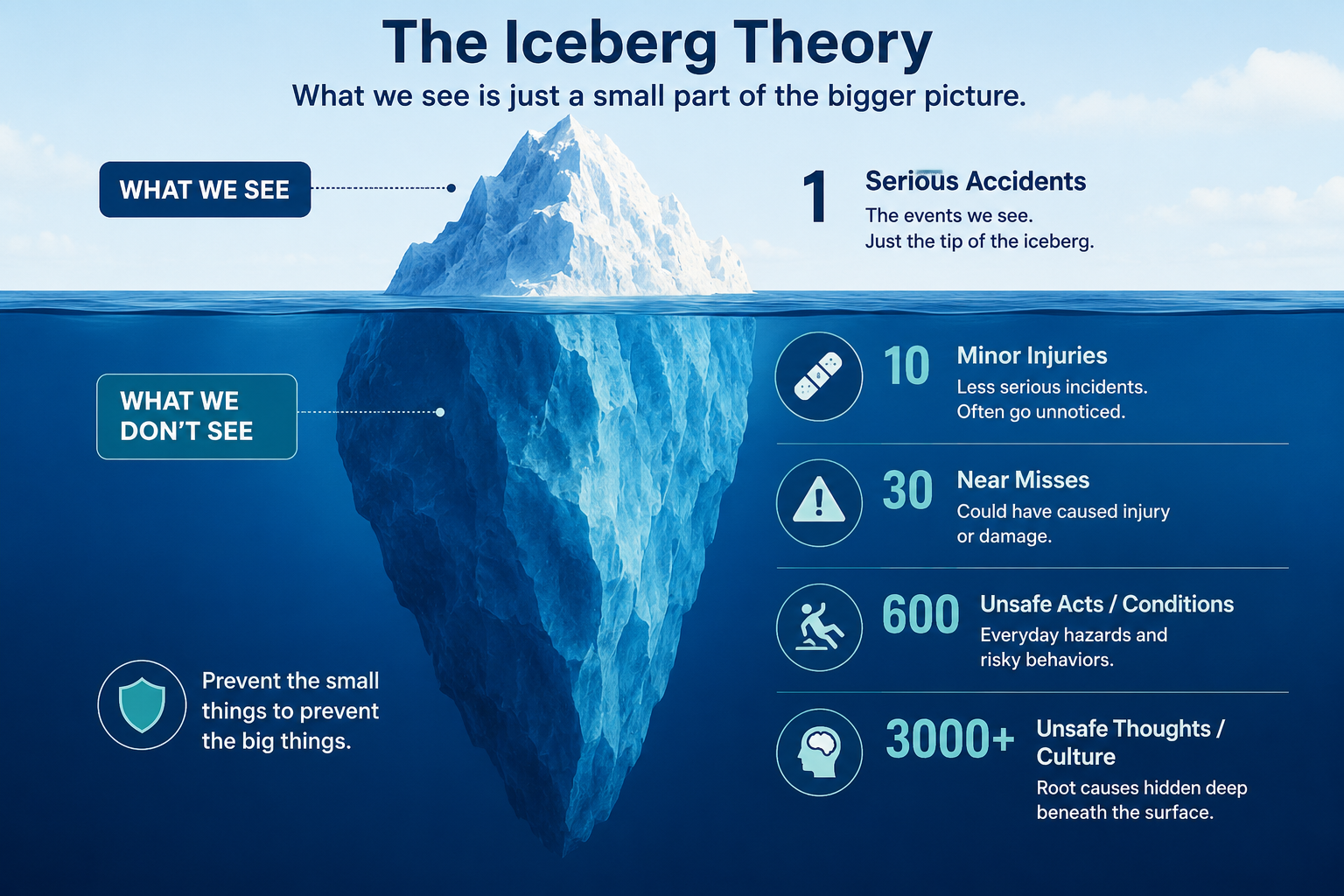
2. The Iceberg Theory
The Iceberg Theory illustrates that visible workplace injuries represent only a small fraction of the total safety problem. Beneath the surface lies an enormous hidden mass that management cannot see without active reporting.
Key Takeaway
A Near Miss Reporting System is the sonar that maps what lies beneath the waterline. Without it, management navigates blind and serious injuries appear without warning.
Conclusion
A Near Miss Reporting System is not a compliance checkbox. It is the most powerful preventive tool in the EHS professional’s arsenal. When properly implemented with structured workflows, embedded root cause analysis, disciplined CAPA management, and meaningful KPI tracking, it converts invisible risk into visible and actionable intelligence.
The theories of Heinrich, Domino sequencing, and the Iceberg model all point to the same truth: the information needed to prevent the next serious injury already exists inside your operation. It lives in the minds of your frontline workers who experienced a close call last Tuesday, spotted a frayed cable last week, or noticed a colleague bypassing a safety control last month.
Key outcomes organizations achieve with a mature near miss analysis culture supported by purpose-built near miss software include:
- Measurable reduction in recordable injury rates year over year
- Lower workers’ compensation costs and insurance premiums
- Reduced regulatory exposure and audit findings
- Stronger workforce engagement and safety ownership at the frontline
- A defensible, documented safety management system for leadership
Ready to transform your safety program?
Contact our EHS solutions team to schedule a platform walkthrough. A Near Miss Reporting System built for your industry can be live within days.