EHS Software in Cement Industry is becoming essential for managing the complex safety and compliance challenges faced by modern cement plants. Workers are regularly exposed to hazards such as high-temperature equipment, heavy machinery, confined spaces, dust, and work at height. Maintaining a safe workplace requires a structured approach that enables organizations to identify risks, implement controls, and ensure compliance with industry regulations.
By digitizing safety processes, EHS software helps cement manufacturers streamline permit management, inspections, incident reporting, contractor safety, and risk assessments through a single platform. With real-time visibility, automated workflows, and centralized safety data, organizations can improve operational efficiency, strengthen compliance, and create a safer working environment for employees and contractors.
Why Paper-Based EHS Systems Fall Short
Consider how safety management typically worked in a traditional cement plant. When a worker needed to carry out a hot work job near the coal mill, a supervisor would write out a paper permit. That permit might sit on a desk waiting for the area owner’s signature. By the time all approvals were collected, hours had passed and workers were sometimes under pressure to start before the permit was fully authorised.
The problems with paper-based safety management go beyond inconvenience. They create real safety gaps:
| Aspect | Paper-Based EHS | Digital EHS Software |
|---|---|---|
| Permit to Work | Manual, multi-copy forms with physical signatures | Digital workflow with approvals, timestamps, and status tracking |
| Incident Reporting | Handwritten forms, often delayed or incomplete | Mobile reporting in real time, structured fields, photo upload |
| Near Miss Tracking | Rarely reported due to effort required | Simple mobile reporting, instant notification to supervisors |
| Inspection Checklists | Paper forms, manually compiled | Digital checklists with auto-scheduling and compliance reports |
| Risk Assessment | Static documents, updated infrequently | Dynamic risk library, real-time updates, AI-driven analysis |
| Audit Management | Binders and spreadsheets | Automated scheduling, digital evidence, trend dashboards |
| Contractor Management | Manual logs and physical binders | Digital safety pass, induction tracking, live compliance status |
| Data Analysis | Manual data entry into spreadsheets | Automated dashboards and pattern recognition |
How EHS Software in Cement Industry Improves Safety and Compliance
When a digital EHS platform is deployed in a large cement facility, what stands out first is not the technology, it is the change in behaviour. Supervisors check whether permits are properly closed. Workers report near misses because it takes two minutes on a mobile app. Safety data that once took weeks to compile appears on a dashboard in real time.
EHS software brings all safety processes into one connected system. Instead of separate paper forms for permits, inspections, incidents, and audits, everything flows through a single platform. Data is consistent, traceable, and accessible to anyone who needs it whether in the control room, at the corporate office, or at the job site.
1] Digital Permit to Work
The Permit to Work (PTW) system is the backbone of safe work management in any cement plant. Hot work, confined space entry, work at height, electrical isolation, excavation — all of these require formal permits before work can begin. In a busy plant, you might be managing dozens of active permits at any one time.
A digital PTW system transforms how this works. The requestor raises a permit on a mobile device or computer, attaches a job description, lists the hazards and precautions, and submits it for approval. The system routes it to the right approvers automatically. If a required isolation is not completed, the permit cannot be issued. Once work is done, digital closure confirms the area is safe. The complete audit trail is stored automatically.
Digital PTW also prevents conflicts. In a cement plant, it is not uncommon for two jobs to be planned near the same equipment. A digital system flags those conflicts before work starts and prevents simultaneous tasks that could create unsafe conditions.
1.1] Common Permit Types in Cement Plants
Cement plants deal with a wide range of high-risk activities, each requiring a specific type of permit:
- Hot Work Permit: Required for any activity involving open flames, sparks, or heat generation such as welding, grinding, or cutting particularly near coal mills, fuel storage, or dust-laden environments where ignition risk is elevated.
- Confined Space Entry Permit: Mandatory before entry into silos, hoppers, preheater cyclones, clinker coolers, or underground ducting. These spaces may contain oxygen-deficient atmospheres, toxic gases from clinker, or engulfment hazards.
- Work at Height Permit: Required for any task carried out more than two metres above ground, including maintenance on preheater towers, chimney stacks, raw mill platforms, and clinker cooler rooftops some exceeding 100 metres.
- Electrical Work Permit: Covers all maintenance or testing activities on electrical systems, switchgear, or motor control centres. Must be linked to a verified LOTO isolation before work begins.
- Excavation Permit: Required for any ground-breaking activity within the plant boundary. Involves verification of underground utility drawings and an assessment of ground stability before excavation starts.
| PTW Step | Purpose | Risk if Missed |
|---|---|---|
| Hazard Identification | Identify all potential hazards associated with the task before work begins, including energy sources, nearby operations, and environmental conditions. | Workers may proceed without awareness of critical risks, significantly increasing the likelihood of injury or fatality. |
| Isolation Verification | Confirm that all energy sources have been physically locked out, tagged, and tested to a zero-energy state before the permit is issued. | Live energy released during work can cause electrocution, crush injuries, or uncontrolled equipment movement. |
| Toolbox Talk | Brief the full work team on site-specific hazards, required controls, and emergency procedures immediately before the job starts. | Workers may be unaware of recent changes in plant conditions or specific risks at the job location. |
| Shift Handover | Formally transfer permit responsibilities between shifts, including full briefing on work status, active isolations, and any pending actions. | An incoming shift may unknowingly restart equipment or remove isolations while work is still in progress. |
| Permit Closure | Confirm that work is complete, the area is safe, all personnel and tools are accounted for, and isolations are restored in the correct sequence. | Incomplete closures leave plant in an unsafe or undefined state, creating risk for subsequent operations. |
2] Contractor Safety and Safety Pass Management
Contractors pose significant safety risks to cement plants due to varying training levels, site familiarity, and safety cultures. Digital contractor management mitigates this by automating the onboarding process.
The system ensures that before entry, all contractors have completed mandatory inductions, hold verified competencies, and possess valid documentation via a digital safety pass. Upon arrival, the system automatically validates these requirements against the specific job; if any criteria are unmet, access is denied. This automation is critical during high-volume periods like shutdowns, where manual verification would otherwise become unmanageable.
3] EHS Software in Cement Industry for Incident Reporting and CAPA
When an incident occurs in a cement plant, quick investigation is critical. Regulators may require reports within 24 hours while management and workers need immediate answers. Digital incident management allows incidents to be reported instantly through a mobile device with photos, witness statements, location details, and hazard categories. The safety team receives the report in real time and can begin the investigation without waiting for paperwork.
AI-assisted Root Cause Analysis (RCA) strengthens investigations by analysing incident details and suggesting likely causes using similar incidents, historical plant data, and industry knowledge. Once root causes are identified, the system generates Corrective and Preventive Actions (CAPA), assigns responsibilities and deadlines, tracks progress, and sends reminders for overdue actions.
| Step | Manual Investigation | AI-Assisted Investigation |
|---|---|---|
| Data Collection | Physical interviews, paper records, memory recall | Digital record, photos, location data, instant access to history |
| Root Cause Identification | Depends on investigator knowledge and experience | AI suggests probable causes based on similar incidents and data patterns |
| 5 Whys Analysis | Brainstorming session, prone to bias and gaps | AI-guided questioning that challenges each answer for deeper analysis |
| CAPA Assignment | Verbally assigned, tracked on spreadsheet | System-assigned with owner, deadline, and automated follow-up |
| Closure Verification | Manual confirmation, often delayed | Digital evidence upload, system-verified closure |
| Trend Reporting | Manual compilation, infrequent | Automatic trend analysis available in real time |
4] Near Miss Reporting and AI-Guided 5 Whys
Near misses are the most valuable safety information a plant can collect. A near miss tells you a hazard exists, that it almost caused harm, and that there is still time to fix it. But near misses are massively underreported in most cement plants. The effort of filling in a paper form after a long shift is enough to make most people say ‘it was nothing’ and move on.
A digital near miss reporting on a mobile phone removes that barrier. A worker spots a loose grating on a walkway at height, takes a photo, selects the hazard type, adds a short description, and submits the report in under two minutes. The supervisor is notified immediately. The hazard is tagged to its location on the plant map and becomes part of the analysable safety data.
AI-guided 5 Whys analysis takes investigation a step further. Traditional sessions often stop too early because the facilitator lacks enough information. An AI-guided system analyses the near miss, cross-references similar events, and prompts the investigator with specific follow-up questions at each level. The result is a deeper and more accurate understanding of what went wrong.
5] Lockout Tagout (LOTO) Management
LOTO is one of the most critical safety procedures in any cement plant. Ball mills, crushers, conveyors, and kiln drives are enormous machines. If any of them are started while a maintenance team is working inside, the consequences are catastrophic. Proper energy isolation is not optional, it is the difference between life and death.
Digital LOTO software replaces physical logbooks and manual tag registers with a live digital record of every energy isolation in the plant. When a technician applies a lock to an electrical panel, that action is recorded in the system. The permit to work is linked to the LOTO record. No one can start work without confirmation that isolation is complete, and no one can remove the isolation until work is formally signed off.
The system also maintains digital LOTO procedures for each piece of equipment. Rather than relying on a technician to recall exact isolation points for a specific conveyor, they pull up the step-by-step procedure on a tablet at the job site and confirm each step digitally before moving on. For plants running complex shutdowns with dozens of simultaneous isolations, this level of control is essential.
| LOTO Step | Why It Matters | Consequence if Skipped |
|---|---|---|
| Energy Source Identification | All hazardous energy sources — electrical, hydraulic, pneumatic, thermal, and gravitational — must be identified and listed before work starts. | Technicians may lock out only some energy points, leaving residual energy that can seriously injure or kill. |
| Lock Application | Each worker applies their own personal lock to every isolation point, ensuring no one else can energise the equipment while they are working on it. | Without personal locks, another person can inadvertently re-energise equipment, with potentially fatal results. |
| Verification / Try-Out | After locks are applied, the worker attempts to start the equipment to confirm that zero energy state has actually been achieved. | Assumed isolations can be incomplete. Skipping verification has caused fatalities even when locks appeared to be in place. |
| Restoration Sequence | When work is complete, energy is restored in a defined sequence after all personnel and tools are accounted for and the permit is formally closed. | Out-of-sequence restoration can cause equipment damage, uncontrolled movement, or injury to anyone still in the work area. |
6] Risk Assessment and Dynamic Hazard Analysis
Traditional risk assessments in cement plants are often conducted once a year, printed out, signed, and filed away. By the time they are reviewed again, conditions may have changed significantly. New equipment installed. A process modified. A new hazard introduced. But the risk assessment still reflects what existed twelve months ago.
Digital risk assessment tools allow for continuously updated hazard registers. When a new task is planned, the system pulls relevant hazards from the library, suggests risk controls based on historical data, and generates a risk score. If conditions change mid-job, the risk assessment can be updated in real time from a mobile device.
7] Inspection Checklists and Smart Scheduling
Routine inspections play a critical role in hazard prevention. Activities such as housekeeping checks, equipment inspections, fire extinguisher audits, and electrical panel reviews must be completed consistently. In paper-based systems it is often difficult to verify whether inspections were completed and what findings were recorded.
Digital inspection management improves this process by assigning checklists to specific areas with due dates and automatically notifying supervisors when inspections are overdue. Findings are documented with photos and GPS locations and remain open until formally closed. The system also compiles historical data into trend reports automatically. Smart scheduling adds another layer of intelligence by analysing past inspection results and recommending additional inspections when needed. For example, if conveyor belt inspections repeatedly identify issues during certain months the system can recommend increasing inspection frequency during those periods.
| Feature | Traditional Risk Assessment | AI-Powered Risk Assessment |
|---|---|---|
| Update Frequency | Annual or project-based | Real-time, updated as conditions change |
| Hazard Identification | Relies on team knowledge and experience | AI suggests hazards from database of similar tasks |
| Risk Scoring | Manual and subjective | Consistent scoring with data-driven weightings |
| Integration with PTW | Separate document, manually cross-referenced | Automatically linked to the permit workflow |
| Trend Analysis | Not available | Automatic pattern detection across risk registers |
| Predictive Capability | None | Flags emerging risks based on near miss and incident trends |
8] Management of Change (MoC)
Every cement plant goes through changes, new equipment installations, process modifications, raw material substitutions, and organisational changes that affect safety responsibilities. Each change can introduce new hazards. The Management of Change process exists to ensure safety implications are assessed before any change is implemented.
In practice, MoC is one of the most frequently bypassed processes in many plants, simply because the paper-based version is slow and complex. Digital MoC software makes it straightforward. A change request is raised, required approvals and safety evaluations are assigned automatically, and the change cannot proceed until all reviews are complete. Training requirements, updated risk assessments, and revised procedures are all linked to the MoC record.
9] Emergency Management Through EHS Software in Cement Industry
In an emergency whether it is a fire in the coal mill, a gas release near the kiln, or a structural failure, knowing exactly how many people are inside the plant and where they are is critical. Digital headcount tracking uses check-in and check-out records, contractor access logs, and permit records to maintain a real-time count of everyone in the facility. In an emergency, the safety officer can instantly identify who is in the plant, where they were last recorded, and who has not yet reached the muster point.
Emergency management software complements this with digital response plans. Evacuation routes, muster point locations, emergency contact lists, roles and responsibilities, and drill schedules are all stored in the system and accessible on mobile devices. Drills are recorded and analysed so gaps in response are identified before they are needed for real.
10] Waste Management
Cement plants generate a range of hazardous and non-hazardous waste. Kiln dust, spent refractory materials, used lubricating oils, and packaging waste all need to be managed in compliance with environmental regulations.
Digital waste management modules track waste generation, categorisation, storage, and disposal records, making regulatory reporting straightforward and audit-ready. The system maintains a clear record of each waste stream, how it is classified, how it is handled, and which licensed contractor is responsible for disposal. This gives EHS teams the evidence they need during inspections and reporting periods without scrambling to compile records manually.
11] Safety Data Sheet (SDS) Management
Cement plants use a wide range of chemicals, grinding aids, dust suppressants, fuels, lubricants, and cleaning agents. Workers handling these materials need immediate access to accurate, up-to-date Safety Data Sheet (SDS) information. In a paper system, finding the right SDS often means going to an office and searching through a binder. In a chemical emergency, that delay can matter.
A digital SDS library makes every document searchable and accessible on a mobile device directly at the job site. A worker can immediately look up safe handling procedures, first aid measures, storage requirements, and spill response instructions without leaving the work area. The system also tracks SDS version currency and alerts the EHS team when suppliers issue updated documents, ensuring the plant always works from current information.
12] Fire Safety Equipment Register
Fire safety equipment can only protect people and assets when it is properly maintained and ready for use. In many plants, issues such as overdue fire extinguisher servicing, obstructed sprinkler systems, or non-functional hydrants often go unnoticed when records are managed manually. A digital fire equipment management provides complete visibility of all firefighting assets across the facility. It tracks equipment locations, inspection schedules, maintenance activities, and testing records for hydrants and deluge systems. The system also maintains an up-to-date inventory of emergency response equipment including breathing apparatus, fire blankets, and emergency showers while sending timely reminders to ensure inspections and servicing are never missed.
13] Accident Reporting Using EHS Software in Cement Industry
During a serious workplace incident, fast communication and accurate information are essential. A digital accident reporting system instantly alerts safety teams, plant management, and emergency responders while automatically escalating notifications based on incident severity. It captures photos, witness statements, and other evidence with time stamps before the scene changes. AI-supported root cause analysis helps identify recurring causes and contributing factors, while corrective and preventive actions can be assigned, tracked, and escalated as needed. The system also provides instant access to hospitals, emergency services, and corporate safety contacts for a coordinated response.
Case Study: Priya Cement
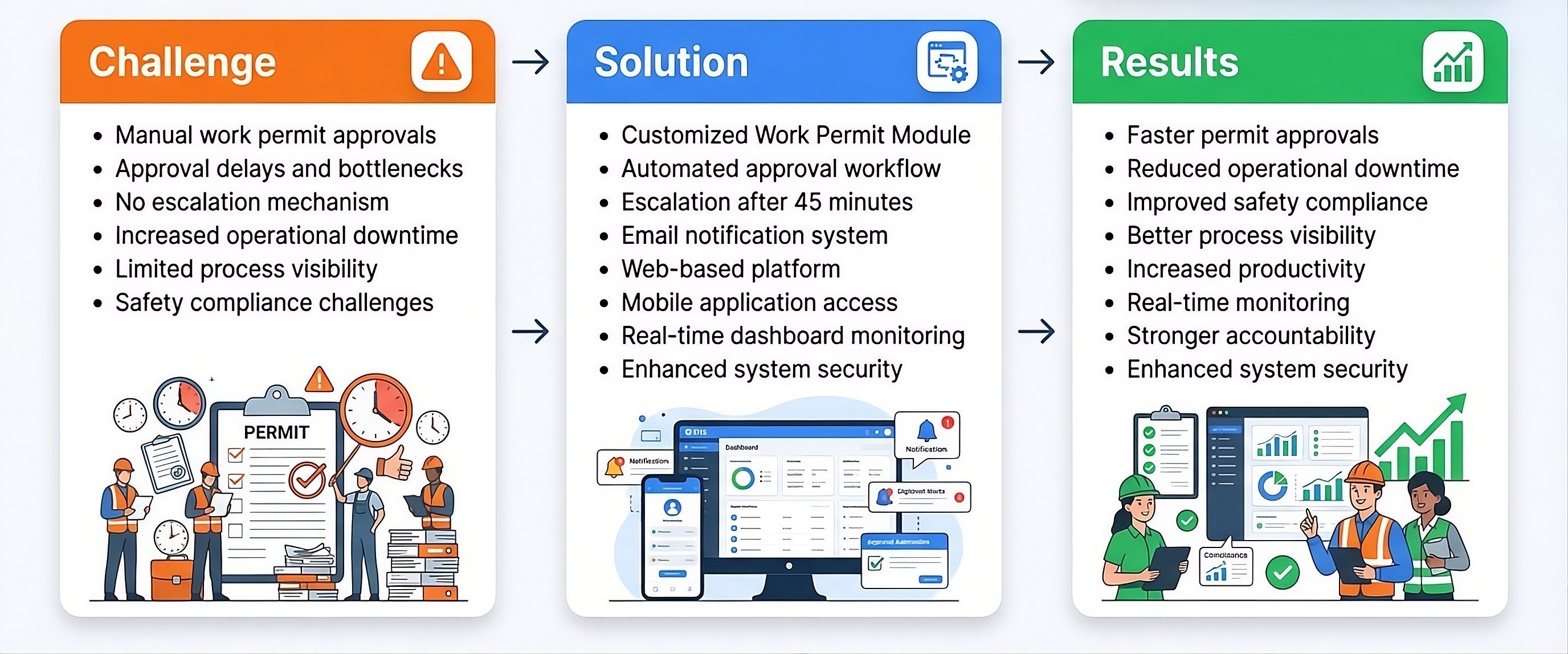
Company Overview: Priya Cement is one of India’s well-established cement manufacturers, with a strong emphasis on safe and efficient plant operations. As production expanded and workflows became more complex, the company found it increasingly difficult to manage work permits and safety approvals through manual, paper-based processes, leading to delays and reduced visibility.
Challenge, Approach & Result: To simplify these processes, Priya Cement partnered with EHS4Safety to implement a tailored digital EHS solution. The platform brought together automated Permit-to-Work workflows, smart escalation rules, real-time notifications, and easy access through web and mobile applications. By replacing manual approvals with a connected digital system, the company was able to speed up permit processing, reduce operational downtime, strengthen safety compliance, and create a more transparent and accountable workplace.
AI-Powered EHS Software in Cement Industry
The application of artificial intelligence in EHS management is not about replacing the safety officer. It is about giving safety professionals tools that extend their reach and sharpen the quality of their decisions. In cement plants, AI is already delivering practical value across several areas:
- AI-based PPE Detection: Camera systems using computer vision continuously monitor work areas and entry points to verify that workers are wearing required PPE. Non-compliance triggers an immediate supervisor alert, enabling a real-time response rather than a post-incident review. It Improves worker safety through AI PPE detection.
- AI-powered Inspection Scheduling: The system analyses historical inspection data, findings trends, and equipment performance to recommend when and where additional inspections are needed, shifting inspection planning from a fixed calendar to a risk-based approach.
- AI-driven Risk Assessment: When a new task or change is entered into the system, AI cross-references the plant’s risk database and broader industry incident records to suggest relevant hazards and appropriate controls, reducing dependence on individual memory and improving consistency across teams.
- AI-assisted Root Cause Analysis: Following an incident or near miss, AI analyses event details alongside historical plant data to surface the most probable root causes. This speeds up investigations and reduces the risk of the real cause being missed under time pressure.
- AI-guided 5 Whys: During root cause investigations, the system prompts investigators with specific, contextually relevant follow-up questions at each level of the 5 Whys process. This produces more rigorous outcomes than traditional brainstorming sessions, which often stop too early or lose direction.
- Pattern Recognition from Incidents and Near Misses: AI continuously analyses the accumulating database of incidents, near misses, inspections, and permit records to detect emerging patterns. If a specific location, task type, or time period is generating a disproportionate number of events, the system flags it for management attention before a serious injury occurs.
The key point is that AI in EHS software is practical and operational. It works with data the system is already collecting and makes that data more useful, more visible, and more actionable.
How to Choose the Best EHS Software in Cement Industry
Not all EHS software is designed for the specific demands of cement manufacturing. When evaluating options, these are the factors that matter most:
- Industry-specific modules: PTW, LOTO, confined space management, work at height permits, and contractor safety pass should be core modules not optional add-ons.
- Mobile accessibility: Cement plants are large. Workers and supervisors need full system access on mobile devices from anywhere in the plant, including areas with limited connectivity.
- Genuine AI capabilities: Look for verified AI features automated root cause analysis, AI-guided 5 Whys, predictive risk assessment, and AI-powered PPE detection not marketing claims.
- Multi-plant support: If you manage more than one cement facility, the system should provide consolidated dashboards and cross-plant safety performance comparisons.
- Integration with plant systems: The EHS platform should connect with maintenance management systems, HR systems, and access control to share relevant data without duplication.
- Ease of use: If the system is difficult to use, workers will not use it. The interface for reporting, permits, and inspections must be simple and fast.
- Customisation: Cement plants have specific workflows. The software should be configurable to match existing processes rather than forcing teams to change how they work.
- Support and implementation: Deploying EHS software is a significant operational change. The vendor should provide dedicated onboarding support, training for all user levels, and responsive ongoing assistance.
Conclusion:
The cement plants that consistently reduce injury rates, build a genuine safety culture, and stay ahead of regulatory requirements are not doing so because they have more safety officers. They are doing it because their systems work. Digital EHS software is now the foundation of effective safety management in the cement industry. The complexity of operations, the diversity of hazards, the volume of contractors, and the physical scale of cement facilities combine to make paper-based systems inadequate. They are simply not capable of handling the volume and detail of information that serious safety management demands.