Introduction
AI EHS Software is fast becoming the backbone of modern safety management across manufacturing plants, construction sites, chemical facilities, and logistics hubs. Organizations that once relied on spreadsheets and manual inspections are now evaluating platforms that can predict hazards before they turn into incidents.
Choosing the right platform is not a simple software purchase; it is a decision that affects compliance posture, insurance costs, and ultimately, human lives. This guide breaks down what AI EHS Software actually is, why artificial intelligence is reshaping industrial safety, the features that separate genuinely intelligent platforms from repackaged legacy tools, and the mistakes that commonly derail selection projects.
What Is AI EHS Software?
AI EHS software refers to Environmental, Health, and Safety management platforms that embed artificial intelligence machine learning models, computer vision, natural language processing, and predictive analytics into core safety workflows. Unlike traditional Environmental Health and Safety Software that simply digitizes forms, an intelligent EHS platform analyzes patterns, flags anomalies, and generates recommendations without manual number-crunching.
A traditional EHS system might store an incident report. An AI-powered EHS platform reads that same report, cross-references it against historical near-misses, and alerts a plant manager that a similar failure pattern occurred twice in the last quarter. That distinction passive record-keeping versus active insight generation is what separates legacy tools from genuinely intelligent ones.
Why AI Is Transforming Workplace Safety
Industrial facilities generate enormous volumes of safety data: inspection logs, sensor readings, camera feeds, incident reports, and audit findings. Human teams simply cannot process this volume fast enough to catch every warning sign. AI safety software closes that gap by continuously scanning data streams for early indicators of risk.
Three forces are driving this shift:
- Volume of data – IoT sensors, wearables, and cameras now produce far more safety-relevant data than any manual review process can handle.
- Regulatory pressure – Regulators increasingly expect documented, data-backed proof of proactive risk management, not just reactive incident logs.
- Cost of incidents – A single serious injury can cost a facility well beyond direct medical expenses, factoring in downtime, insurance premiums, and reputational damage.
Predictive safety analytics allows safety teams to move from reacting to incidents toward preventing them, which is precisely why AI workplace safety software has become a board-level topic rather than a departmental one.
Must-Have AI Features in the Best EHS Software
Not every platform marketed as “AI-powered” delivers genuine intelligence. Some simply add a chatbot on top of legacy forms. The sections below outline the features that genuinely define the best AI EHS software available in the market today.
1. AI-Powered Risk Assessment
An AI risk assessment software module should assign dynamic risk scores that update automatically as conditions change, rather than static scores set once a year during an annual review.
- Dynamic risk scoring based on live inputs (weather, shift patterns, equipment age)
- Predictive hazard identification using historical incident data
- AI-generated recommendations for control measures
- Real-time updates whenever new hazards are logged
Practical Example
Industry: Oil & Gas
A refinery technician requests a hot work permit near a separator unit that recently reported a minor gas reading anomaly. Because the risk assessment module continuously ingests live gas-detector and wind-sensor data, the unit’s risk score automatically jumps from moderate to high the moment the anomaly is logged. The system withholds automatic permit approval and instead routes the request to a safety officer for additional gas testing before work can begin. Without this real-time scoring, the permit could have been approved on schedule using outdated risk data. The refinery avoids a potential ignition source near a compromised unit, and low-risk permits elsewhere on site continue to auto-approve, keeping maintenance throughput unaffected while high-risk work gets the scrutiny it needs.
2. AI Incident Management
AI incident management transforms what used to be a multi-day paperwork exercise into a same-day investigation process.
- Automated incident reporting through mobile and web applications
- Real-time incident notifications to supervisors and EHS teams
- Smart categorization of incident type, severity, and location
- Digitally evidence can be captured, including photos, videos, voice notes, and documents
- Automatic incident logging with timestamps and audit trails
- Offline incident reporting with automatic synchronization
- Centralized incident records for easy tracking and regulatory compliance
- Configurable workflows for incident approval and escalation
A logistics warehouse using this kind of system can cut incident closure time from two weeks to under 48 hours simply because the software pre-organizes evidence instead of leaving it scattered across emails.
Practical Example
Industry: Automotive
A technician at an automotive assembly plant suffers a minor hand pinch while loading components into a robotic welding cell. The incident is immediately reported through a mobile AI EHS application, where the supervisor captures photos, voice notes, and the exact location of the event. The software automatically classifies the incident based on severity, records all relevant details in a centralized incident register, notifies the EHS team in real time, and generates a digital incident record. With instant reporting and automated documentation, the organization ensures timely response, accurate recordkeeping, regulatory compliance, and improved visibility of workplace incidents across multiple production lines.
3. AI-Powered Incident Investigation, Root Cause Analysis & CAPA
AI streamlines the entire post-incident process by helping organizations investigate incidents, identify root causes, and ensure corrective actions are completed effectively. Instead of relying on manual methods, AI provides structured workflows, uncovers recurring hazards, and tracks every action through to verification.
Key capabilities include:
- AI-guided incident investigation workflows
- Guided 5 Whys root cause analysis
- Recommendations based on similar historical incidents
- Pattern recognition across sites and shifts
- Structured corrective and preventive action (CAPA) management
- Automated reminders and escalation for overdue actions
- Verification workflows before CAPA closure
- Complete audit trail from investigation to closure
Practical Example
Industry: Steel Manufacturing
A furnace operator suffers a minor burn during molten metal tapping. The AI EHS platform guides the investigation using a structured workflow and 5 Whys analysis, identifying that a worn heat-resistant curtain is the root cause. The system automatically assigns CAPA tasks to replace similar curtains across the plant, sends reminders until completion, and requires photo verification before closing the case, helping prevent similar incidents in the future.
5. AI Audit Management
AI audit software helps organizations plan, conduct, and monitor audits more efficiently by replacing manual checklists with intelligent workflows and real-time insights.
Key capabilities include:
Risk-based audit scheduling
Digital audit checklists
AI-generated audit findings
Standardized compliance scoring
Trend analysis across departments and sites
Audit reports with actionable insights
Practical Example
Industry: Food & Beverage
A beverage manufacturing facility conducts monthly internal food safety audits across multiple production lines. AI identifies that one packaging line consistently scores lower in hygiene compliance and automatically prioritizes it for future audits. By highlighting recurring audit findings early, the facility addresses sanitation issues before they affect product quality or regulatory compliance.
6. AI Inspection Intelligence
AI inspection software enables faster and more consistent workplace inspections by guiding inspectors, identifying recurring hazards, and recommending inspection priorities based on risk.
Key capabilities include:
Smart inspection scheduling
Mobile digital inspection checklists
AI-assisted hazard identification
Photo and voice-based evidence capture
Predictive inspection recommendations
Real-time inspection reports
Practical Example
Industry: Manufacturing
During routine equipment inspections, AI repeatedly detects oil leakage around the same production machine through inspection reports and uploaded images. Recognizing the recurring issue, the system recommends increasing inspection frequency and alerts the maintenance team before the leak develops into a major equipment failure or workplace safety hazard.
6. AI PPE Detection
AI PPE detection uses camera feeds to verify compliance continuously rather than during occasional spot checks.
- Helmet detection at entry points and work zones
- Gloves detection near chemical handling stations
- High-visibility vest detection in vehicle movement areas
- Safety shoe detection on shop floors
- Automated entry control that restricts access without proper PPE
- Compliance reporting summarized by shift, zone, or individual
Practical Example
Industry: Construction
At a multi-contractor construction site, dozens of workers move through a single entry turnstile each morning. The camera-based PPE detection system identifies a worker attempting to enter without a hard hat and automatically blocks the turnstile while sending an alert to the site supervisor’s phone. Because the restriction is enforced consistently and in real time, rather than relying on an occasional manual spot check, entry violations drop noticeably within the first month as workers adjust their habits. The compliance report breaks violations down by contractor crew, which helps the site safety manager identify which subcontractor needs a refresher toolbox talk, reducing the risk of a head injury on a site where multiple crews are working simultaneously.
7. AI Safety Analytics & Dashboards
Traditionally, many factories display monthly safety statistics, environmental performance, incident records, and compliance information on physical notice boards. While these paper-based reports provide a snapshot of past performance, they are often updated only once a month and offer limited visibility into emerging risks. AI-powered safety dashboards replace static notice boards with real-time, interactive displays that continuously update safety KPIs, incident trends, environmental metrics, audit findings, and compliance status, enabling faster decision-making and proactive risk management.
- KPI dashboards covering both leading and lagging indicators
- Predictive analytics forecasting likely incident hotspots
- Leading indicators such as near-miss frequency and training completion
- Lagging indicators such as lost-time injury rates
- Executive-level reporting formatted for board presentations
Practical Example
Industry: Power Generation
A utility operating several power generation stations needs a consolidated view of safety performance rather than reviewing each site’s reports separately. The KPI dashboard aggregates near-miss frequency, training completion rates, and lost-time injury rates across all stations in a single view. Predictive analytics flags that one station’s leading indicators, specifically a rising number of near-miss reports, are trending negative even though no actual incident has occurred there recently. This prompts the regional safety director to schedule a proactive site visit rather than waiting for a lagging indicator like an injury to force attention. The executive report for the board is generated automatically each month, cutting down the manual reporting time that previously consumed a full day of a safety analyst’s schedule.
8. Intelligent Compliance Management
AI compliance management keeps regulatory obligations visible instead of buried in filing cabinets or shared drives.
- Regulatory compliance tracking mapped to applicable laws and standards
- Centralized document management for licenses, permits, certificates, and Safety Data Sheets (SDS)
- Automatic reminders before renewal deadlines
- Continuous compliance tracking across multiple regulatory frameworks
- AI-powered SDS management ensures employees have instant access to the latest Safety Data Sheets, supporting hazardous chemical compliance and safe handling practices
- Audit-readiness reporting available on demand
Practical Example
Industry: Pharmaceuticals
A pharmaceutical manufacturing facility operating under strict Good Manufacturing Practice (GMP) requirements must track a large number of certifications, including environmental discharge permits, equipment calibration certificates, and Safety Data Sheets (SDS) for hazardous chemicals. The compliance module automatically reminds the responsible manager thirty days before each permit’s expiry date and ensures the latest SDS documents are readily available to employees handling chemicals. When a regulatory body arrives for a surprise inspection, the audit-readiness report is generated instantly, showing every required document current and valid. This helps the facility avoid compliance violations, supports safe chemical handling, and minimizes the risk of production disruptions.
9. Mobile AI EHS Platform
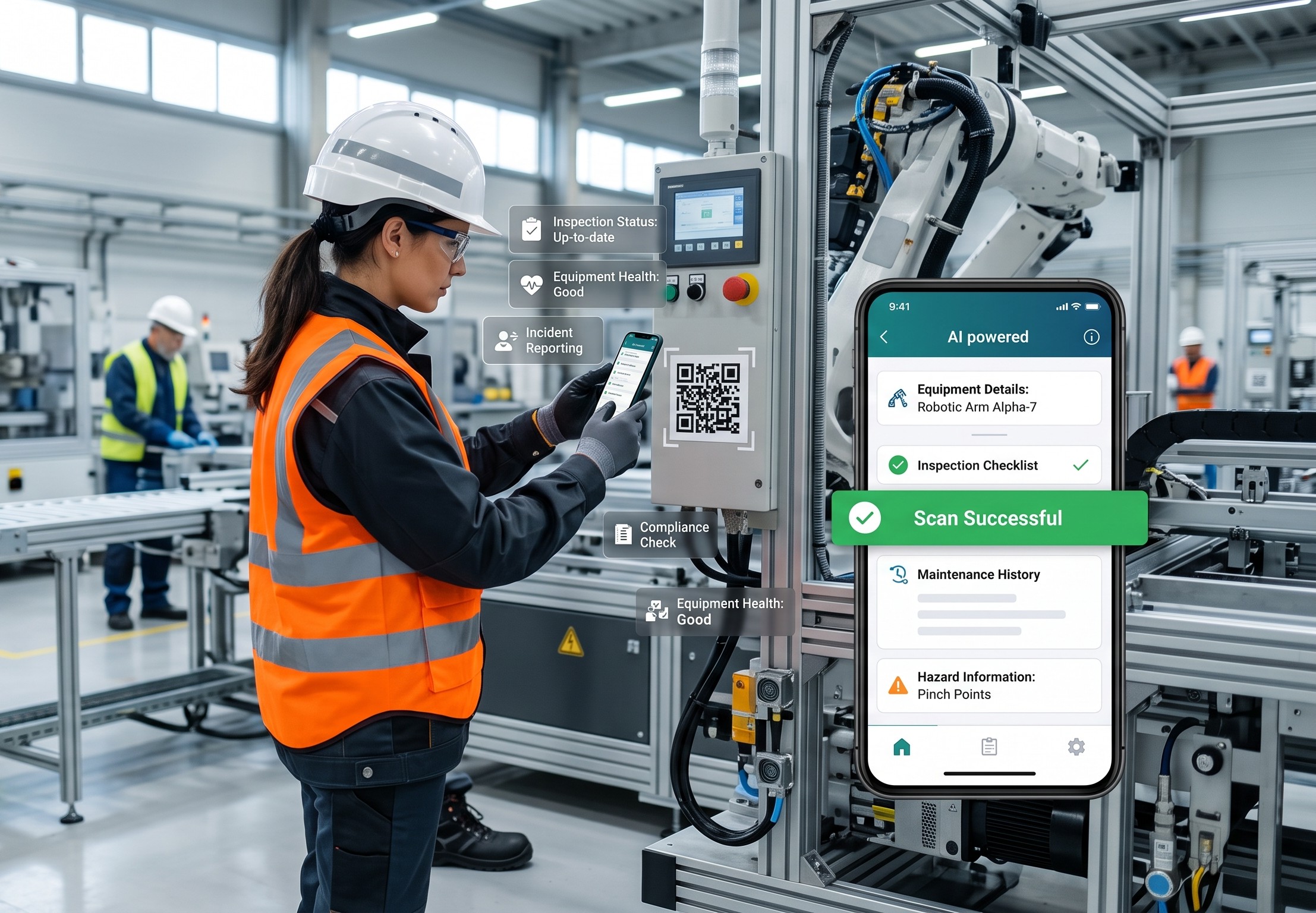
A mobile AI EHS platform extends intelligence to the shop floor, not just the safety office.
- Mobile-based inspections completed directly from a tablet or phone
- On-the-spot incident reporting with photo attachments
- Offline mode for areas with poor connectivity, such as underground mines
- Field observation logging for near-misses and unsafe conditions
- QR code integration for quick equipment or location identification
Practical Example
Industry: Mining
A safety officer conducting an underground inspection at a mine has no reliable network signal at depth. Using the mobile app’s offline mode, the officer logs ventilation readings and structural observations from several sections as usual, with the data stored locally on the device. Once the officer returns to the surface and the device reconnects, all logged observations sync automatically to the central system without any manual re-entry. Under the mine’s previous paper-based process, these observations would sit in a notebook for hours or days before being transcribed, delaying any response to a flagged hazard. The offline-first design means a ventilation concern identified underground reaches the responsible engineer the same shift instead of the next day.
10. Scalability, Integration & Security
An enterprise EHS software platform must operate reliably across multiple sites, business units, and geographies.
- ERP integration for procurement and asset data
- HRMS integration for training records and workforce data
- IoT integration for sensor-based monitoring
- Multi-site deployment with centralized visibility
- Cloud-based architecture supporting rapid scaling
- Granular user permissions by role and site
- Data encryption in transit and at rest
- Automated backup and disaster recovery protocols
Practical Example
Industry: Aerospace
An aerospace component manufacturer operates several assembly facilities across different regions and acquires a new facility through a corporate acquisition. Because the EHS platform is already integrated with the company’s ERP system for equipment maintenance schedules and its HRMS for workforce training records, the newly acquired facility can be brought onto the same platform without a lengthy standalone implementation. Safety and compliance data from the new site is migrated into the same centralized cloud architecture used by existing facilities, and role-based permissions are applied consistently from day one. This spares the corporate safety team from running a separate onboarding project for every acquisition and ensures the new facility follows the same audit-tested security and reporting standards as the rest of the network immediately.
11. AI Camera-Based Predictive Safety Monitoring
AI-powered camera systems and predictive analytics help prevent workplace accidents by detecting unsafe acts, hazardous conditions, and risky behaviors before they result in an incident. By continuously analyzing live video feeds and worker movements, the system provides real-time alerts that enable immediate intervention.
Key capabilities include:
Detection of unsafe acts and unsafe conditions
Alerts for unauthorized or restricted area entry
Detection of incorrect equipment usage
Work-at-height and unsafe posture monitoring
Real-time PPE compliance monitoring
Near-miss detection using movement and proximity analysis
Automated alarms with supervisor notifications
Predictive alerts to prevent accidents before they occur
Practical Example
Industry: Ports & Shipping
At a container terminal, an AI-powered camera system monitors operations around an active gantry crane. When a dock worker unintentionally enters a restricted lifting zone without the required PPE, the system immediately detects the unsafe act, identifies the restricted area violation, and triggers real-time alerts to both the crane operator and the shift supervisor. The crane operation is temporarily paused until the worker safely exits the area and complies with safety requirements. By combining camera-based monitoring with predictive AI alerts, the system prevents a potential struck-by incident, reduces reliance on manual observation, and automatically logs the event for future safety analysis and continuous improvement.
12. AI Invisible Injury Trends
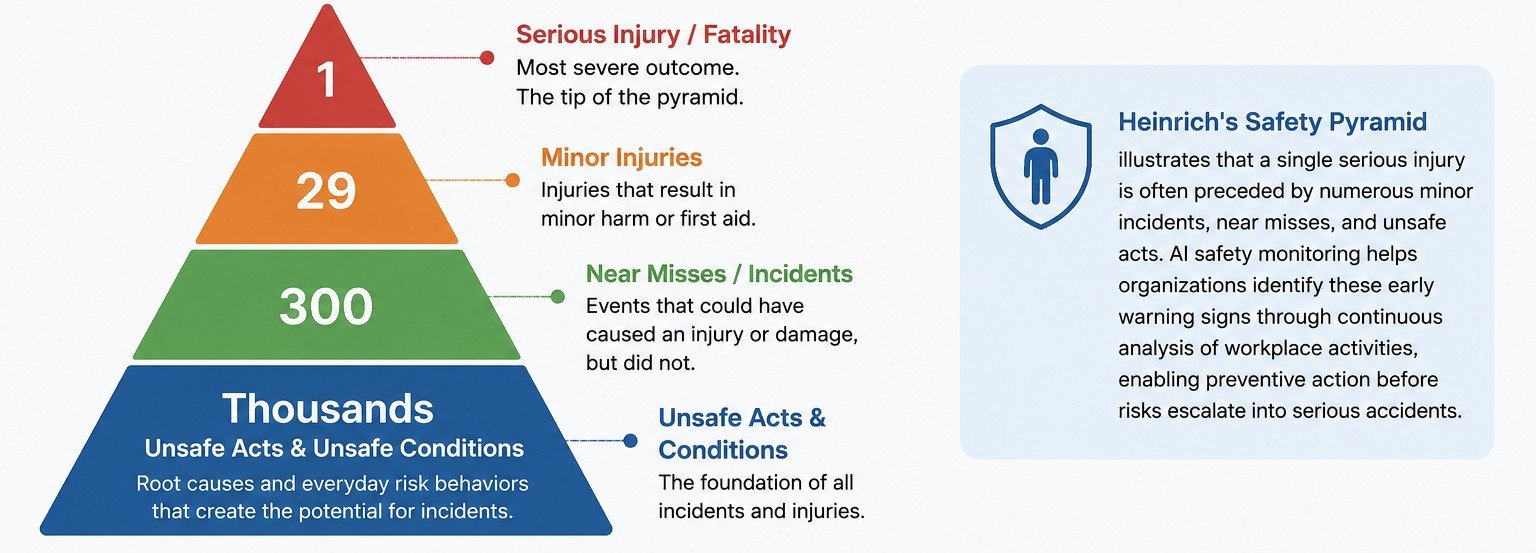
Not every workplace hazard is immediately visible during a routine walk-through. In line with Heinrich’s Safety Pyramid, which suggests that serious accidents are often preceded by numerous unsafe acts, near misses, and minor incidents, AI safety monitoring systems analyze subtle risk indicators that are easily overlooked. By identifying hidden patterns and emerging trends early, organizations can take preventive action before minor issues escalate into recordable injuries or major workplace accidents.
- Hidden injury pattern detection across departments
- Ergonomic risk analysis for repetitive tasks
- Fatigue indicators based on shift length and rest periods
- Repetitive motion analysis for assembly-line roles
- Predictive injury prevention recommendations before symptoms escalate
Practical Example
Industry: Manufacturing
Workers at a component assembly line perform the same manual fastening motion for an entire shift. The AI module analyzes historical ergonomic assessments alongside shift-length data and identifies that operators at one particular station show early fatigue indicators that closely match patterns seen before previous repetitive strain injury claims at the same plant. Rather than waiting for a worker to report discomfort, the system recommends rotating personnel through that station more frequently. Because musculoskeletal injuries typically build up gradually and are often not reported until they become painful enough to affect performance, this kind of early flag allows the plant to intervene with job rotation before a claim is ever filed, reducing both the human and the compensation cost of the injury.
13. AI Forklift Safety
Material handling remains one of the highest-risk activities in warehousing and manufacturing, making this a frequently requested module within AI industrial safety software.
- Collision avoidance alerts between forklifts and pedestrian
- Pedestrian detection in aisles and loading zones
- Speed monitoring against site-specific limits
- Blind-spot monitoring at intersections and racking corners
- Geofencing to restrict forklifts from pedestrian-only zones
- Driver behavior monitoring, including harsh braking and sharp turns
Practical Example
Industry: Warehousing & Logistics
Inside a busy distribution center, forklifts and pedestrian order-pickers regularly share the same aisles during peak fulfillment periods. Geofencing automatically reduces forklift speed limits the moment a unit enters a pedestrian-dense zone, while pedestrian detection sensors trigger an audible warning when a picker steps out from a blind corner near tall racking. Driver behavior monitoring also flags that one specific operator has a repeated pattern of harsh braking near the packing area, prompting a targeted refresher training session rather than a generic fleet-wide reminder. Over a peak season, near-miss reports between forklifts and pedestrians drop noticeably, and the facility avoids the kind of low-speed collision that, while rarely fatal, is one of the most common causes of lost-time injury in warehouse operations.
Common Mistakes to Avoid When Selecting AI EHS Software
Selection projects frequently go wrong for reasons that have little to do with the software itself:
- Buying based only on price – The cheapest option often lacks the AI depth needed for meaningful risk prediction.
- Ignoring scalability – A platform that works for one site may buckle when rolled out across ten facilities.
- Ignoring mobile support – Shop-floor workers rarely sit at a desktop; a weak mobile experience kills adoption.
- Choosing software without genuine AI – Some vendors rebrand basic automation as AI,offering little predictive value.
- Poor integration capability – A platform that cannot connect to existing ERP or HRMS systems creates data silos.
- Weak reporting – Dashboards that cannot be customized for different stakeholders reduce executive buy-in.
- Poor user adoption planning – Even the most advanced platform fails if workers are not trained to use it.
- Lack of vendor support – Ongoing configuration and troubleshooting needs require responsive vendor support, not just a sales team.
How AI EHS Software Creates Long-Term Business Value
The return on investment from an intelligent EHS platform extends well beyond compliance checkboxes:
- Reduced incidents through earlier hazard identification
- Better compliance with consistently tracked regulatory obligations
- Lower insurance costs as claims history improves
- Improved productivity from fewer disruptions caused by incidents
- Better ESG reporting supported by accurate, auditable safety data
- Higher employee engagement when workers see safety concerns acted on quickly
- Stronger safety culture built on visible, data-backed accountability
- Better decision-making supported by real-time analytics
- Faster ROI as manual administrative work decreases
- Reduced downtime from fewer unplanned incident-related stoppages
Future Trends in AI EHS Software
The next generation of intelligent EHS platforms is likely to include:
- Computer vision – extending beyond PPE checks into full behavioral analysis
- Generative AI – assistants drafting incident reports and audit summaries automatically
- Digital twins – simulating hazard scenarios before physical changes are made
- Wearables – tracking fatigue, heat stress, and gas exposure in real time
- IoT – sensors to predict critical equipment failures, including potential boiler bursts.
- Predictive analytics – maturing to forecast incidents weeks in advance
- Autonomous safety monitoring – requiring minimal human oversight
- Smart factory – integration linking safety data directly to production systems
- Edge AI – processing camera feeds on-site for faster alerts
- AI assistants for EHS – answering compliance questions instantly for frontline teams
Conclusion
Selecting the best AI EHS software is not about chasing the most feature-heavy brochure. It is about matching genuine artificial intelligence capabilities predictive risk scoring, computer-vision-based PPE detection, automated root cause analysis, and real-time behavioral alerts to the specific hazards present in a given operation. A cement plant, a pharmaceutical facility, and a logistics warehouse each carry different risk profiles, and the right platform should reflect that.
EHS Platforms illustrate how modern AI-powered EHS softwares are moving toward this integrated, predictive model rather than functioning as static record-keeping tools. When evaluating options, decision-makers should prioritize platforms that combine strong AI depth with proven scalability, robust security, and dependable vendor support since a platform that looks impressive in a demo but fails during a multi-site rollout delivers little lasting value.
Ultimately, the strongest safety outcomes come from pairing capable AI EHS software with a genuine organizational commitment to acting on the insights it generates.