Introduction
An incident reporting software is what separates a safety program that catches problems early from one that finds out about them the hard way. Workplace incidents rarely happen for a single, isolated reason; they happen because a hazard was unreported, a near miss was shrugged off, or a corrective action from six months ago never actually got verified. A well-built incident reporting software exists to close exactly that gap, turning scattered, after-the-fact paperwork into a structured process that catches problems early and stops them from repeating.
Traditional reporting methods weren’t built for how fast modern operations move. A worker fills out a carbon-copy form at shift end, it sits in a folder, and by the time an EHS manager reviews it, the details have gone soft and the corrective action has quietly stalled. That lag is where risk accumulates and it’s why organizations across manufacturing, oil and gas, construction, healthcare, and pharmaceuticals are moving toward digital safety management platforms that capture, investigate, and close out events in real time.
The organizations that get real value from this approach aren’t the ones that simply record more incidents. They’re the ones that use the data to spot patterns, fix root causes, and stop the same failure from repeating on a different shift, six months later.
Understanding an Incident Reporting Software
What Is an Incident Management System ?
An incident management system is a structured, usually software-supported process that lets organizations report, investigate, classify, and resolve workplace incidents while tracking every corrective action through to verified closure. It is not a form. It’s the entire lifecycle from the moment something goes wrong to the moment leadership confirms the underlying cause is actually gone.
There’s an important distinction between recording an incident and preventing its recurrence. Plenty of organizations excel at the first and struggle with the second. A logbook full of well-documented injuries that keep happening for the same reason isn’t workplace safety management – it’s just better bookkeeping. A genuine system closes the loop: investigation feeds root cause analysis, root cause analysis feeds a corrective action, and the corrective action gets verified before the file closes.
Types of Incidents Managed
A mature system has to handle far more than lost-time injuries:
- Workplace injuries – from a minor first-aid cut to a serious lost-time case, like a hand injury from an unguarded conveyor.
- Near misses – a forklift nearly clipping a pedestrian aisle. The richest source of predictive data in any safety program.
- Unsafe acts – bypassing a machine guard or skipping a lockout step to save time.
- Unsafe conditions – a blocked fire exit, exposed wiring, or a damaged ladder rung.
- Property damage – a loading dock collision or a forklift striking a racking system.
- Fire incidents – anything from a small electrical spark to a full evacuation.
- Environmental incidents – a chemical spill or an emissions exceedance.
- Equipment failures – a mechanical breakdown that creates a safety risk beyond the repair cost.
- Occupational illnesses – exposure-related conditions like hearing loss or respiratory issues that develop gradually.
- Accidents: Unplanned events that cause injury, illness, property damage, or environmental impact and require investigation to prevent recurrence.
Tracking all of these inside one system, instead of scattering them across different forms and departments, is what gives a safety team a genuine picture of organizational risk.
Regulatory Compliance Requirements for Incident Management
OSHA Incident Recording and Reporting Requirements
In the US, OSHA’s 29 CFR Part 1904 sets the baseline for incident recordkeeping. It requires most employers to maintain accurate records of work-related injuries and illnesses using three core documents:
- OSHA 300 Log – the ongoing record of every recordable injury and illness.
- OSHA 301 Incident Report – the detailed report completed for each recordable case, capturing what happened, when, and the treatment provided.
- OSHA 300A Summary – the annual summary that gets posted for employee visibility.
Facilities managing these manually often only discover errors when an auditor flags them, by which point the penalty exposure is already locked in.
ISO 45001 Incident Investigation Requirements
Clause 10.2 of ISO 45001 covers incident, nonconformity, and corrective action. It requires organizations to react to incidents in a controlled way, investigate their causes, take proportional corrective action, and evaluate whether that action worked feeding results back into risk assessments and training rather than filing them away.
ISO 14001 Environmental Incident Reporting
For environmental events specifically, ISO 14001 requires similar discipline: identifying nonconformities, correcting the environmental impact, and preventing recurrence. That’s why spills and emissions incidents belong inside the same reporting platform as safety events, rather than a separate environmental silo.
Industry-Specific Requirements
Industry | Key Compliance Focus |
Manufacturing | Machine guarding, LOTO violations, ergonomic injuries |
Chemical | Process safety events, exposure incidents, spill reporting |
Pharmaceutical | Contamination events, GMP deviations tied to safety |
Oil & Gas | Process safety, permit-to-work violations, hydrocarbon releases |
Construction | Falls, struck-by incidents, scaffolding failures |
Mining | Ground control incidents, gas exposure, entrapment |
Healthcare | Needlestick injuries, patient-handling injuries, exposure events |
Why Organizations Need Digital Incident Reporting Software
Parameter | Manual Incident Management | Digital Incident Management Software |
Reporting speed | Delayed, often end-of-shift | Real-time, from the point of occurrence |
Data accuracy | Prone to transcription errors | Structured forms reduce input errors |
Communication | Emails and verbal handoffs | Centralized, automated notifications |
Investigation tracking | Scattered, easy to lose | Defined workflow with status visibility |
Compliance | Manually compiled OSHA/ISO reports | Auto-generated compliance documentation |
Analytics | Limited, retrospective | Real-time dashboards and predictive analytics |
The shift toward digital safety management isn’t about chasing technology for its own sake — it’s about closing the gap between when something goes wrong and when the right person finds out, a gap that on paper can stretch for days.
How an Incident Management Software Works

Incident Detection
Incidents surface through several channels: an employee notices something during a shift, a routine safety inspection catches a hazard, an AI model flags an unusual pattern in prior data, or a connected sensor detects an abnormal reading before anyone walks past it.
Incident Reporting
Once detected, the event needs to be logged fast. Digital forms and mobile incident reporting let a worker submit a report from the location where it happened, often with a photo attached, instead of waiting for a desk and a keyboard.
AI-Based Incident Reporting. Voice-to-text lets a worker describe an event verbally while the system transcribes it and pre-fills key fields. Automatic categorization suggests the right incident type based on the description, and AI-assisted drafting helps turn a rushed, incomplete note into a clear, structured account.
Incident Information Collection
A complete report captures date and time, exact location, people involved, photos or video, witness statements, and the immediate actions taken on the spot the raw material every later investigation depends on.
Injury Assessment and Classification
injuries are commonly classified as:
- Fatal Injury: An incident that results in the death of an individual.
- Lost Time Injury (LTI): An injury that prevents an employee from performing their regular work duties for a period of time.
- Restricted Work Injury (RWI): An injury where an employee can work but with limitations or modified duties.
- Medical Treatment Injury (MTI): An injury requiring medical treatment beyond basic first aid.
- First Aid Injury (FAI): A minor injury that requires only basic first aid treatment.
- Recordable Injury: An injury that meets regulatory criteria and must be officially recorded.
- Near Miss / No Injury Incident: An event that could have caused injury but did not result in harm.
Injury Analysis by Body Parts. Tracking injuries by body part head, hand, eye, back, leg reveals patterns a raw incident count misses. A cluster of hand injuries on one line usually points to a guarding or PPE gap; recurring back injuries often point to a manual handling or ergonomics issue that needs fixing at the process level, not just the individual level.
Automated Notifications and Escalations
The moment an incident is logged, the right supervisor, EHS manager, or department head gets alerted based on severity and location, with automatic escalation if an assigned action goes overdue.
Investigation Management
Investigation management assigns an investigator, sets a timeline, and structures evidence collection and interviews so the process doesn’t stall indefinitely waiting on someone’s calendar.
Root Cause Analysis in Incident Management
Root cause analysis is what separates fixing the symptom from fixing the problem skip it, and an organization keeps patching the same recurring failure.
5 Whys Analysis
Works well for simpler, single-cause incidents repeatedly asking “why” until the process, not the person, is identified as the real cause.
Fishbone Diagram (Ishikawa Analysis)
Organizes potential causes into categories Man, Machine, Method, Material, Measurement, and Environment useful when an incident has several contributing factors rather than one obvious trigger.
4M Root Cause Analysis
Narrows the focus to four core factors:
- Man – human factors like training gaps, fatigue, or unsafe behavior.
- Machine – equipment failures or overdue maintenance.
- Method – a procedure that’s outdated, unclear, or routinely skipped.
- Material – quality or handling issues with the materials involved.
Having multiple root cause analysis methods available inside one incident investigation software platform means investigators aren’t forced to fit every incident into the same template.
Corrective and Preventive Action (CAPA) Management
CAPA Assignment
Every corrective action needs a named owner, a priority level tied to risk severity, and a realistic deadline vague ownership is the single biggest reason CAPAs stall.
Action Tracking After CAPA
Once assigned, action tracking monitors status and progress, escalating automatically when a deadline slips instead of relying on someone remembering to follow up.
CAPA Effectiveness Verification
Closing a CAPA because a box got checked isn’t the same as confirming it worked. Effective verification means someone checks, after implementation, that the hazard is gone and the incident hasn’t recurred.
Essential Features of an Effective Incident Reporting Software
Real-Time Incident Reporting – a supervisor learns about a spill within minutes, not at shift change, preserving more usable evidence.
Mobile Incident Reporting – nobody on a job site carries a laptop, so phone-based reporting sharply increases how often near misses get logged.
Near Miss Reporting – every serious injury has a stack of unreported near misses behind it. Making this fast, under a minute, captures the data predictive models depend on.
Configurable Incident Forms – a chemical plant needs exposure fields; a construction site needs fall-height fields. Configurable forms adapt without a developer.
Automated Notifications and Alerts – the right people get notified based on severity and type, not because someone remembered to forward an email.
Workflow Automation – moves a case automatically from reporting to investigation to CAPA to closure without manual handoffs.
Investigation Management – structures assignment, evidence, and deadlines so nothing stalls indefinitely.
Root Cause Analysis Tools – built-in 5 Whys, fishbone, and 4M templates keep investigations consistent across sites.
Corrective Action Management – tracks CAPA from assignment through verified closure.
Injury and LTIR Tracking – turns raw incident counts into standardized, comparable rates.
LTIR (Lost Time Injury Rate)
LTIR measures how often lost-time injuries occur relative to hours worked. The standard formula is:
LTIR = (Number of Lost Time Injuries × 200,000) ÷ Total Hours Worked
The 200,000 figure represents 100 employees working 40 hours a week for 50 weeks, giving a rate comparable across facilities of different sizes. LTIR matters because it’s one of the most commonly benchmarked safety metrics industry-wide.
Alongside LTIR, most programs also track TRIR (Total Recordable Incident Rate), covering all recordable cases, not just lost-time ones; TTIR, a broader measure some organizations use internally; Severity Rate, which weighs incidents by days lost rather than count; Near Miss Rate, a signal of reporting-culture health; and Repeat Incident Rate, which flags when the same failure keeps recurring – a clear sign a prior corrective action never addressed the real root cause.
Evidence and Document Management – keeps photos, videos, reports, and investigation documents attached to the incident record instead of scattered across email and shared drives.
Witness Statement Recording – time-stamped, digital statements preserve accounts before memory fades or gets influenced by later conversations.
Incident Classification and Severity Assessment – consistent classification is what makes aggregate reporting meaningful across sites.
Regulatory Compliance Tracking – keeps a running record of what’s been reported, filed, and met against OSHA and ISO deadlines.
Audit Trail – logs every action, timestamp, and user automatically, so “who approved this and when” is one click away, not a week of digging.
Safety Analytics and Reporting
KPI Monitoring
Dashboards turn raw incident data into something leadership actually reviews: incident trends over time, severity trends, department-level performance, and location-based comparisons across multiple sites.
Digital Safety Board
A digital safety board, shown on-site or shared company-wide, keeps safety visible day to day through indicators like days since the last accident, overall safety performance, open CAPAs, and recent observations.
Safety Metrics
Safety Metric | Purpose | Business Value |
LTIR | Tracks lost-time injuries per standard hours worked | Industry-comparable safety benchmark |
TRIR | Captures all recordable cases | Broader view of injury frequency |
Near Miss Rate | Measures reporting culture health | Predicts future incident risk |
CAPA Closure Rate | Tracks how many actions get finished on time | Signals whether fixes are actually happening |
Repeat Incident Rate | Flags recurring failures | Reveals ineffective root cause analysis |
Investigation Cycle Time | Measures speed from report to root cause | Faster prevention, less exposure |
AI-Powered Incident Reporting Software and Predictive Safety
AI is shifting incident management from documentation toward genuine prevention.
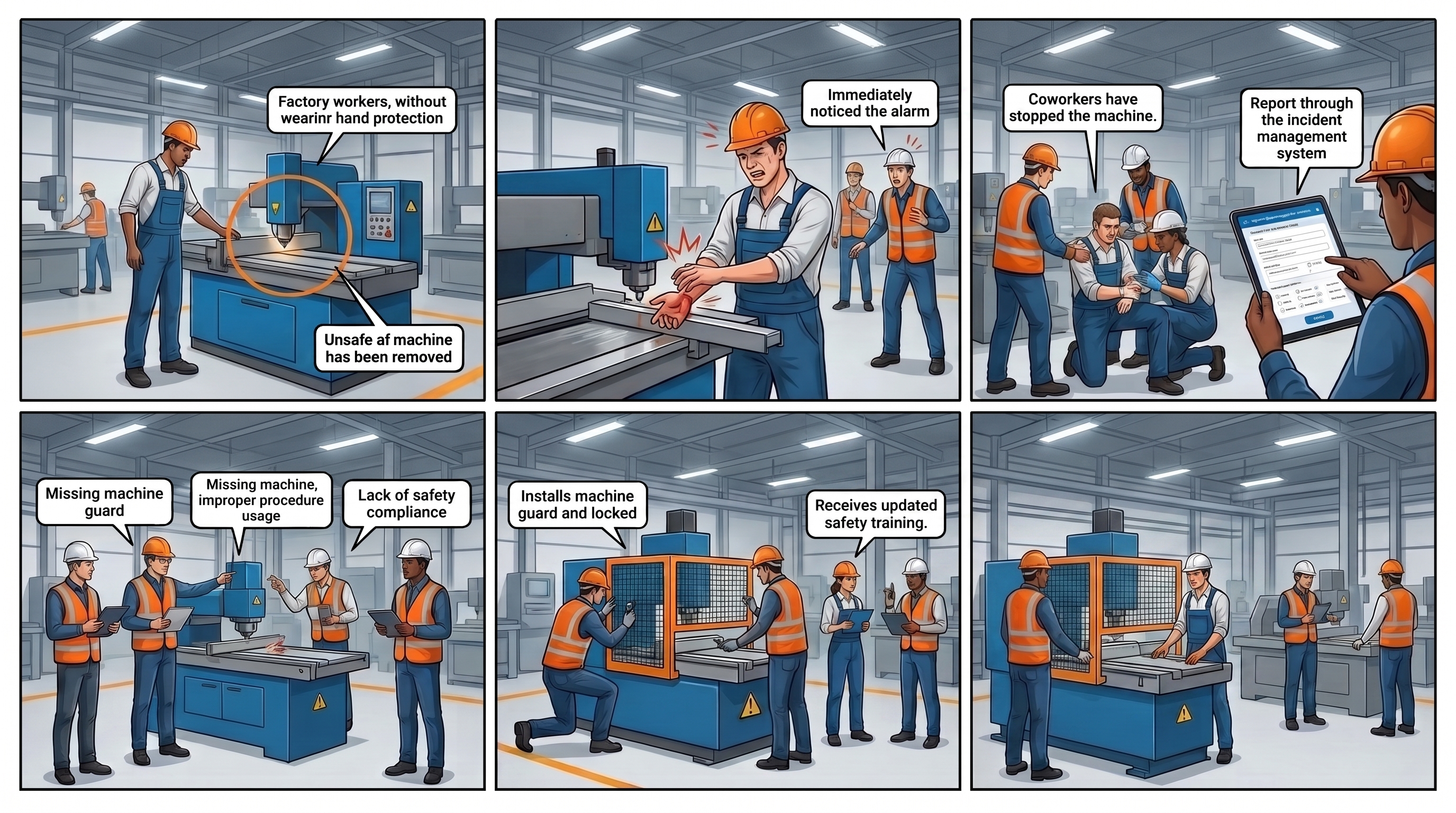
AI-Powered Safety Illustrative Stories: AI can transform incident investigations into engaging comic-style stories and illustrations, helping workers understand causes, consequences, and preventive actions through easy-to-follow visual learning.
AI-Assisted Incident Reporting – pre-fills details from voice or text input, lowering the friction that keeps workers from reporting in the first place.
AI-Based Incident Classification – reads a free-text description and suggests the correct category and severity, keeping tagging consistent for reliable trend analysis.
AI Root Cause Analysis – cross-references historical incidents to surface causal patterns an investigator might not think to check manually.
AI Investigation Assistance – surfaces similar past cases automatically the moment a new investigation opens, saving hours of manual searching.
Predictive Safety Analytics – analyzes historical incidents, near misses, and operational patterns to forecast where a higher-severity event is likely, flagging unsafe trends before they escalate.
AI-Based CAPA Recommendations – suggest corrective actions based on what resolved similar incidents previously, then track whether those actions held.
Computer Vision – applied to camera feeds, detects unsafe behavior, missing PPE, or unauthorized entry into a restricted zone, logging it automatically.
IoT and Wearable Integration – enables real-time monitoring a wearable can flag a fall, gas exposure, or unsafe heart rate, feeding directly into a connected safety system rather than waiting for a self-report.
Digital Twins and Advanced Simulation – an emerging application, modeling a facility’s real-time conditions against a safe operating baseline to flag deviations before they become incidents.
Multi-Site Incident Management
For organizations running multiple facilities, multi-site management consolidates data centrally while letting each location manage its own daily workflow. This gives corporate safety teams comparative visibility across sites and consistent global compliance management, without micromanaging local operations.
Cloud-Based vs On-Premise Incident Reporting Software
Factor | Cloud-Based | On-Premise |
Cost | Lower upfront, subscription model | Higher upfront, infrastructure investment |
Scalability | Easy to add sites and users | Requires added hardware |
Security | Vendor-managed, contractually governed | Fully controlled internally |
Accessibility | Available from any device, anywhere | Typically limited to internal network |
Maintenance | Handled by the vendor | Managed by internal IT |
Integration | Easier API-based connections | Often requires custom development |
Role-Based Access Control
Role-based access ensures workers report incidents without seeing sensitive investigation details, supervisors manage cases for their team, EHS managers get full investigation and CAPA oversight, and management teams get dashboard-level visibility without wading through case-level detail.
Integration With Other EHS Modules
Incident tracking delivers the most value when it’s connected, not isolated:
- Risk Assessment – incidents feed back into updated risk ratings.
- Permit to Work – incidents linked to permit violations get flagged automatically.
- Audit Management – audit findings can trigger incident-style investigations.
- Inspection Management – failed inspection items convert directly into incidents.
- Training Management – root causes tied to training gaps trigger refresher assignments.
- Contractor Management – contractor-related incidents feed into contractor safety scoring.
- Document Management – investigation reports and evidence stay linked to the incident record.
Together, these integrations turn incident tracking from a standalone log into the connective layer of a complete digital safety management ecosystem.
Future of Incident Reporting Software
The next generation of incident management platforms is moving from reactive documentation toward genuine prediction. AI-driven forecasting is already flagging high-risk conditions before an incident occurs. Automated investigations are cutting the time between an event and a confirmed root cause. Digital twins are starting to model facility risk in real time, and connected workers wearing sensors generate safety data continuously rather than only when something goes wrong. Real-time risk monitoring and advanced analytics are converging into a single view where incident data, risk assessment, and training all feed the same decision-making layer.
Conclusion
A safety program is only as good as the discipline behind how it’s run, but the right incident reporting software removes most of the friction that causes that discipline to break down. The real shift worth aiming for isn’t more reports, it’s moving from reacting to incidents after they happen to preventing the conditions that cause them in the first place. Organizations that get this right build more than compliance; they build resilience, because a workforce that trusts the reporting process, root causes that actually get fixed, and safety decisions backed by real data compound into fewer repeated incidents year after year. That’s the difference between a safety program that plateaus and one that keeps getting measurably safer.