Introduction
How to calculate LTI rate is a common question for safety managers and EHS professionals who need to measure the real impact of workplace incidents. Lost Time Injuries (LTIs) are widely used to evaluate how safety incidents affect employee availability, productivity, and compliance performance.
Many organizations still rely on spreadsheets to track LTI data. While this approach may work initially, it often leads to inconsistent records, calculation errors, and delayed safety reporting. Understanding the correct LTI rate formula and best practices is essential for accurate EHS performance monitoring.
What Is the LTI Rate?
The LTI Rate, or Lost Time Injury Rate, measures how often work-related injuries lead to employees missing at least one full scheduled workday.
This metric is commonly monitored by:
- EHS managers
- Safety and compliance officers
- Plant and operations managers
- Audit and risk management teams
The LTI rate enables organizations to compare safety performance across departments, sites, contractors, and reporting periods.
What Qualifies as a Lost Time Injury?
A case is classified as a Lost Time Injury when:
- The injury or illness is work-related
- The employee is not able to carry out their regular work responsibilities.
- At least one complete working shift is missed after the incident day
Important Clarification (Next-Day Rule)
If an employee is injured but is able to return to work for their next scheduled shift, the incident is generally not recorded as an LTI.
Examples of Lost Time Injuries
- Bone fractures
- Severe cuts requiring recovery time
- Burns that result in absence
- Musculoskeletal injuries causing lost workdays
Incidents Not Classified as LTIs
- First-aid-only cases
- Medical treatment with no lost workdays
- Near-miss events
Accurate classification is essential, as incorrect reporting can distort safety metrics and affect audits or client requirements.
Why Is the LTI Rate Important?
Monitoring the LTI rate helps organizations:
- Measure the effectiveness of safety controls
- Identify high-risk tasks and locations
- Evaluate the success of corrective actions
- Meet legal, regulatory, and client safety expectations
- Drive continuous safety improvement
A consistently high LTI rate usually signals weaknesses in hazard identification, employee training, or operational procedures.
How to Calculate LTI Rate Using the Standard Formula
Standard Formula
LTI Rate = (Number of Lost Time Injuries × Multiplier) ÷ Total Hours Worked
The multiplier is used to normalize results and allow comparisons across different workforce sizes.
Understanding Multiplier Differences
1,000,000 Working Hours (Global / ISO / ILO Standard)
- Commonly applied in international reporting
- Frequently used in manufacturing, construction, oil and gas, and heavy industries
- Reflects exposure across large industrial workforces
- Often referred to as LTIFR (Lost Time Injury Frequency Rate)
200,000 Working Hours (US / OSHA Standard)
- Primarily used in the United States
- Based on the assumption of 100 employees working 40 hours per week for 50 weeks
- Commonly known as LTIR (Lost Time Injury Rate)
Both calculation methods are acceptable, provided the selected multiplier is clearly stated and applied consistently.
How to Calculate LTI Rate: Step-by-Step Example
Scenario
- Number of Lost Time Injuries: 2
- Total hours worked: 500,000 hours
- Multiplier used: 1,000,000
Step-by-Step Calculation
Step 1: Multiply injuries by the multiplier
2 × 1,000,000 = 2,000,000
Step 2: Divide by total hours worked
2,000,000 ÷ 500,000 = 4.0
Result
The LTI Rate is 4.0, meaning four lost time injuries occurred per one million working hours. This example follows international reporting standards and is mathematically correct.

What Is Considered a Good LTI Rate?
Acceptable LTI values vary by industry risk level, but general guidance includes:
LTI Rate | Safety Performance |
Below 1.0 | Excellent |
1.0 – 3.0 | Acceptable |
Above 3.0 | Needs improvement |
Rather than focusing only on a target number, organizations should aim for continuous and sustained reduction.
Lagging vs Leading Safety Indicators
The LTI rate is a lagging indicator, meaning it reflects incidents that have already happened. While it is essential for compliance and reporting, it does not predict future risks.
To improve safety proactively, organizations should also monitor leading indicators, such as:
- Safety training completion rates
- Near-miss reporting trends
- Safety inspections performed
- Corrective action closure status
Modern EHS management software enables tracking of both lagging and leading indicators within a single platform.
Common Mistakes in LTI Rate Calculation
Organizations often report incorrect LTI values due to:
- Excluding contractor working hours
- Misclassifying injury severity
- Manual data entry errors
- Delayed incident reporting
- Inconsistent documentation practices
These issues reduce data accuracy and limit meaningful trend analysis.
How EHS Software Simplifies LTI Tracking
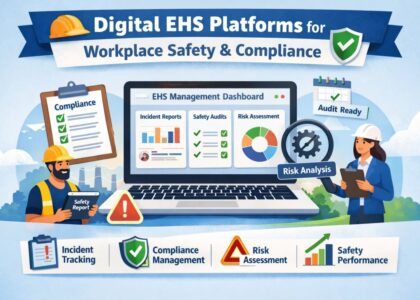
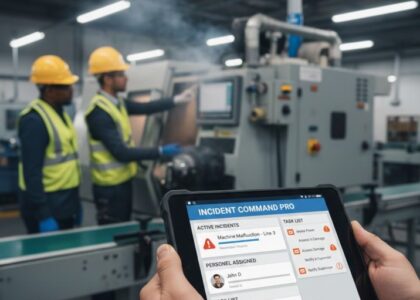
Managing LTI data manually is time-consuming and prone to errors. A digital EHS management solution helps by:
- Capturing incidents in real time
- Automatically categorizing injury types
- Applying the correct regional multiplier
- Instantly calculating LTI rates
- Generating standardized dashboards and compliance reports
This allows safety teams to focus more on prevention and less on administrative tasks.
Conclusion
The LTI rate is a critical safety metric that shows how effectively an organization manages workplace injuries. By applying the correct formula, understanding regional standards, and ensuring accurate injury classification, organizations can improve reporting quality and compliance.
Using digital EHS software further strengthens safety performance by eliminating manual errors and delivering real-time insights that support a proactive safety culture.