
Manufacturing floors, warehouses, and process plants carry risks that unfold in minutes rather than hours, which is why more operations teams are replacing paper-based response plans with Emergency Preparedness Software. This category of software brings emergency planning, evacuation tracking, response team coordination, and post-incident review onto a single digital platform, giving plant managers and EHS professionals a clear understanding of their organization’s preparedness before, during, and after an emergency.
Instead of scattered spreadsheets, printed maps, and phone trees that break down under pressure, a centralized system keeps every stakeholder, from shop-floor employees to contractors and visitors, connected to the same real-time information. This article examines the specific features that modern workplaces, particularly manufacturing units, should evaluate when choosing emergency preparedness software, and how each one supports faster, better-coordinated response.
Essential Features of Emergency Preparedness Software

Emergency Planning and Risk Assessment
Every dependable emergency response starts with a plan that people can actually find and follow, which is where digital emergency response plans prove their worth. Rather than storing procedures in a binder that sits in a drawer, a digital plan is accessible from any device and can be updated the moment a hazard changes or a process line is reconfigured, which matters on sites where layouts and storage arrangements shift frequently.
Workplace hazard identification tools let safety teams log risk points directly against a facility layout, covering chemical storage areas, high-voltage equipment, confined spaces, and other conditions specific to a given production line. Once hazards are mapped, emergency preparedness software typically organizes the planning stage around a consistent set of building blocks:
- Scenario-Specific Digital Emergency Response Plans
- Workplace hazard identification against the facility layout
- Emergency procedure documentation for fires, spills, entrapment, or natural disasters
- Evacuation route definition, adjustable as production areas shift
- Emergency team assignment for clear ownership of each response
- Scheduling and managing mock drills to rehearse the plan
Because plant risks vary by department, planning for different emergency scenarios individually, rather than relying on one generic protocol, keeps procedures aligned with actual shop-floor conditions and gives each team a plan written for the hazards they actually face.
Evacuation and Live Workforce Headcount
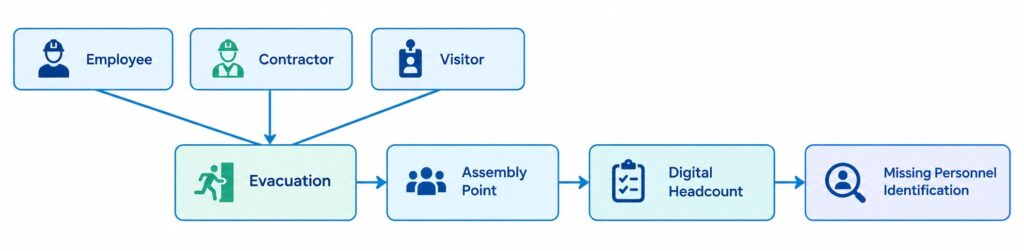
When an alarm sounds, the priority shifts from planning to accounting for every person on site, and this is where live workforce tracking becomes essential. Initiating evacuation procedures through the software triggers a coordinated sequence rather than a scramble, notifying relevant teams and activating tracking functions automatically.
Real-time headcount tracking covers three distinct groups that a manufacturing site typically has to manage at once:
- Employees, through attendance tracking for the permanent workforce
- Contractors, who may be unfamiliar with the site layout
- Visitors, who are on the premises without a fixed work area
Each group is checked against assembly point monitoring data as people arrive at designated safe zones, so coordinators are not relying on a paper sign-in sheet that may never reach the right hands during an actual evacuation. Live headcount verification then compares the number of people checked in against the number expected on site, drawing on attendance and access records. This comparison is what makes identifying missing personnel possible within minutes rather than after a manual roll call, and monitoring evacuation status across every assembly point gives response coordinators a single view of where gaps remain.
Emergency Response Team Management
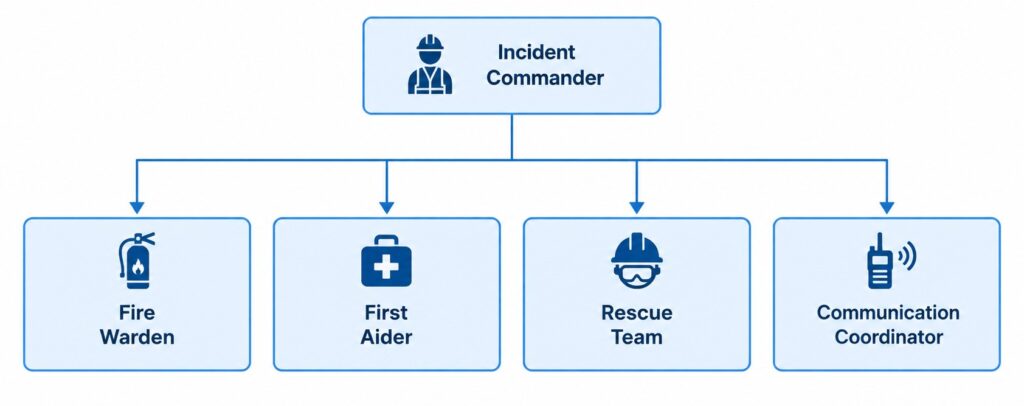
Coordinated response depends on clearly defined roles, and emergency preparedness software organizes this through structured Emergency Response Teams, typically including:
- Incident Commanders, who oversee the overall response
- Fire Wardens, who manage evacuation within their zones
- First Aiders, who handle injuries
- Rescue Teams, who address entrapment or confined-space situations
- Communication Coordinators, who keep information flowing between teams and management
Responsibility assignment within the platform means each responder knows their scope before an incident occurs, not during one, and responder contact information is stored centrally so notifications reach the right numbers and addresses without manual lookup during a crisis. Responder readiness is tracked continuously, rather than assumed, so a plant manager always knows who is currently on site and able to act.
Competency management adds another layer of assurance, with the software tracking:
- Certifications held by each responder
- Mandatory training completions
- Medical qualifications relevant to their role
- Broader competency records documenting ongoing capability
- Certification expiry dates, flagged automatically ahead of renewal
Together, these features mean a plant manager can confirm, at any moment, that the personnel assigned to respond are both available and properly qualified.
Emergency Drill Management
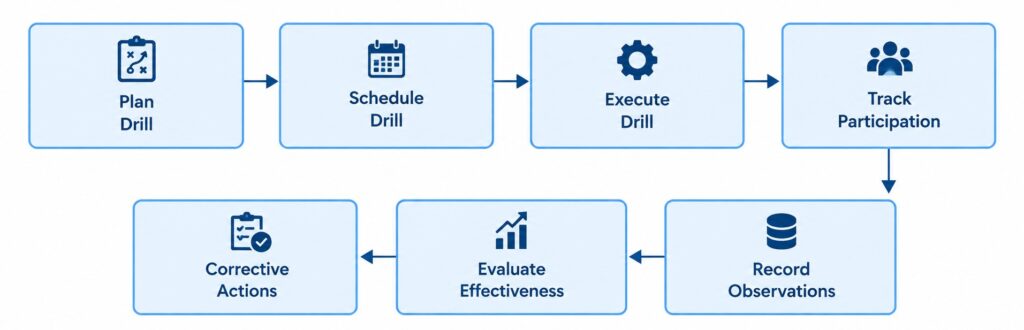
A response plan only proves itself under practice conditions, and structured drill management is what keeps that practice consistent. A typical drill cycle within the software moves through several stages:
- Drill planning, selecting a scenario such as a fire evacuation, chemical release, or medical emergency
- Drill scheduling, assigning a date and notifying participants in advance
- Drill execution, run according to the planned scenario
- Participation tracking, recording who took part and in what capacity
- Observation recording, logging issues such as a blocked exit or a delayed response in real time
- Drill effectiveness evaluation, often measured by the time taken to reach the assembly point
- Recommendations and corrective follow-up, feeding into the next drill or the underlying procedure
Because every drill is logged as a digital record, safety teams can compare performance across quarters or sites, building a documented history rather than a one-off exercise that is quickly forgotten. This record also makes it straightforward to show, during an audit or a management review, exactly how often drills were run and what came out of each one.
Emergency Alerts and Multi-Channel Communication
Speed of notification often determines how quickly a workforce responds, and instant emergency notifications are central to that speed. Emergency preparedness software pushes alerts to employees and contractors the moment an incident is declared, without waiting for a manual phone tree or overhead announcement to reach every corner of a large facility. This matters most in facilities where noise levels or physical distance make a single announcement system unreliable on its own. Emergency Response Team notifications are typically prioritized separately, ensuring that Incident Commanders, Fire Wardens, and other responders are alerted immediately so they can begin coordinating before the wider workforce receives instructions.
Alerts are distributed across multiple channels so that no one is left uninformed because of a single point of failure:
- Mobile push notifications
- SMS text alerts
- Email notifications
- In-app messages
Targeted emergency communication allows messages to be sent to specific zones, shifts, or teams rather than the entire facility, useful when an incident is contained to one production area and a broader alert would cause unnecessary disruption elsewhere. This combination of speed and targeting is a core reason organizations look for a reliable emergency notification system as part of their preparedness software.
Real-Time Emergency Response Coordination
Once an incident is underway, response effectiveness depends on visibility, and a centralized emergency dashboard is built to provide exactly that. From this single screen, coordinators can typically monitor:
- Real-time emergency status across the facility
- Team deployment and the position of response personnel
- Employee evacuation status as it updates
- Live headcount data from every assembly point
- Rescue progress for entrapment or medical extraction situations
- Response activity, from the initial alert through to resolution
This level of emergency response team coordination, visible from one screen, reduces the communication gaps that commonly slow down manual, radio-based response efforts, particularly across large sites where multiple teams are working different zones at the same time.
AI-Powered Emergency Intelligence
Artificial intelligence is increasingly built into emergency preparedness platforms to identify risks before they escalate. Depending on the platform, AI-powered capabilities typically include:
- Real-time hazard identification from camera feeds and sensor data
- AI obstruction detection on evacuation routes and exits
- Fire equipment inspection support, confirming extinguishers and hose reels remain accessible
- Assembly point recommendations based on the nature and location of an incident
- Intelligent video analytics for situational awareness during an active event
- Real-time AI alerts that surface anomalies without constant manual monitoring
Collectively, these AI-supported emergency response insights help close the gap between detecting a hazard and acting on it, reducing the reliance on a person happening to notice a problem during a routine walk-through.
Post-Incident Review and Corrective Action Management
The period immediately after an emergency is when the most valuable lessons are available, provided they are captured properly. Emergency preparedness software typically supports this review through:
- Recording observations from responders and witnesses while details are fresh
- Documenting response actions taken at each stage of the event
- Generating reports that give management a structured account of what happened
- Emergency performance review, examining response time and adherence to procedure
- Corrective and Preventive Actions (CAPA), assigned with owners and due dates
- Lessons learned and improvement actions, tracked through to completion
Maintaining these emergency records in one place also supports audits, since the full history of an incident and its follow-up is available on demand rather than scattered across departments, spreadsheets, and email threads.
Emergency Analytics and Reporting
Beyond individual incidents, emergency preparedness software aggregates data across events to reveal patterns that are difficult to see from single reports alone, giving EHS leaders a longer-term view of whether preparedness is actually improving. Interactive dashboards commonly present:
- Emergency response time, showing how quickly teams reached affected areas
- Evacuation status, tracked across incidents and drills
- Drill effectiveness, measured over time
- Team performance, broken down by responder group
- Incident trends, surfacing recurring problem areas
Because every drill, alert, and incident is logged automatically, centralized emergency records accumulate into a reliable performance history that supports both internal reviews and external compliance reporting.
Interactive Emergency Maps
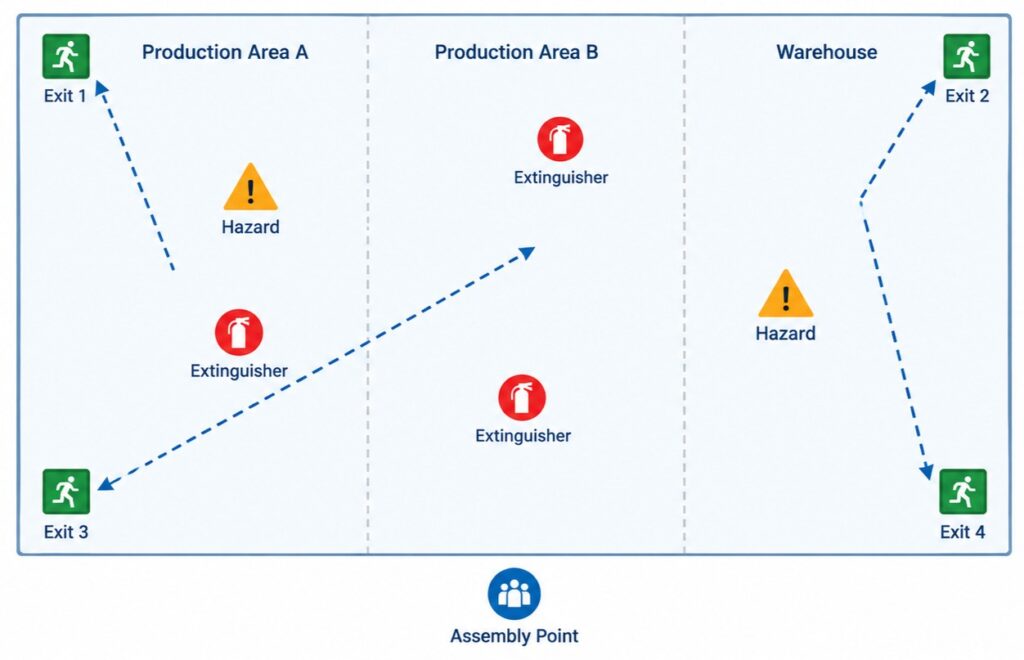
Interactive emergency maps display evacuation routes, exits, assembly points, and emergency equipment on the actual facility layout. They can also highlight hazards such as chemical storage and high-risk machinery for better situational awareness. Updated digital maps help employees and responders quickly identify safe routes and critical locations during an emergency.
Conclusion
Modern manufacturing workplaces face emergencies that move quickly and involve employees, contractors, and visitors across large, complex sites. The features covered here, from digital emergency planning and live headcount tracking to response team management, multi-channel alerts, AI-supported intelligence, and post-incident analytics, work together to close the gaps that paper-based systems leave open. Choosing Emergency Preparedness Software with these capabilities gives plant managers and EHS professionals a coordinated, evidence-based way to prepare for incidents, respond with clarity, and improve continuously based on real performance data rather than guesswork. For manufacturing units where downtime and safety risks carry real consequences, this level of structured readiness is becoming a practical necessity rather than an optional upgrade.


