
Introduction
Workplace safety has long depended on someone noticing unsafe behavior at the right moment. As industrial operations expand across multiple shifts, locations, and large workforces, manual PPE monitoring can no longer provide consistent coverage. AI PPE Detection Software addresses this challenge by continuously monitoring PPE compliance through computer vision, detecting violations in real time without fatigue or gaps. Instead of relying on periodic inspections and paper checklists, organizations can move from reactive incident investigation to proactive accident prevention by identifying and correcting unsafe behavior before it leads to an incident.
What Is AI PPE Detection Software?
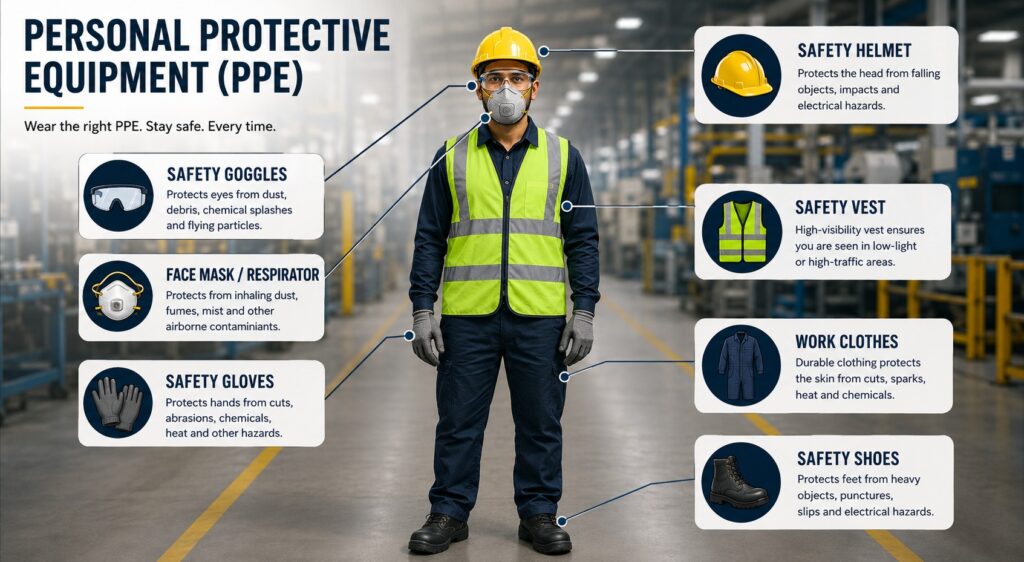
vision to automatically identify whether workers are wearing required personal protective equipment in real time. Rather than depending on manual spot-checks, the software continuously analyzes live video feeds from existing CCTV or IP cameras and flags non-compliance the moment it occurs.
To understand why this technology works so well, it helps to break down the core components behind it.
Artificial Intelligence in this context refers to machine learning models trained specifically to recognize patterns associated with PPE: the shape of a helmet, the reflective stripes on a safety vest, the outline of protective goggles. These models improve over time as they process more footage from real industrial environments.
Computer Vision is the branch of AI that allows software to “see” and interpret visual information the way a human would, but at a scale and speed no human team could match. It identifies people, objects, and their relationship to one another within a video frame for example, recognizing that a person is present in a hazardous zone without a hard hat.
Deep Learning models, typically built on convolutional neural networks, are what give AI safety monitoring its accuracy. These models are trained on thousands of annotated images showing correct and incorrect PPE usage, allowing the system to distinguish a worker wearing a helmet from one who is bare-headed, even under different lighting conditions, camera angles, and worker postures.
CCTV-based monitoring is the delivery mechanism. Since most industrial facilities already have surveillance infrastructure in place, AI PPE detection typically integrates directly with existing cameras rather than requiring an entirely new hardware rollout. This is a major reason adoption has accelerated so quickly; the incremental cost of adding intelligence to cameras that are already installed is far lower than building a new monitoring system from scratch.
Automated PPE compliance is a continuous, unblinking layer of oversight that flags helmet, vest, glove, footwear, and eyewear violations as they happen, rather than during a scheduled walk-through hours later.
Industries are adopting this technology for a straightforward reason: the cost of a single serious workplace injury, in both human and financial terms, far exceeds the cost of preventing it. Regulatory bodies are also tightening reporting requirements, insurance providers are rewarding proactive safety programs with better premiums, and boards are increasingly asking safety leaders to show measurable, data-backed compliance rather than anecdotal assurances.
How AI PPE Detection Software Works
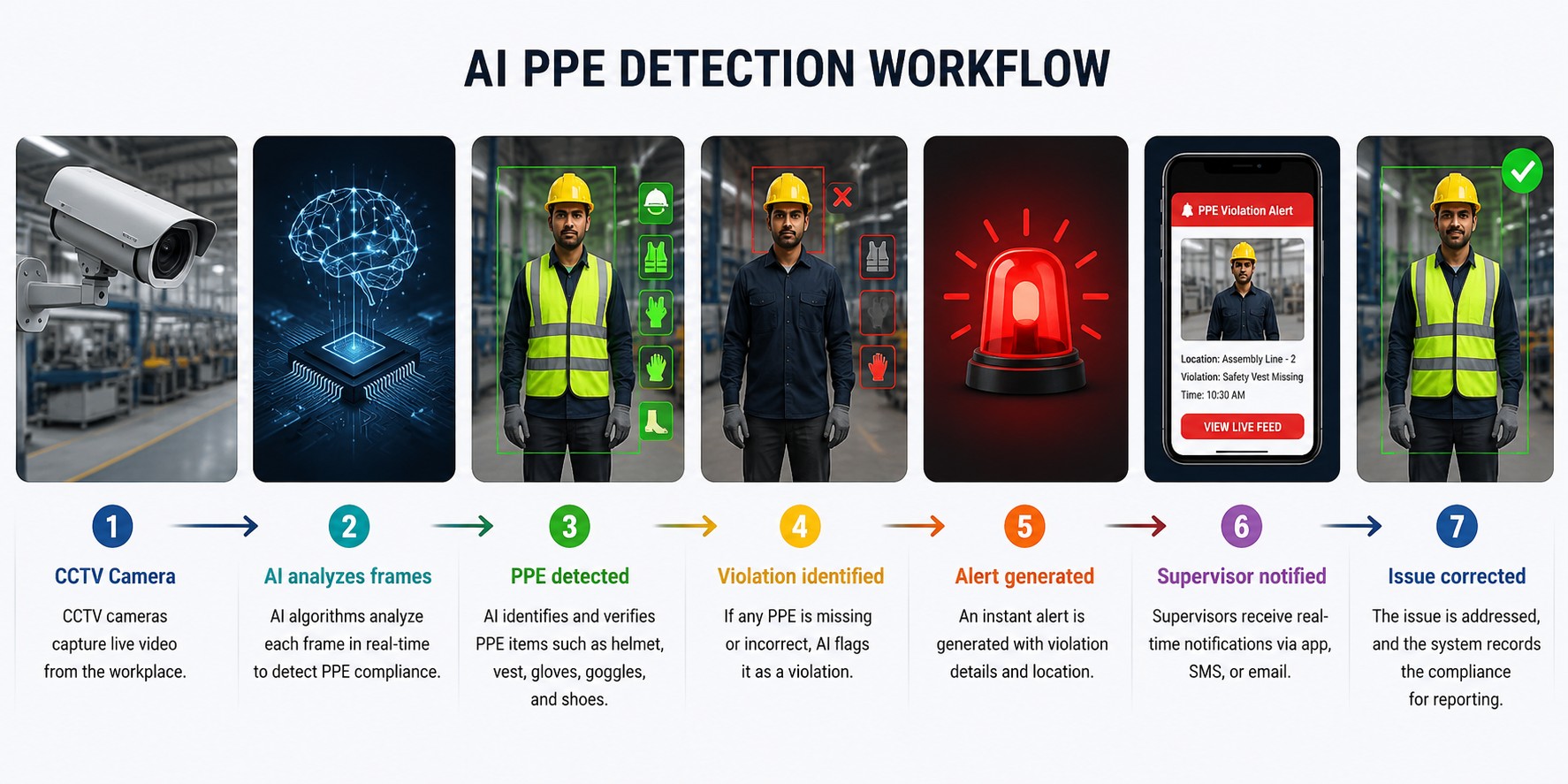
How It Works
AI PPE detection follows a logical, five-stage process that turns raw video into actionable safety intelligence.
1. Monitor
The process begins with CCTV monitoring and IP camera feeds that are already installed across the facility. Cameras positioned at entry points, production lines, loading docks, and high-risk zones continuously capture video of the work area. Because the software is designed to work with standard surveillance hardware, facilities rarely need to rip out and replace existing infrastructure. This single fact makes industrial AI cameras far more accessible than they might initially sound in most cases, it is the intelligence layer that is new, not the cameras themselves.
2. Detect
Once video is streaming in, the AI engine analyzes every frame in real time using real-time PPE detection models. The system is trained to identify:
- Safety helmets
- Safety vests
- Safety shoes
- Gloves
- Face shields
- Safety goggles
- Missing PPE
- Improper PPE usage (for example, a helmet worn but left unfastened, or a vest present but not properly closed)
3. Alert
When a violation is detected, the system triggers an immediate notification through multiple channels, including:
- Mobile notifications pushed directly to relevant personnel
- SMS alerts for immediate visibility even without app access
- Email alerts for record-keeping and escalation trails
- Dashboard notifications visible to safety teams monitoring in real time
- Broadcasts instant voice alerts in regional languages for faster response to PPE violations.
This real-time warning system ensures that a violation is not just logged for a future report, it is surfaced to someone who can act on it within seconds, not hours.
4. Escalate
Not every alert gets resolved immediately, and that is exactly the gap that escalation workflows are designed to close. Configurable escalation logic ensures that unresolved violations move up the chain of responsibility automatically. When an operator does not respond to or resolve an alert within the configured response time, the system automatically forwards the alert to the supervisor for immediate action. If the supervisor does not act, it goes to the safety officer, and then up the chain. This structure prevents the single biggest failure mode in manual safety programs: a violation being noticed but quietly falling through the cracks because no one followed up. With automated escalation, accountability is built into the system rather than left to individual initiative.
5. Analyze
Every detection, alert, and resolution feeds into a central analytics layer. Compliance monitoring becomes strategic here rather than operational. Dashboards aggregate violation trends over time, highlight which zones or shifts see the most non-compliance, and support corrective action planning. Some platforms may offer predictive insights. For example, some may detect and point out patterns that identify an elevated risk of an incident occurring, shift, zone, or even an individual employee.
Key Features of AI PPE Detection Software
Real-Time PPE Monitoring
At the core of any credible AI safety solution is the ability to detect violations as they happen, not after the fact. Real-time monitoring means a missing helmet is flagged within seconds of a worker entering a restricted zone, giving supervisors the chance to intervene before an incident occurs rather than reviewing footage after one already has.
AI-Based Helmet Detection
Head injuries remain among the most common and most preventable workplace incidents. Helmet detection AI identifies whether a worker is wearing a hard hat correctly, distinguishing between no helmet, an improperly fastened helmet, and full compliance a level of nuance manual spot-checks routinely miss.
Safety Vest Detection
High-visibility vests are critical wherever workers operate near moving vehicles, forklifts, or heavy machinery. Safety vest detection confirms not just presence but visibility flagging vests that are unzipped, removed, or obscured in a way that defeats their purpose.
Safety Shoe Detection
Manufacturing and construction environments expose workers to hazards such as falling materials, sharp objects, and heavy equipment, making proper safety footwear essential for reducing the risk of foot injuries.Detecting proper footwear compliance at entry points and throughout the shift closes a gap that is otherwise nearly impossible to monitor manually across an entire shift.
Gloves Detection
In chemical handling, machining, and materials handling environments, hand injuries are among the most frequent recordable incidents. Automated glove detection works proactively to keep handlers of dangerous materials and operators of hazardous equipment safe, rather than reactively through the filing of injury reports.
Face Shield & Safety Goggles Detection
Environments involving welding, grinding, chemical splashes, or flying debris require eye and face protection that is easy to overlook at the moment. Even in quickly changing production settings, where employees might have the opportunity to start a task without their complete PPE, AI-based detection would enable the rapid identification of security gaps.
Unauthorized Personnel Detection
Beyond PPE compliance, the same computer vision PPE detection infrastructure can identify individuals entering restricted or hazardous zones without proper authorization or credentials. This adds a critical layer of workplace hazard detection that extends well beyond gear compliance into access control.
Instant Alerts & Notifications
As covered earlier, immediate alerts ensure violations reach the right person through the right channel. This is what separates AI-powered safety monitoring from passive video recording; the system does not just capture the moment, it acts on it.
Dashboard & Compliance Analytics
Key dashboard capabilities typically include:
- Live Violation Feed – a real-time stream of current and recent violations across all monitored zones
- Compliance Score – a single aggregated metric shows overall PPE data across the facility.
- Zone-wise Analytics – breakdowns showing which specific areas generate the most violations, helping target interventions precisely
- Shift-wise Reports – comparisons across shifts to identify whether certain time periods show weaker compliance
- Camera-wise Performance – visibility into which cameras or zones are generating the most detections, useful for both safety and camera-placement optimization
- Trend Analysis – longer-term patterns showing whether compliance is improving or deteriorating over weeks and months
- Heat Maps – visual representations of violation concentration across a facility layout
CCTV & IP Camera Integration
Because most facilities already operate extensive surveillance networks, compatibility with existing industrial AI cameras and IP camera systems is a defining feature of practical AI PPE platforms. This lowers the barrier to adoption compared with solutions that require entirely new hardware.
Incident Recording & Evidence Management
Every detected violation can be automatically supported by video recording, image snapshots, and precise timestamps. This creates a proper audit trail that supports internal investigations, regulatory compliance, and insurance claims replacing incomplete written statements with objective evidence.
Multi-Site Monitoring
For organizations operating in several plants or facilities, centralized monitoring allows safety officers to view compliance data of every site from a single dashboard, rather than piecing together separate reports from each location.
Cloud-Based Access & Mobile Monitoring
Deployment flexibility allows organizations to choose the option that best fits their operational and security requirements. Cloud-based deployment enables faster implementation and secure remote access, while on-premise deployment is ideal for facilities with stringent data governance, regulatory, or network security policies. With mobile access, safety officers and plant managers can receive alerts, monitor compliance, and view dashboards from any location, ensuring timely decision-making beyond the control room.
AI PPE Detection Software and the Hierarchy of Controls
Personal protective equipment (PPE) is the last level in the Hierarchy of Controls, following elimination, substitution, engineering controls, and administrative controls. AI PPE Detection Software does not eliminate hazards or replace higher-level controls; it ensures PPE is worn correctly and consistently. By improving PPE compliance, it strengthens the last line of defense and reduces worker exposure to risks.
Benefits of AI PPE Detection Software
Faster Time-to-Correction
Faster time-to-correction reduces the window between an unsafe act and a supervisor’s response, cutting the opportunities for a violation to progress into an injury. By enabling immediate intervention, it helps lower the frequency of recordable incidents over time.
Accountability Without Extra Headcount
Accountability without extra headcount extends safety oversight to every corner of a facility without adding dedicated monitoring staff. It provides leadership with consistent coverage across shifts and locations while keeping incremental costs lower than hiring additional supervisors.
Risk-Proportionate Resource Allocation
Risk-proportionate resource allocation enables safety teams to direct training, signage, and supervision toward the areas with the highest hazards. Rather than spreading resources evenly across a site, organizations achieve a better return on every safety initiative.
Data-Backed Decision-Making
Data-backed decision-making transforms anecdotal safety observations into measurable performance indicators. This gives leadership the evidence needed to prioritize budgets, target training programs, and demonstrate safety improvements to boards, regulators, and insurers.
Compliance with Privacy Regulations
Compliance with privacy regulations provides organizations with a defensible approach to worker privacy while still capturing the safety benefits of video monitoring. This reduces legal and reputational exposure as data protection requirements continue to evolve across regions.
Faster Scaling Across Sites
Faster scaling across sites enables organizations to bring new facilities under safety oversight quickly with minimal upfront infrastructure investment. This is particularly valuable when expanding operations or opening additional locations.
Control Over Sensitive Data
Control over sensitive data allows organizations with strict IT or regulatory requirements to keep video data within their own environment. This supports compliance with internal governance policies and industry-specific data protection regulations.
A Single Source of Safety Truth
A single source of safety truth connects PPE compliance data with the broader EHS ecosystem, including incident management, audits, and corrective actions. This enables safety performance to be tracked, reported, and managed from one consistent record instead of reconciling information across multiple systems.
Permit to Work (PTW) Integration
Once a digital Permit to Work (PTW) is approved, the EHS platform automatically triggers AI PPE Detection Software to monitor the designated work area. PPE compliance is continuously verified throughout the permit duration, while any violations are instantly detected and alerts are sent to supervisors. This enables proactive, real-time monitoring for permitted work activities.
Improved Regulatory Compliance
Continuous PPE monitoring supports compliance with OSHA, ISO 45001, and internal safety procedures by maintaining a continuous compliance record. Every detection is timestamped to create reliable digital audit evidence, improving audit readiness, reducing manual compliance gaps, and enabling proactive compliance management.
Reduces Manual CCTV Monitoring
AI PPE Detection Software automatically monitors multiple CCTV feeds, significantly reducing the need for continuous manual surveillance. It minimizes operator fatigue and human error while ensuring consistent monitoring, allowing safety professionals to focus on inspections, investigations, audits, and other preventive safety activities.
Helps Reduce Incident Severity
AI PPE Detection Software cannot eliminate workplace hazards, but it enables faster corrective action by detecting PPE violations in real time. This helps prevent many unsafe situations from escalating into incidents, often reducing them to near misses. If an incident does occur, proper PPE can help reduce injury severity, lowering overall risk rather than eliminating it.
Strengthens Workplace Safety Culture
Continuous PPE monitoring reinforces safe behaviour, improves accountability, and increases awareness of PPE requirements across the workplace. It provides management with real-time visibility into compliance trends and supports proactive decision-making. The resulting analytics also strengthen workplace safety culture through continuous training and ongoing improvement initiatives.
Industries That Benefit from AI PPE Detection Software
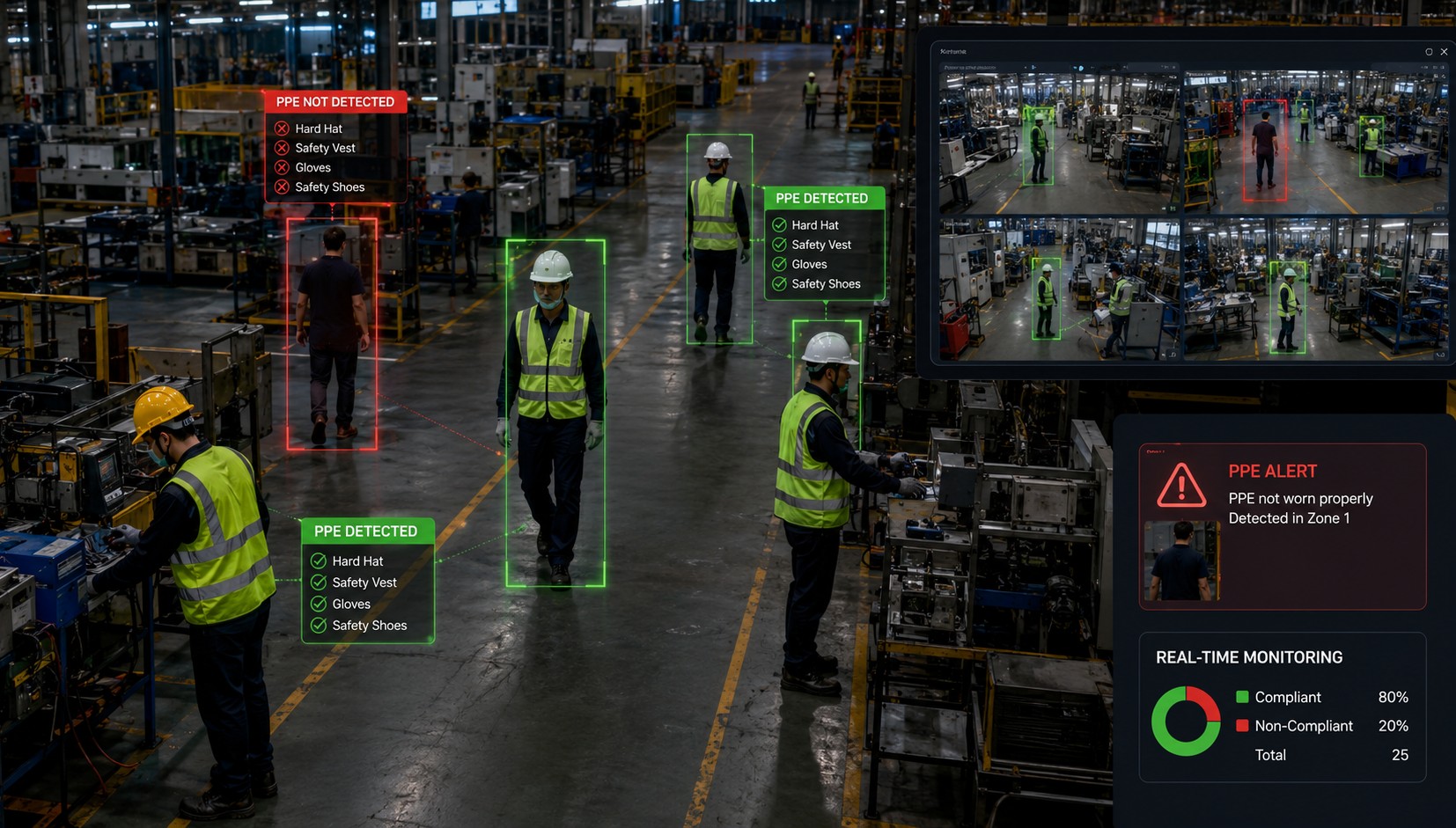
Manufacturing
The floors involve moving machinery, conveyor systems, and repetitive material handling, making helmet, glove, and footwear compliance essential. Manufacturing safety software built on AI detection reduces the recordable incident rate associated with rotating equipment and material handling injuries, directly supporting smart factory safety initiatives.
Construction
Sites present some of the highest-risk environments in any industry, with falling objects, heavy equipment, and constantly changing layouts. Construction safety software powered by AI helmet and vest detection helps enforce compliance across a workforce that is often transient, subcontracted, and spread across a large, unstructured site.
Oil & Gas
The facilities require specialized PPE including flame-resistant clothing, gas detectors, and face protection due to the presence of flammable materials and high-pressure systems. AI monitoring adds a consistent layer of oversight in environments where a single lapse can have catastrophic consequences.
Chemical Plants
It demands strict adherence to gloves, face shields, and respiratory protection due to exposure risks. Automated detection reduces the chance that a worker skips protective gear during a quick task, a common root cause of chemical exposure incidents.
Mining
The operations combine confined spaces, heavy machinery, and dust exposure, making helmet and respiratory PPE compliance non-negotiable. AI-based monitoring extends safety oversight into underground or remote areas that are difficult for supervisors to physically patrol.
Warehouses & Logistics
These environments see high foot and forklift traffic, making vest visibility and footwear compliance critical to preventing collision-related injuries. Workplace safety software here also supports unauthorized zone-entry detection around loading docks and racking systems.
Pharmaceutical
Its facilities require strict adherence to gloves, face masks, and hygiene-related PPE, both for worker safety and product contamination control. AI monitoring supports quality compliance alongside worker protection.
Aerospace
The manufacturing involves precision assembly, chemical bonding agents, and cleanroom-adjacent environments where PPE lapses can affect both worker safety and product integrity. AI detection supports consistent compliance across highly regulated production lines.
Power Plants
This involves high-voltage equipment, confined spaces, and rotating machinery, all demanding strict helmet, glove, and footwear compliance. Occupational safety software here supports compliance in facilities that often run continuous, unattended operations overnight.
Heavy Engineering
The environments combine welding, cutting, and material handling, requiring face shields, gloves, and footwear compliance across large, noisy facilities where verbal safety reminders are easily missed.
Fixed AI Cameras vs Portable AI Cameras
Factor | Fixed AI Cameras | Portable AI Cameras |
Installation | Permanently mounted, requires initial setup and cabling | Deployable within minutes, no fixed wiring required |
Mobility | Static coverage of a defined zone | Can be relocated as work areas or project phases change |
Coverage | Consistent, wide-area monitoring of high-traffic zones | Targeted coverage of temporary or high-risk work areas |
Scalability | Scales well across large, permanent facilities | Scales well across short-term projects or changing sites |
Best Applications | Production floors, entry points, warehouses | Construction sites, temporary work zones, outdoor projects |
Advantages | Reliable uptime, stable network connectivity, lower maintenance | Flexibility, rapid redeployment, ideal for evolving job sites |
Limitations | Fixed field of view, costly to relocate | Battery and connectivity constraints, potential exposure to weather |
Cost Considerations | Higher upfront installation cost, lower long-term operating cost per zone | Operational cost is higher and also can be damaged as it is moveable |
Common PPE Violations AI Can Detect
- Missing Safety Helmet: Detects workers entering production areas, construction sites, or hazardous zones without wearing a safety helmet.
- Missing Safety Vest: Identifies personnel not wearing high-visibility safety vests in areas with vehicle movement, warehouses, or active work zones.
- Missing Gloves: Flags workers handling chemicals, machinery, or sharp materials without the required protective gloves.
- Missing Safety Shoes: Detects employees entering areas with heavy equipment, falling-object hazards, or material handling operations without safety footwear.
- Missing Safety Goggles or Face Shield: Recognizes workers performing grinding, welding, cutting, or chemical handling tasks without appropriate eye and face protection.
- Unauthorized Personnel Detection: Identifies individuals entering restricted or hazardous areas without proper authorization or credentials.
- Restricted Zone Entry Without Required PPE: Detects authorized personnel who enter designated work zones without wearing the mandatory PPE required for that specific area.
- Improper PPE Usage: Detects incorrectly worn protective equipment, such as unfastened helmets, unzipped safety vests, improperly fitted gloves, or incorrectly positioned face shields and goggles.
- Multiple Simultaneous PPE Violations: Identifies multiple safety violations at once for example, a worker missing both gloves and a face shield during a hazardous task ensuring that no critical safety issue goes unnoticed through continuous AI-powered monitoring.
Challenges and Best Practices for Implementation
Successful deployment of AI PPE detection software depends on more than just installing cameras and turning on the system. Camera placement needs careful planning. Cameras must capture clear, unobstructed views of entry points and high-risk zones without excessive glare, blind spots, or obstruction from equipment.
- Optimize Lighting Conditions: Poor or inconsistent lighting can reduce detection accuracy, especially in warehouses, outdoor construction sites, and low-light environments. Installing adequate lighting or using cameras designed for low-light performance helps improve AI accuracy.
- Gain Worker Acceptance: Employees may initially perceive AI monitoring as a surveillance tool. Communicating that the system is designed to enhance workplace safety rather than monitor individual performance encourages greater acceptance and cooperation.
- Address Privacy and GDPR Compliance: Organizations should implement privacy-focused measures such as face blurring, role-based access controls, and secure data storage to protect employee privacy while complying with regulations like GDPR and other data protection standards.
- Reduce False Positives Through Continuous Learning: AI systems may generate false alerts during the initial deployment phase. Regularly reviewing flagged events and retraining AI models with real operational data improves detection accuracy over time.
- Customize AI Models for the Workplace: AI models should be calibrated to the site’s unique conditions, including camera angles, lighting, PPE colors, work environments, and regional PPE variations, to maximize detection performance.
- Ensure Reliable Network Connectivity: Stable internet or network infrastructure is essential for real-time monitoring. Remote or outdoor locations may benefit from edge AI processing, allowing cameras to analyze footage locally even with limited connectivity.
- Implement Effective Change Management: Successful deployment requires employee awareness programs, operator training, well-defined escalation procedures, and visible management support to integrate AI monitoring into daily safety practices.
- Perform Regular System Maintenance: Periodically inspect cameras, update AI software, maintain network infrastructure, and verify system performance to ensure reliable operation and accurate PPE detection.
- Continuously Improve the System: Use analytics, compliance reports, and violation trends to refine camera placement, update monitoring zones, optimize alert thresholds, and improve escalation workflows as operational requirements evolve.
Conclusion
AI is transforming workplace safety by replacing periodic manual inspections with continuous, automated monitoring. AI PPE Detection Software detects PPE violations in real time, improving consistency, reducing workplace incidents, strengthening regulatory compliance, and helping safety teams focus on high-risk areas for greater operational efficiency. As AI-powered monitoring becomes the industry standard across manufacturing, construction, energy, and logistics, organizations that adopt it build a scalable, data-driven EHS strategy that supports growth, meets increasing regulatory requirements, and creates a measurably safer workplace.


