Introduction
Every maintenance shutdown carries one risk that no plant can afford to ignore: hazardous energy left uncontrolled while workers are inside or around equipment. Electrical faults, sudden mechanical movement, a valve that reopens, or a pump that restarts without warning have injured maintenance workers across industries for decades. This is why Lockout Tagout Software has become a serious topic among safety professionals tired of watching paper-based systems fail at the exact moment they are needed most. A permit to work software alone can authorize a job, assign a supervisor, and record a signature, but it cannot physically confirm that a machine has been isolated from every energy source. That confirmation belongs to lockout tagout procedure discipline, and without it, a permit is just paperwork sitting on top of an unverified risk.
Many facilities still run permit management and hazardous energy isolation as two separate activities, handled by two teams, tracked in two registers. The gap between them is exactly where accidents happen. This article explains how a connected system brings these two processes together, why international standards already expect this kind of integration, and what plant managers, safety officers, and maintenance teams can expect to gain when isolation and authorization move as one workflow instead of two disconnected paper trails.
Understanding the Relationship Between Lockout Tagout and Permit to Work
What is Lockout Tagout (LOTO)?
Lockout Tagout, generally called LOTO, is the physical and procedural method of isolating equipment from every source of energy before maintenance, repair, or servicing begins. It is not a form. It is a set of physical actions: identifying energy sources, de-energizing them, applying a lock, attaching a tag, and verifying that stored energy has been released. Equipment maintenance work of any real risk should never start without this step being completed and confirmed by an authorized employee.
Hazardous energy is rarely just one type. A single machine can carry several forms at once, and each one needs its own isolation method:
• Electrical – power supply to motors, control panels, and circuits
• Mechanical – moving parts, flywheels, gears, or springs under tension
• Hydraulic – pressurized fluid in rams, presses, and lifting systems
• Pneumatic – compressed air trapped in lines and actuators
• Thermal – hot surfaces, steam lines, or residual heat from processes
• Chemical – residual product, vapors, or reactive substances inside vessels
• Stored Energy – capacitors, springs, or elevated components that can move under gravity
What is Permit to Work?
A Permit to Work is the formal authorization that allows a specific job to proceed under defined conditions, at a defined time, by named personnel. It exists to make sure that before anyone touches a piece of equipment, the risks have been assessed, controls have been agreed, and the right people have signed off. High-risk jobs almost always require a permit before the first tool is picked up, and most facilities organize permits by the type of hazard involved:
• Hot Work Permit – covers welding, cutting, grinding, or any task involving open flames or heat sources near flammable material
• Cold Work Permit – covers non-hot activities in areas that still carry some risk, where basic precautions still need to be confirmed
• Work at Height Permit – required for tasks on scaffolds, ladders, rooftops, or any elevated platform
• Confined Space Entry Permit – required before anyone enters tanks, vessels, pits, or underground chambers
• Electrical Permit – authorizes qualified personnel to work on live or isolated electrical systems under controlled conditions
• Excavation Permit – required before digging begins, to confirm underground utilities and services have been identified and protected
Each permit type carries its own checklist and risk factors, but all of them share the same underlying purpose: making sure work only starts once the right precautions have been confirmed in writing.
Why LOTO and PTW Must Work Together
Permit Type | LOTO Integration | Why LOTO is Required | Typical Energy Sources Isolated |
Electrical Work Permit | Mandatory | Prevents electric shock, arc flash, and unexpected energization during electrical work | Electrical power, capacitors, batteries |
Mechanical / Cold Work Permit | Mandatory | Prevents unexpected startup or movement of machinery during maintenance | Mechanical, electrical, hydraulic, pneumatic |
Equipment Maintenance Permit | Mandatory | Ensures equipment is fully isolated before servicing, repair, or inspection | Electrical, mechanical, hydraulic, pneumatic, gravity |
Line Breaking / Process Isolation Permit | Mandatory | Prevents release of hazardous pressure, chemicals, steam, or gases | Pressure, steam, chemical, hydraulic, pneumatic |
Hot Work Permit | Conditional | Required when welding, cutting, or grinding is performed on equipment that must first be isolated | Electrical, mechanical, fuel, gas |
Why Integrating Permit to Work and Lockout/Tagout Matters
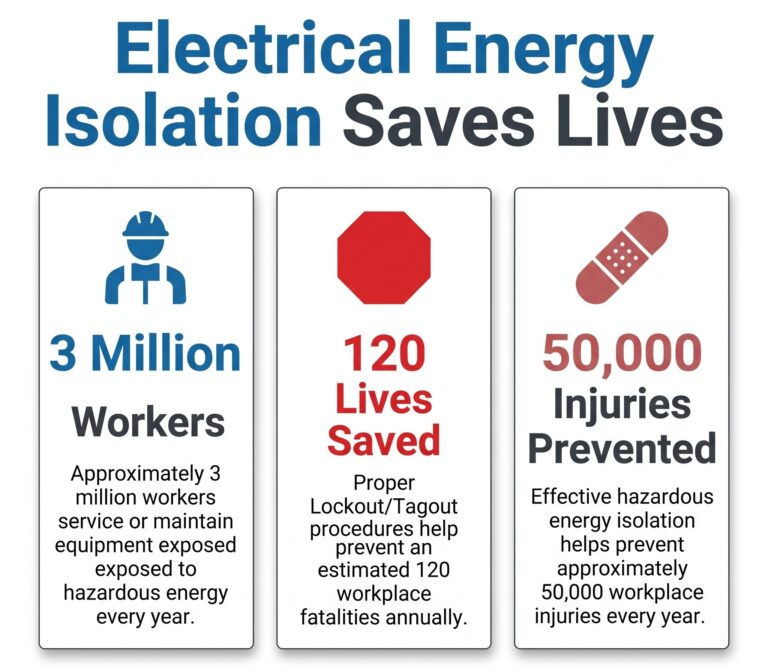
A permit gives permission. Lockout/Tagout (LOTO) provides protection. One without the other leaves a critical gap in the safety system. Before any maintenance or servicing begins, hazardous energy must be isolated and verified. Only after that verification should a permit be approved and work commence. Likewise, equipment should only be re-energized once the work is complete and the permit has been formally closed.
This is not just a recommended practice, it is embedded in modern safety standards. OSHA 29 CFR 1910.147 establishes the requirements for controlling hazardous energy during servicing and maintenance. ISO 45001 requires organizations to integrate these controls into a documented occupational health and safety management system, while ANSI/ASSP Z244.1 provides detailed guidance on developing effective energy control programs. Rather than treating permit authorization and energy isolation as separate processes, these standards emphasize that they should work together. Integrated digital software closes this gap by ensuring that permits cannot proceed until energy isolation has been completed and verified.
The benefits of this integration extend well beyond compliance:
Enhanced Worker Safety: Preventing accidental energization is the primary objective of LOTO, and integrating it with Permit to Work ensures isolation is verified before work begins and maintained until the job is safely completed.
Faster Approvals and Reduced Paperwork: Digital workflows eliminate duplicate forms and manual handovers, allowing approvals to move more quickly while maintaining complete documentation.
Improved Cross-Functional Coordination: Maintenance, operations, electrical teams, and safety personnel all work from the same real-time information, reducing miscommunication and ensuring everyone follows the same process.
Greater Visibility and Easier Compliance Audits: Every permit, isolation step, approval, and restoration activity is automatically recorded with timestamps, making audit preparation and regulatory inspections much simpler.
Stronger Incident Investigations: Historical records remain searchable, allowing organizations to quickly trace previous permits, energy isolation activities, and maintenance work for any asset.
Reduced Downtime and Higher Operational Efficiency: Better planning, standardized procedures, and faster coordination help organizations complete maintenance within scheduled windows while minimizing unnecessary equipment downtime.
Challenges of Managing Lockout Tagout and Permit to Work Separately
Facilities that keep these two systems apart, even with good intentions, tend to run into the same problems repeatedly, the ones that push safety teams to start evaluating Lockout Tagout Software in the first place.
Manual documentation: It is the first and most obvious issue. Paper permits and paper lock registers live in different folders, sometimes different offices. A permit approver has no direct way of confirming that isolation described on a separate LOTO sheet was actually carried out, so approval becomes an act of trust rather than verification.
No real-time visibility: When lock status lives on a clipboard and permit status lives on a different form, nobody in the control room or the safety office can see, at a glance, what state a piece of equipment is in. Without a shared view, the honest answer is often “check with the shift supervisor,” which is not good enough during an emergency.
Communication gaps: there is a natural result of running two systems on two tracks. The permit issuer may not know maintenance added an extra isolation point. The electrician applying a lock may not know the permit scope changed an hour ago. Contractors brought in for a shutdown are especially exposed here, since they often do not know the complete permit approval process used at a site they are visiting for the first time, and without shared information in real time, they are left guessing.
Incorrect energy isolation: It becomes more likely when there is no digital checklist forcing a step-by-step confirmation of every energy source. A missed isolation point on a multi-source machine is one of the most common causes of LOTO-related injuries, and manual systems have no built-in way to flag it.
Delayed permit approvals: It happens when paperwork has to physically travel between departments for maintenance signs, then walks the form to operations, then to the safety office. Every handoff adds waiting time that a shutdown schedule cannot absorb.
Unauthorized lock removal: It is a serious and underreported problem. When a lock register is a paper log in a drawer, nothing stops someone from removing a lock before the permit is officially closed, especially under pressure to restart production.
Difficult audits: It ties all of this together. When an investigator asks for the full history of a job, who applied the lock, who verified isolation, who approved the permit, and when it was removed pulling that from three separate paper trails takes hours, with gaps common. Departments working in isolation, combined with a general lack of visibility, means top management cannot easily monitor day-to-day activity across a large site, and problems are usually found only after something has already gone wrong.
How Lockout Tagout Software Simplifies Permit to Work Integration
Digital Permit Initiation
In an integrated system, the LOTO software and the permit process start together instead of being requested separately. Once a maintenance job is raised, the associated LOTO request is generated automatically alongside the digital permit to work. An Open Release request the formal step confirming equipment can be safely handed back for isolation or later returned to service is created in parallel with the permit itself, so the permit and the lockout record move through the workflow together as one connected process instead of two documents that only meet at the end.
Automatic Energy Isolation Verification
Before a permit can be approved, the system displays the specific energy sources tied to that equipment directly inside the permit record. The approver does not need to call the maintenance team to ask what has been isolated isolation steps, de-energization status, and mandatory confirmations are already visible on screen. This means a permit approver can directly see the energy sources involved, the isolation points addressed, and the confirmed de-energization status before signing off, closing the exact gap described earlier where approval relied on trust rather than verification.
Linked Lockout and Permit Records
Every lock applied in the field is connected to a specific permit number rather than existing as a standalone entry. This gives each piece of equipment a running equipment history every past isolation, permit, and maintenance event tied to that asset in one place, ready to show exactly how it was isolated last time and by whom when it comes up for servicing again.
Role-Based Approval Workflow
Different departments typically sign off on different aspects of a job: maintenance confirms isolation is complete, operations confirms the equipment is safe to hand over, electrical confirms circuit isolation, and safety confirms the risk assessment, before a final permit approval closes the loop. What matters here is that workflow changes from one organization to another a chemical plant may require five approval stages while a smaller unit may only need two. The software should allow this to be configured around each organization, with some companies adding layers for higher-risk permits and others streamlining routine jobs.
Real-Time Lock and Permit Status
A connected dashboard shows the current state of every job in progress, using clear status markers such as Lock Applied, Isolation Verified, Permit Pending, Permit Active, Work Completed, Lock Removed, and Equipment Energized. Instead of asking a supervisor for a verbal update, plant leadership can see exactly where every permit and lock stands at that moment. This directly answers the visibility gap described earlier top management can monitor activity across shifts, departments, and even multiple sites without waiting for an end-of-day report.
Digital Checklists and Verification
Isolation is confirmed through a structured isolation checklist rather than a memory-based walk-through. Each energy source is checked off individually, lock verification is recorded, and a digital signature confirms who performed the check. Photo evidence attached to the isolation point adds further proof the work was done correctly, particularly useful for contractor safety management, where site familiarity cannot always be assumed.
Safe Permit Closure
Once work is finished, the permit moves through a permit closure stage that includes a final inspection of the work area, confirmation that tools and materials are removed, and formal authorization for lock removal. Only after this closure step is complete does the equipment get released for restoration, so equipment isolation is never lifted based on an informal “we’re done here” from the work crew.
Complete Traceability
Every action in the process of who applied the lock, who verified isolation, who approved each stage of the permit, exact timestamps, and who authorized lock removal is recorded automatically. This builds an audit trail ready for inspection at any time, without anyone reconstructing events from memory or paper. When an incident investigation happens, this recorded history turns what used to take days of paperwork reconciliation into a matter of minutes.
Slight Overview of Lockout Tagout Workflow
Before looking at how the two processes connect, it helps to see the basic lockout sequence on its own:
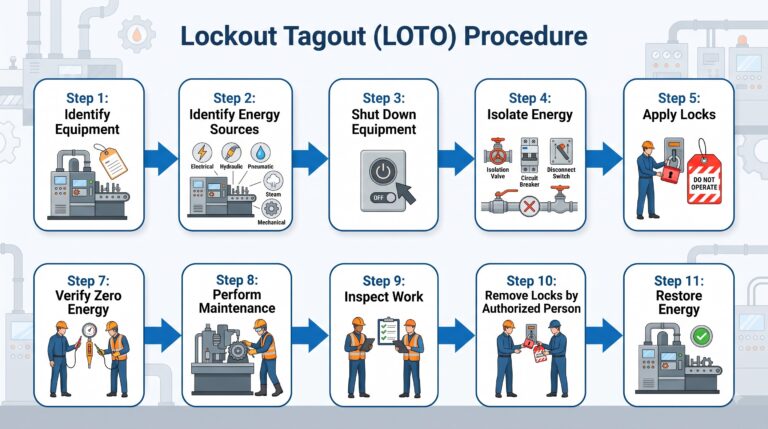
Every organization may adjust this sequence slightly to match its own internal procedures, equipment types, and risk levels, but the underlying logic of isolate, verify, work, and restore stays consistent across industries.
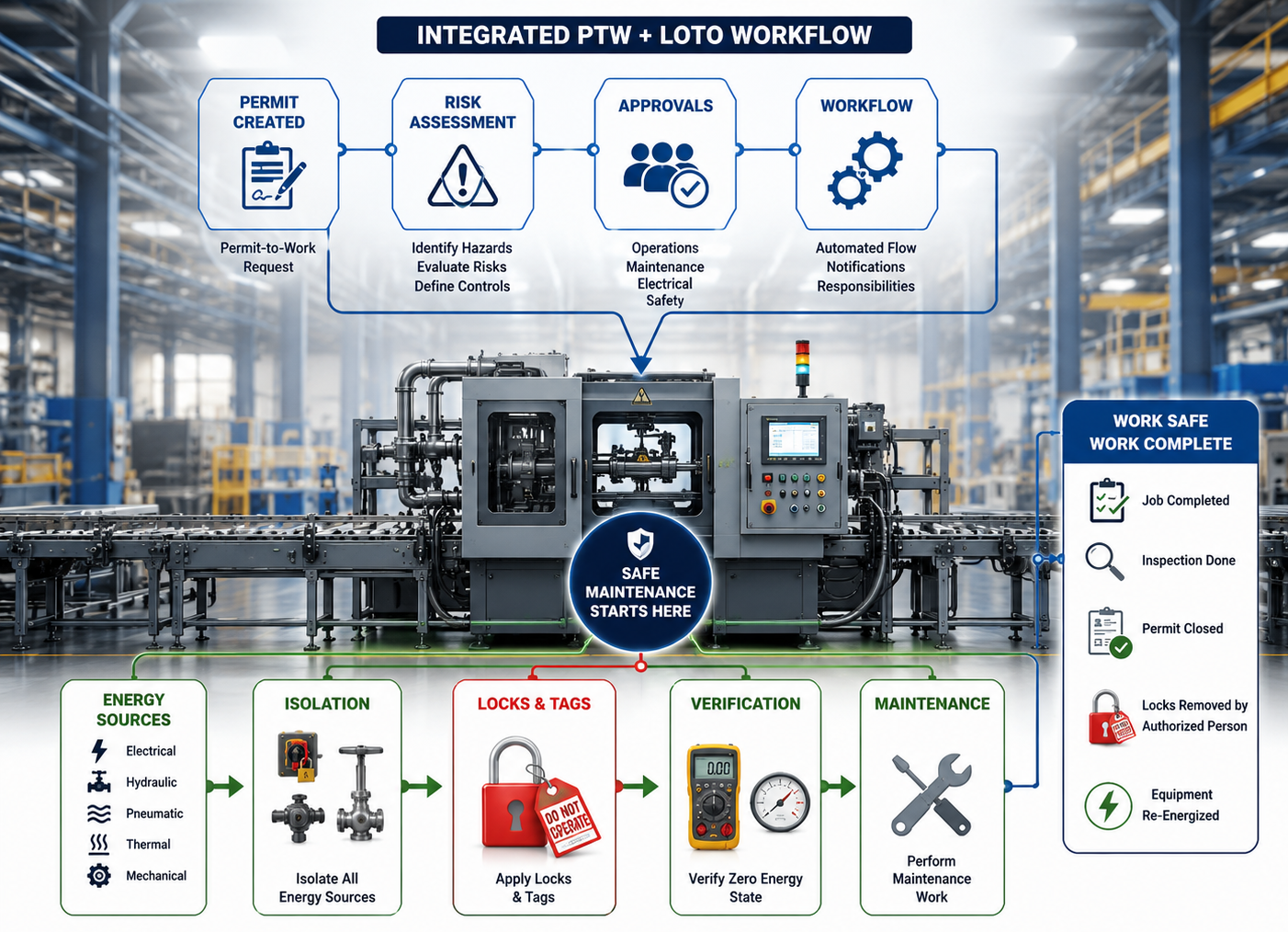
Integrated Lockout Tagout and Permit-to-Work Workflow
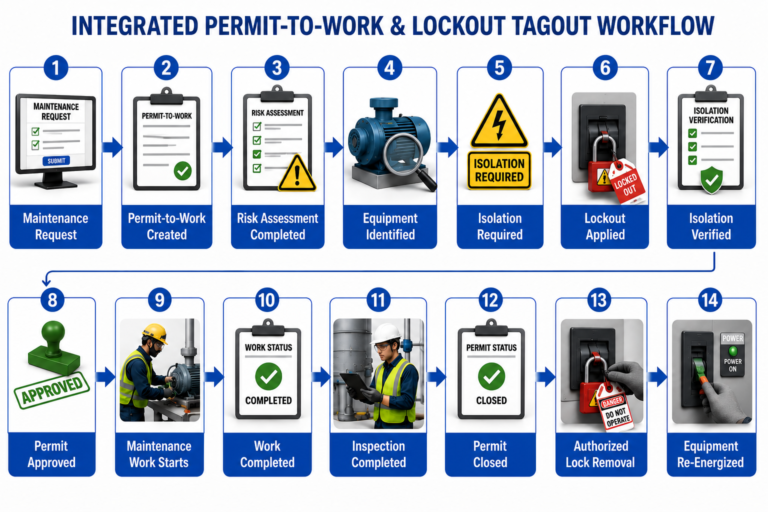
Maintenance Request
A maintenance request initiates the workflow and automatically triggers the Permit to Work (PTW) process instead of allowing both processes to start independently.
Risk Assessment
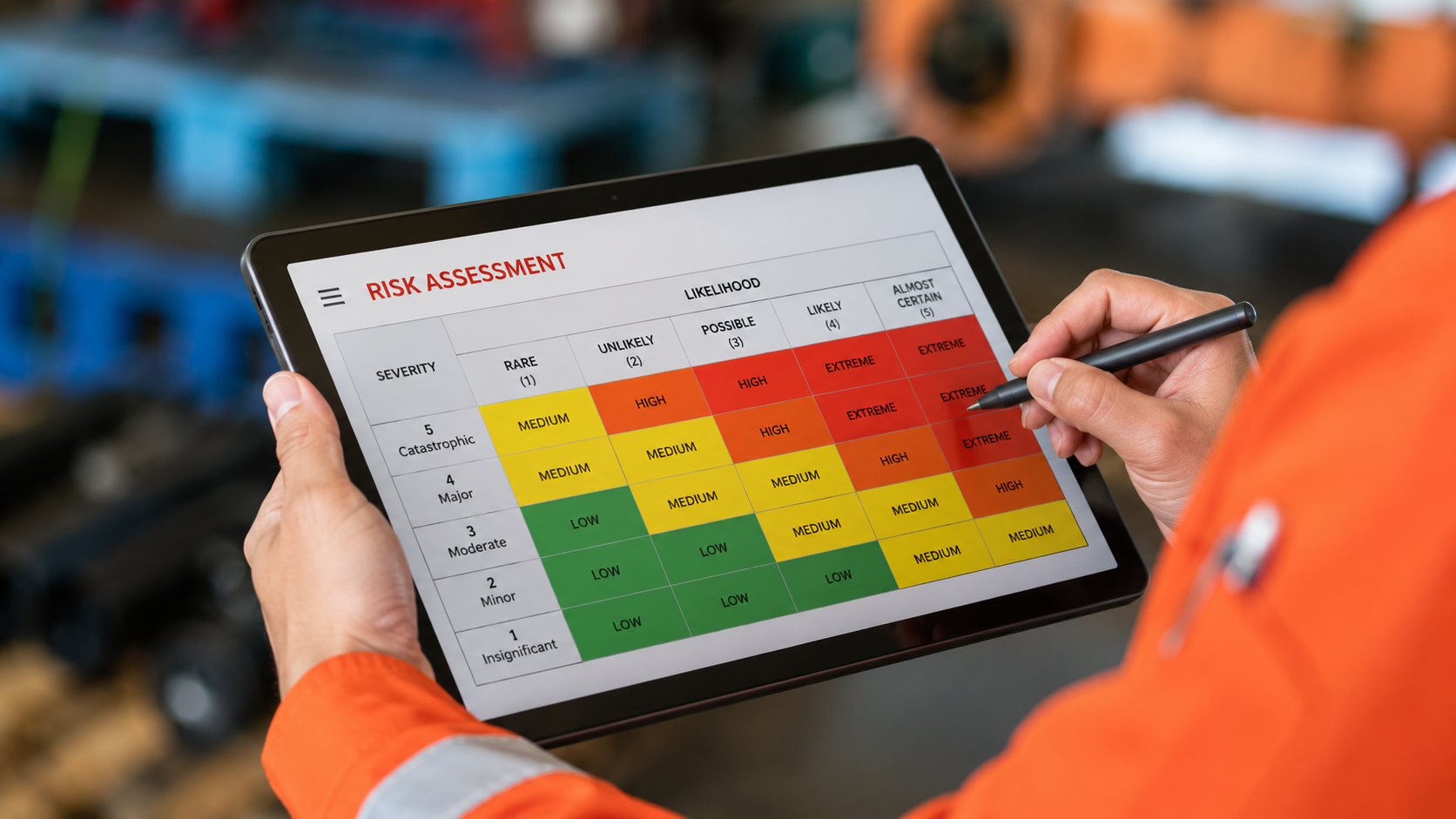
A risk assessment is completed to identify hazards, assess risks, and determine the necessary control measures before work begins.
Equipment Identification
The correct equipment and all associated hazardous energy sources are identified to ensure the right asset is isolated.
Energy Isolation
All applicable energy sources are isolated using the appropriate isolation devices before maintenance activities start.
Lockout Applied
Authorized personnel apply locks and tags to isolation points to prevent accidental or unauthorized equipment energization.
Isolation Verified
Isolation is verified by confirming that all hazardous energy has been fully de-energized before work is authorized.
Permit Approved
The permit is approved only after successful verification of energy isolation and completion of all required safety checks.
Maintenance Work
Maintenance activities begin only after the permit has been approved and the equipment has been confirmed safe to work on.
Inspection Completed
A final inspection verifies that the maintenance work has been completed correctly and that the equipment is ready for normal operation.
Permit Closed
The Permit-to-Work is formally closed after confirming that the job has been completed and all safety requirements have been met.
Authorized Lock Removal
Locks and tags are removed only by authorized personnel after permit closure and final approval.
Equipment Re-Energized
Equipment is safely returned to service only after all locks have been removed and every safety verification has been completed.
Organizational Flexibility
Organizations can configure the workflow based on their operational requirements.
LOTO and PTW can operate as a fully integrated process or remain separate and can be connected during critical safety checkpoints.
High-risk industries such as chemical plants, refineries, power generation, and heavy manufacturing generally benefit from complete LOTO and PTW integration.
Integrated workflows reduce manual handoffs between departments.
A single digital workflow minimizes communication gaps and human errors.
Centralized records provide a single source of truth for permits, energy isolation, approvals, and maintenance activities.
Integration improves visibility, accountability, audit readiness, and overall maintenance safety.
Key Features That Enable Seamless LOTO and PTW Integration
A few core features consistently make the difference between Lockout Tagout Software that looks good on paper and one that actually holds up on the shop floor:
• A digital lock register that tracks every lock, tag, and lockbox in use across the facility
• Permit-linked isolation records so no lockout event exists without a corresponding permit reference
• Role-based approvals that match each organization’s actual chain of authorization
• Digital signatures replacing paper sign-offs at every stage
• QR code equipment verification, allowing field technicians to scan equipment and instantly pull up its isolation history
• Mobile accessibility so isolation steps, permits, and checklists can be completed from the field, not just from an office terminal
• Notifications that alert relevant personnel about approvals, expiries, and pending actions
• Dashboards giving supervisors and management a live view of ongoing work
• A complete audit trail and detailed permit history and lock history for every asset
Beyond these, organizations with an in-house LOTO setup benefit from being able to configure equipment-specific isolation points, custom fixtures, and machine components directly in the system, so the isolation procedure reflects the actual physical layout of that machine rather than a generic template.
Best Practices for Implementing Lockout Tagout Software with Permit to Work
Getting the most out of Lockout Tagout Software depends on how it is set up and used, not just the platform itself. A few practices consistently separate facilities that get real value from those that struggle:
Standardizing procedures across shifts and departments removes the guesswork behind inconsistent isolation. Clearly defining approval stages in advance, rather than figuring them out mid-shutdown, keeps the workflow moving. Maintaining detailed isolation records for every job builds the historical base that makes future audits far easier. Contractor training and employee training on the specific digital process used at a site, not just general LOTO awareness, prevents the exact confusion described earlier, where visiting contractors do not know the local permit steps.
Periodic reviews help catch bottlenecks or approval stages that no longer fit changing operations. Requiring digital verification before every approval, rather than allowing exceptions “just this once,” keeps the system trustworthy. Monitoring permits and locks in real time, rather than only at shift change, turns a dashboard from a reporting tool into an active safety control.
Conclusion
Permit-to-Work and Lockout Tagout were never meant to function as two separate systems for high-risk maintenance work. A permit that authorizes a job without confirmed isolation is incomplete, and isolation carried out without a formal permit lacks the oversight and accountability that safety programs are built on. Bringing both processes into one connected workflow closes the exact gaps that cause real incidents: unclear energy status, delayed approvals, unauthorized lock removal, and audit trails that take days to reconstruct instead of minutes.
An integrated Lockout Tagout Software approach gives maintenance teams, safety officers, and plant managers a single, reliable view of every isolation and permit in progress. Accountability improves because every action carries a name and a timestamp, audits become a matter of pulling a report rather than chasing down paper, and maintenance planning improves as historical data builds up over time.
For industries where hazardous energy is a daily reality manufacturing, chemical processing, oil and gas, power generation, cement, steel, and mining, treating hazardous energy isolation and permit authorization as one connected process is not an added convenience. It is a practical response to how these accidents actually happen, and it reflects what the underlying safety standards have been pointing toward all along.