Introduction
Visitor Management has moved from a reception-desk formality to a frontline safety and security discipline inside manufacturing plants, factories, and industrial facilities. Every gate that opens for a client, vendor, contractor, auditor, delivery agent, interview candidate, or government inspector introduces a new variable into a controlled industrial environment, and that variable carries operational, safety, and compliance consequences if it is not tracked properly. As facilities expand, contractor headcounts grow, and regulatory scrutiny tightens, workplace security has become a board-level concern rather than a receptionist’s responsibility.
Manual visitor books, handwritten passes, and verbal approvals were tolerable when facilities were small and visitor volumes were low, but they collapsed under the weight of multi-gate campuses, layered access zones, and audit-ready documentation requirements. This article examines the recurring visitor management challenges that manufacturing, automobile, pharmaceutical, chemical, logistics, and heavy-engineering facilities encounter, and explains, problem by problem, how purpose-built software resolves each one while strengthening overall industrial safety, from digital reception at the gate to structured Visitor Safety Management across every zone of a plant.
Why Visitor Management Has Become More Complex
- Multiple Factory Gates: Modern manufacturing facilities often operate through several entry points, including raw material gates, finished goods dispatch gates, employee entrances, and dedicated visitor reception areas. Each gate requires its own verification, authorization, and visitor logging process.
- Increasing Contractor Workforce: During plant shutdowns, maintenance activities, expansions, or annual turnarounds, contractors can outnumber permanent employees. Every contractor must be tracked with the same level of accuracy and accountability as external visitors.
- Sensitive Production Areas: Manufacturing plants contain restricted zones such as hazardous chemical storage, high-value production lines, R&D facilities, and heavy machinery areas. Access must be granted only to authorized individuals based on predefined permissions.
- Rising Compliance and Audit Requirements: ISO standards, inspections, customer audits and internal EHS policies requires organizations to maintain accurate data of who entered the facility, when they entered, why they visited, and who approved their access.
- Emergency Preparedness and Accountability: Effective emergency response depends on having an accurate, real-time record of everyone present on-site. Visitor accountability is now an essential part of evacuation planning, emergency headcounts, and workplace safety.
- Challenges of Multi-Location Manufacturing Operations: Organizations operating multiple plants often follow different visitor registration processes at each location. Standardizing visitor management across all facilities becomes difficult without a centralized digital system.
- Digital Transformation in EHS and Facility Management: Traditional paper registers and isolated manual processes are being replaced by integrated digital platforms that provide centralized records, automated workflows, real-time monitoring, and complete audit trails.
- Visitor Management Has Evolved Beyond Reception: What was once considered a simple reception task has become a strategic business function involving factory visitor management, industrial visitor management, and plant visitor management to strengthen workplace security, compliance, and operational efficiency.
Common Visitor Management Challenges And How Software Solves It
Slow Manual Visitor Registration
Challenges
- Long queues form at gates during shift-change hours
- Reception staff re-enter the same details on multiple registers
- Walk-ins and pre-scheduled guests share one slow queue
- Peak-hour arrivals overwhelm a single reception desk
How Software Solves It
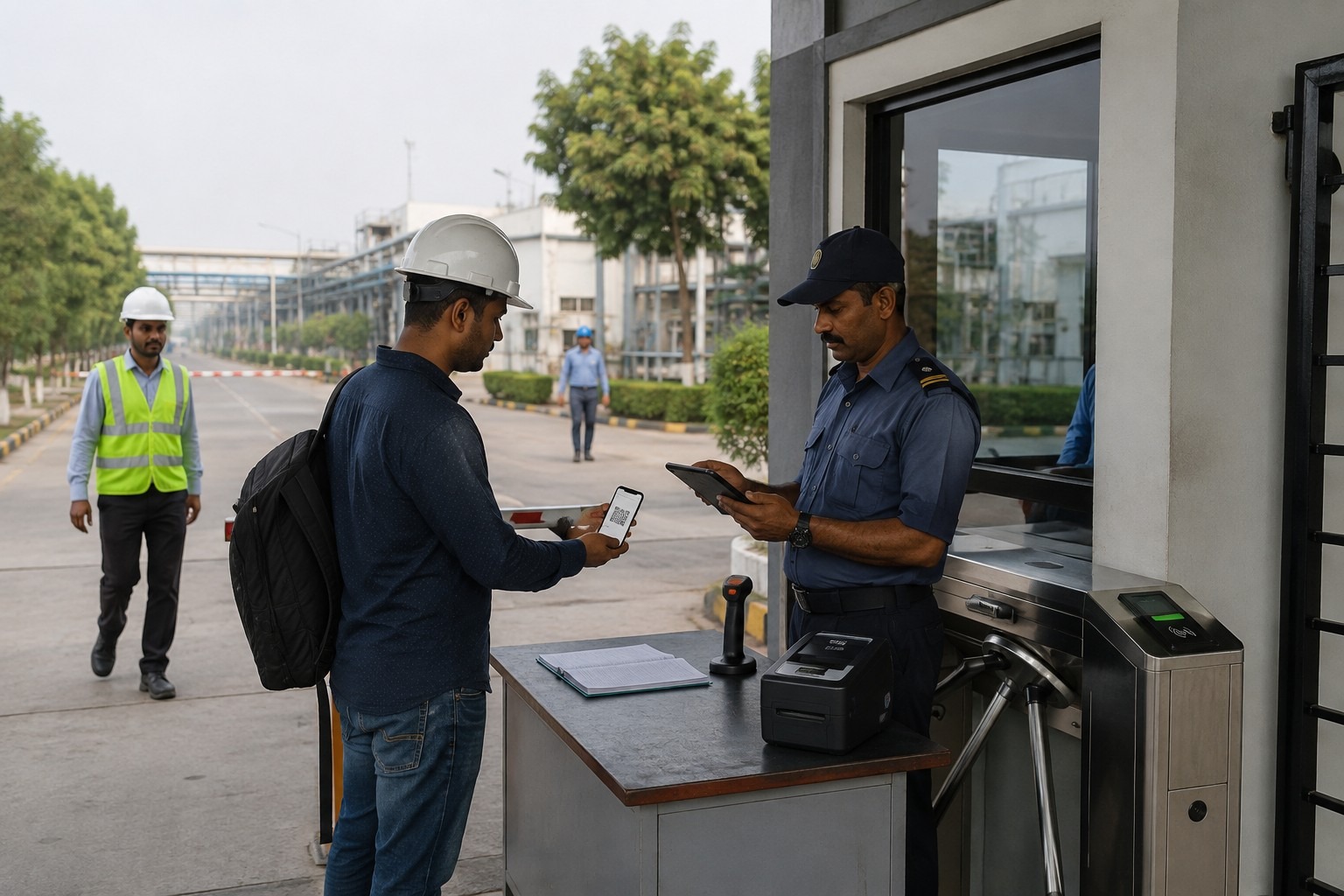
A Visitor Registration Software platform replaces paper registers with self-service kiosks, tablet-based forms, and QR code scanning for faster digital check-ins. The process begins with appointment scheduling and pre-registration, where hosts add visitor details in advance and send QR code invitations via email or SMS.
On arrival, visitors scan the QR code for quick check-in or complete digital registration on a kiosk as walk-ins. Photo capture and government ID verification happen automatically, while host notifications eliminate manual calls. Both pre-registered and walk-in visitors are managed through one digital interface, allowing reception teams to handle all visitors efficiently.
For manufacturing facilities with multiple gates, visitor tracking software ensures consistent registration across locations, supports multi-site deployment, and works on both mobile devices and fixed kiosks through cloud deployment. Faster registration reduces gate congestion, improves security during audits and contractor mobilization, and automatically logs every visitor event for audit reports enhancing both compliance and operational efficiency.
No Proper Visitor Safety Induction
Challenges
- Visitors enter production floors unaware of local hazards
- Induction quality depends on whoever is free at reception
- Contractors often skip facility-specific safety briefings
- No consistent record shows induction actually happened
- PPE and hazard points are explained verbally, if at all
How Software Solves It
Digital visitor induction software makes safety induction a mandatory part of check-in by presenting induction videos and hazard information before badge printing. After digital visitor registration, visitors must complete and accept the safety induction on a kiosk or mobile device before entry is approved.
The same process supports contractor induction, ensuring short-term workers receive the same site-specific briefing. Every acknowledgement is timestamped and stored with the visitor’s record, creating a verifiable compliance log. Badge printing and access card activation occur only after induction is completed, making entry conditional on safety compliance.
Host notifications alert hosts if induction is incomplete, preventing manual overrides. The acknowledgment also records into audit reports, providing proof of safety onboarding for clients and regulatory inspections.
Poor Visitor Identity Verification
Challenges
- Verification depends entirely on a guard’s judgment
- Fake or borrowed identities can go unnoticed
- ID numbers are transcribed by hand, inviting errors
- No consistent standard applies across different gates
- Repeated visitors are verified from start every time
How Software Solves It
Government ID verification and live photo capture at entry create a secure digital identity record. During digital visitor registration, the visitor’s ID is scanned or photographed, a live photo is captured, and both are linked to the visitor’s badge, enabling instant identity verification.
The centrally stored record is recognized across all factory gates, ensuring consistent industrial access control. Host notifications and approval workflows ensure badges are issued only after the visitor entry is approved.
For manufacturing sites, the same record supports contractor management by identifying returning contractors without recollecting documents. Encrypted, access-controlled data replaces paper records and feeds automatic audit reports, providing proof of who was verified, when, and by what method.
Lack of Real-Time Visitor Tracking
Challenges
- No live count of visitors currently on-site
- Exits often go unrecorded in paper logs
- Contractor movement between gates is hard to trace
- Assembly-point headcounts can’t be checked against a visitor list
- Shift supervisors rely on outdated morning tallies
How Software Solves It
Visitor Tracking Software provides a live dashboard that updates with every check-in and check-out, delivering an accurate real-time occupancy count. QR code check-in, digital visitor registration, and visitor check-out automatically update visitor numbers without manual counting.
Zone-based access permissions show where visitors are authorized to be, strengthening Visitor Access Control, while visitor analytics identify peak arrival times and frequently visited zones to improve staffing. Multi-location support displays occupancy across multiple plants in one dashboard, and mobile access lets safety officers monitor live counts anywhere.
Automatic audit reports record every check-in and check-out, allowing any difference between the live dashboard headcount management and a physical way to be traced to a specific visitor record.
Security Risks and Unauthorized Access
Challenges
- Tailgating lets unregistered individuals slip through gates
- Visitors wander into restricted production areas unchecked
- No structured approval step before badges are issued
- Access rules aren’t tied to a visitor’s actual purpose
- Breaches are hard to reconstruct after the fact
How Software Solves It
A Visitor Access module uses a structured approval workflow that requires host authorization before a badge is issued. After approval through host notifications, the system handles badge printing and access card activation, with role-based permissions defining access for clients, contractors, and auditors.
Zone-based access ensures badges unlock only approved doors and areas, preventing unauthorized movement. The same rules apply to contractor management, while every approval, badge activation, and zone entry is automatically logged to create an audit-ready record.
Real-time visitor tracking alerts security if someone enters an unauthorized zone. For multi-location operations, role-based and zone-based rules remain consistent across all sites, while emergency evacuation reports use the same access data to provide documented proof of visitor movement during audits or regulatory inspections.
Manual Visitor Pass Management
Challenges
- Handwritten slips are easily lost or duplicated
- Passes carry no verifiable link to visitor records
- Expired passes are rarely collected or invalidated
- Badge details can’t be confirmed at a glance
- Reissuing a lost pass means starting over manually
How Software Solves It
Visitor Pass Management replaces handwritten slips with a digital badge generated after check-in and any required approval workflow. Visitor badge printing creates a QR code visitor pass, or a digital pass can be sent to a visitor’s phone. Both are time-bound and expire automatically after the scheduled visit.
Each badge is linked to the visitor’s record, allowing security to view the visitor’s photo, approved zones, host, and government ID verification. Access card activation enables only authorized entry and automatically disables expired or checked-out badges.
Lost badges can be deactivated and replaced without recreating the visit. The system also supports contractor management with longer-validity badges while ensuring scheduled expiry. Every badge event, from printing to deactivation, is logged for audit reports, providing a complete and verifiable pass history.
Poor Compliance Documentation
Challenges
- Historical visitor records are rarely complete or legible
- Paper registers are not preserved for long periods
- Auditors ask for proof that doesn’t exist in usable form
- Filtering old records by date or host isn’t possible
- Compliance prep means manually searching stacks of registers
How Software Solves It
A digital audit trail automatically records every digital visitor registration, approval, and check-out with timestamps, eliminating separate manual logs. Centrally stored records can be searched instantly by date, host, visitor type, or zone.
Audit reports can be generated for any period, including government ID verification, safety induction acceptance, and PPE declarations. Real-time dashboards provide continuous compliance visibility, while cloud deployment ensures consistent reporting across multiple locations.
Data security protects visitor information, including photo capture and ID records, with secure storage and controlled access. This keeps facilities continuously audit-ready with searchable, exportable records for client and regulatory inspections.
No Emergency Visitor Accountability
Challenges
- Emergencies expose no reliable list of who is on-site
- Assembly-point headcounts can’t be checked quickly
- Paper registers may be inaccessible during an evacuation
- Visitors’ last-known locations are usually unknown
- Security teams have no automated way to raise the alarm
How Software Solves It
Emergency visitor tracking instantly generates an evacuation list showing all checked-in visitors, their last-known zone from real-time visitor tracking, and their host. Since the system continuously records digital visitor registration, QR code check-in, and check-out events, the list always reflects who is actually on-site.
Automated emergency notifications provide security teams with the live visitor list on mobile devices, while zone-based access data helps identify each visitor’s last recorded location. Contractor management records are included to ensure all workers are accounted for.
With mobile accessibility and cloud deployment, safety officers can access the evacuation list at assembly points even if reception systems are unavailable. The entire event is logged in audit reports to support post-incident reviews and future emergency planning.
Poor PPE Compliance for Visitors
Challenges
- Visitors arrive without helmets, vests, or safety shoes
- PPE requirements often go unenforced at the gate
- No record confirms a visitor was made aware of requirements
- Facility-issued gear isn’t tracked or reliably returned
- Contractors face higher risk from unfamiliar site hazards
How Software Solves It
A mandatory PPE declaration is integrated into the digital safety induction, requiring visitors to confirm they have the required PPE or collect it before badge printing and access card activation. The declaration is timestamped with the visitor’s safety induction record.
The system can track issued PPE, such as helmets and safety vests, against the visitor’s badge and verify its return during visitor check-out. It also supports contractor management, allowing PPE declarations to remain valid for longer engagements.
Host notifications alert hosts if a PPE declaration is incomplete, while role-based permissions enforce stricter PPE requirements for higher-risk zones. Every declaration and equipment record is included in audit reports, providing EHS teams with a complete history of PPE compliance for visitors and contractors.
Inefficient Communication with Hosts
Challenges
- Reception repeatedly calls staff to confirm arrivals
- Hosts several buildings away cause long visitor waits
- reschedules aren’t communicated in advance
- Approvals require a host to walk to reception
- Visitors are left waiting with no status updates
How Software Solves It
Automatic host notifications are sent by email or SMS as soon as a visitor checks in, eliminating manual calls from reception. With mobile accessibility, hosts can review visitor details, including photo capture and visit purpose, and complete the approval workflow from their phones.
Appointment scheduling and pre-registration generate QR code invitations and notify reception of expected visitors. Host reminders reduce no-shows, while rescheduled visits are updated instantly for reception.
A real-time dashboard tracks pending approvals across multiple hosts, and the same notification and approval process works across multi-location sites. All notifications and approvals are recorded in audit reports, providing a complete history of response times and visit authorizations.
Health Screening During Critical Situations
Challenges
- No structured way to capture visitor health declarations
- Temperature and symptom checks are inconsistent or skipped
- Contact tracing after an incident is slow and manual
- High-touch check-in points increase exposure risk
- Health protocols vary from one gate to another
How Visitor Solves It
Software-driven health screening adds a health declaration to digital visitor registration, capturing symptom checks, temperature, or vaccination status during QR code check-in. Combined with contactless kiosks, it reduces shared touchpoints while maintaining screening standards.
Health data is securely stored with government ID verification and photo capture, enabling real-time visitor tracking and audit reports for fast contact tracing after a health or safety incident. Host notifications and approval workflows can automatically flag visitors who do not meet site health requirements.
With multi-location support and cloud deployment, health screening rules are applied consistently across all sites and updated centrally, ensuring ongoing readiness for illness screening and future contact-tracing needs.
Key Features Every Modern Visitor Management Software Must Have to Overcome These Challenges
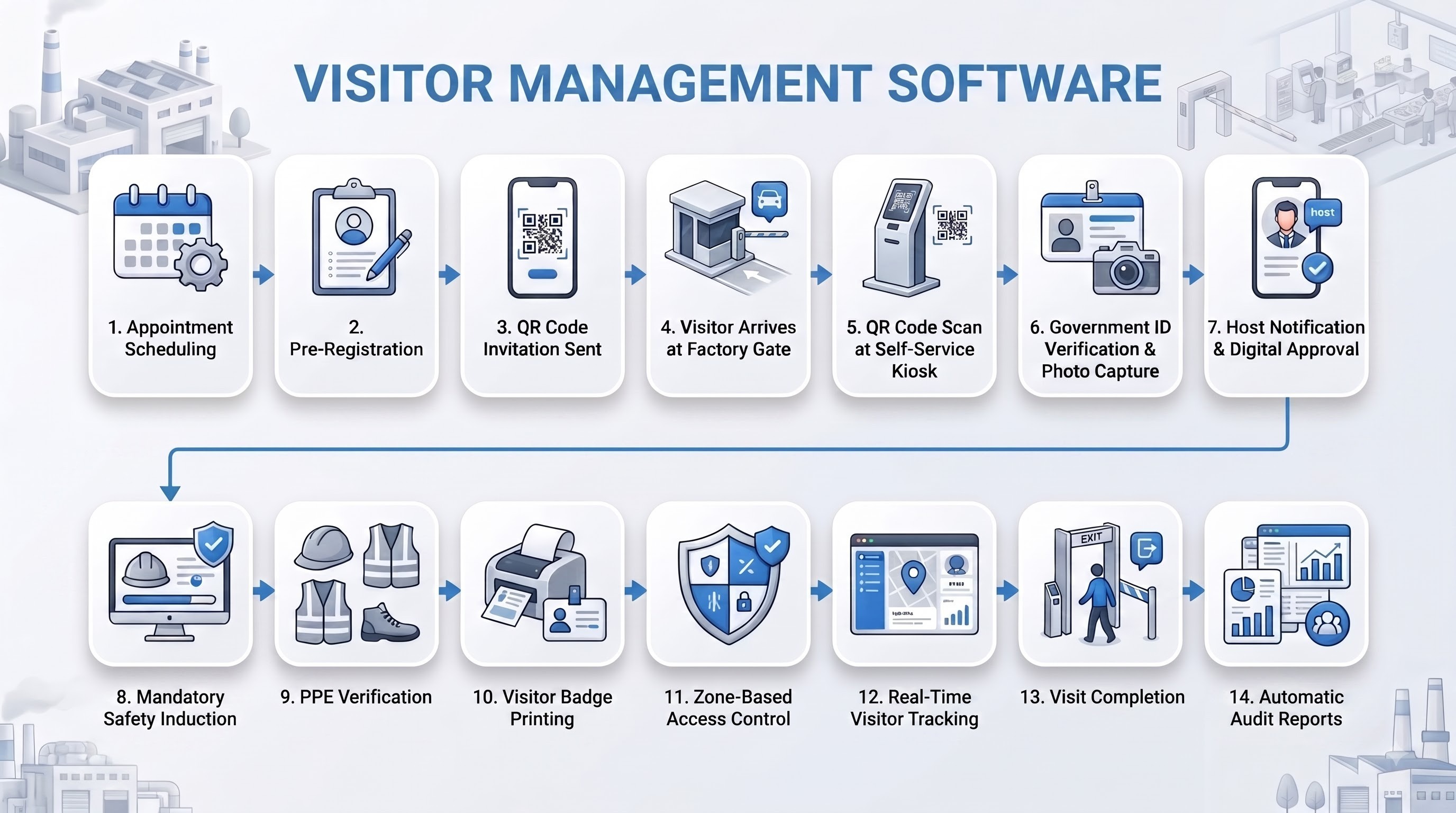
- Digital Visitor Registration: Eliminates manual paperwork by allowing visitors to register digitally through kiosks, tablets, or mobile devices.
- Appointment Scheduling: Enables hosts to pre-schedule visitor appointments, reducing reception delays and improving entry planning.
- QR Code Invitations: Sends secure QR codes before the visit, allowing faster and contactless check-in at the factory gate.
- Photo Capture and Government ID Verification: Verifies visitor identity by capturing photographs and validating government-issued identification for enhanced security.
- Visitor Badge Printing and Management: Automatically generates visitor badges linked to the software database, making visitor identification simple and preventing duplicate or unauthorized passes.
- Visitor Pass Management: Creates digital or printed visitor passes with predefined validity periods and access permissions.
- Host Notifications and Approval Workflow: Instantly notifies hosts through email, SMS, or mobile applications, allowing quick approvals before granting facility access.
- Real-Time Visitor Tracking: Monitors visitor check-in, check-out, live occupancy, and movement within the facility for complete visibility.
- Visitor Analytics and Dashboard: Provides real-time insights into visitor trends, peak visiting hours, frequent visitors, and occupancy statistics through an interactive dashboard.
- Contractor Visitor Management: Tracks contractors separately, manages recurring visits, maintains compliance records, and simplifies contractor entry across multiple manufacturing sites.
- Digital Safety Induction: Delivers mandatory safety induction before entry and records the visitor’s digital acceptance to ensure compliance with workplace safety requirements.
- Emergency Headcount and Evacuation Reports: Generates real-time visitor lists and headcount reports to support faster evacuation and emergency response.
- Role-Based Permissions and Visitor Access Control: Restricts visitor access to authorized departments or production zones using secure access cards and predefined permissions.
- Multi-Location Support: Centralizes visitor management across multiple factories, plants, and business locations from a single platform.
- Cloud Deployment and Mobile Accessibility: Allows authorized personnel to monitor, approve, and manage visitors from any location using cloud-based access and mobile devices.
- Audit Reports and Compliance Documentation: Maintains searchable digital records and automatically generates audit-ready reports for regulatory inspections and internal compliance reviews.
- Data Security: Protects visitor information through secure data storage, role-based access controls, and encrypted records.
- Headcount Management: Continuously updates the number of visitors, contractors, and employees present on-site to improve operational visibility and emergency preparedness.
Future Trends in Visitor Management
The next phase of visitor management is being shaped by artificial intelligence and connected hardware working together rather than as separate add-ons. AI-powered visitor verification and facial recognition are increasingly used for repeat visitors and contractors, cutting check-in time to a glance while reducing the data-entry fraud that manual systems were prone to.
Fully contactless visitor check-in through mobile visitor passes is becoming the default expectation rather than a premium feature, particularly as facilities look to reduce shared touchpoints at reception. IoT-enabled access control is beginning to link directly with turnstiles, boom barriers, and elevator systems, so a verified visitor badge can trigger physical access without manual intervention from security staff.
Cloud visitor management platforms are replacing on-premise servers, giving multi-location organizations a single source of truth across every plant. Predictive visitor analytics, which flag unusual visit patterns or repeated access requests to sensitive zones, are starting to feed into broader security intelligence. As smart factories and Industry 4.0 initiatives mature, visitor and contractor movement data is increasingly expected to integrate with the same digital backbone that already governs production, safety, and asset monitoring systems.
Conclusion
Manual visitor handling was never designed for the scale, complexity, and compliance burden that modern manufacturing facilities now operate under, and the gaps it leaves behind touch security, safety, operations, and audit readiness all at once. A well-implemented Visitor Management resolves these gaps methodically: registration becomes instant rather than a queue-inducing bottleneck, identity verification becomes reliable rather than dependent on a single guard’s judgment, and access control becomes precise rather than a locked door that anyone with a badge can walk through.
Safety induction is enforced consistently instead of skipped under time pressure, compliance documentation becomes searchable rather than buried in a drawer of old registers, and emergency preparedness gains the real-time headcount accuracy that can make the difference during an actual evacuation. Facilities across aerospace, automotive, pharmaceutical, chemical, and logistics sectors are already demonstrating that this shift is not a convenience upgrade but a baseline operational requirement, particularly as visitor management system India deployments continue to expand across multi-location industrial groups. Facilities still relying on paper registers and verbal approvals are carrying a level of security, safety, and audit exposure that is increasingly difficult to justify when a mature, cloud-based alternative is readily available.
Adopting a modern smart visitor management platform is, at this point, one of the more straightforward steps a manufacturing organization can take to close a genuine gap in its industrial workplace security and compliance posture.