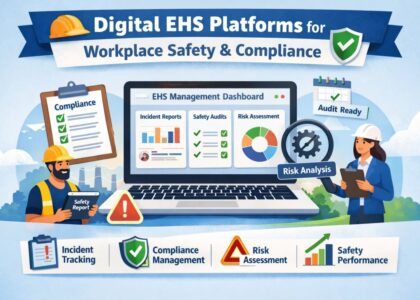
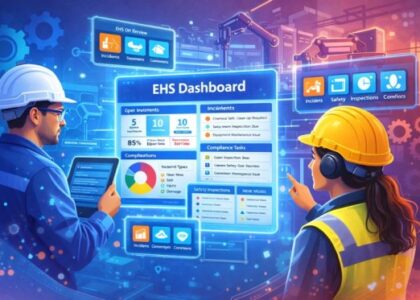
Workplace safety has always been a priority for industries, but the way organizations manage safety is changing rapidly. Traditional Environment, Health, and Safety (EHS) systems depend heavily on manual reporting, paperwork, and reactive actions. In contrast, AI Powered EHS Software introduces intelligence, automation, and predictive insights that help organizations prevent incidents before they happen.
As industries face increasing regulatory pressure, complex operations, and a growing workforce, AI-powered EHS platforms are becoming a necessity rather than a luxury.
What Is AI Powered EHS Software?
AI-based EHS software uses artificial intelligence, machine learning, and data analytics to enhance workplace safety management. Unlike conventional EHS tools that store and display data, AI-driven systems analyze patterns, predict risks, and recommend corrective actions in real time.
These systems continuously learn from:
-
Incident records
-
Near-miss reports
-
Safety audits
-
Permit to Work data
-
Behavioral safety observations
The result is a proactive safety ecosystem that evolves with your operations.
Why Traditional EHS Systems Are No Longer Enough
Many organizations still rely on spreadsheets, paper forms, or basic digital tools for safety management. While these systems may record incidents, they fail to identify hidden risks or future hazards.
Common challenges with traditional EHS systems include:
-
Delayed incident reporting
-
Limited root cause analysis
-
No predictive risk visibility
-
Manual compliance tracking
-
Reactive safety decisions
AI-based EHS software addresses these gaps by turning safety data into actionable intelligence.
Key Features of AI-Based EHS Software
1. Predictive Risk Identification
AI algorithms analyze historical data to identify patterns that indicate potential accidents. For example, repeated near-miss reports in a specific area can trigger early risk alerts.
2. Intelligent Incident Analysis
AI supports advanced root cause analysis methods such as 5 Why, Fishbone, and FMEA, helping safety teams identify systemic issues instead of surface-level causes.
3. Automated Compliance Monitoring
AI systems continuously track compliance with regulations like ISO 45001, OSHA, and local safety standards, reducing the risk of non-compliance penalties.
4. Smart Corrective and Preventive Actions (CAPA)
Based on incident trends, AI recommends targeted corrective actions and monitors their effectiveness over time.
5. Real-Time Dashboards and Alerts
AI-driven dashboards provide live insights into safety performance, high-risk zones, and safety KPIs, enabling faster decision-making.
| Aspect | Traditional EHS Software | AI-Based EHS Software |
|---|---|---|
| Risk Management | Reactive | Predictive & proactive |
| Incident Analysis | Manual investigation | AI-driven root cause analysis |
| Compliance Tracking | Periodic audits | Continuous monitoring |
| Decision Making | Based on past events | Data-driven predictions |
| Reporting | Static reports | Dynamic insights & trends |
| Scalability | Limited | Highly scalable |
This comparison highlights how AI transforms safety management from damage control to prevention.
AI-Based EHS Software vs Manual Safety Processes
| Area | Manual Safety Process | AI-Based EHS System |
|---|---|---|
| Reporting Speed | Delayed | Instant mobile reporting |
| Data Accuracy | Error-prone | High accuracy |
| Risk Visibility | Limited | Real-time insights |
| Workforce Engagement | Low | High via smart alerts |
| Cost Efficiency | High operational cost | Optimized safety spend |
Manual systems struggle to keep up with modern industrial complexity, while AI-based platforms adapt continuously.
Real-World Benefits of AI Powered EHS Software
Organizations using AI-driven platforms such as EHS4Safety experience measurable improvements in workplace safety, compliance, and operational efficiency through predictive safety strategies.
Predictive Risk Identification
Identify hidden patterns in near-miss and audit data to prevent incidents before they happen, moving from damage control to prevention.
Automated Compliance
Continuously track compliance with ISO 45001 and OSHA. Stay perpetually audit-ready with automated tracking and verification.
Enhanced Safety Culture
Improve accountability through behavioral safety observations and smart alerts, fostering a proactive safety ecosystem.
Safety Professional's Note: AI does not replace safety professionals—it strengthens their ability to make informed, life-saving decisions by turning data into intelligence.
Why EHS4Safety Is a Smart Choice
EHS4Safety combines AI-driven intelligence with practical industry workflows, helping organizations move beyond compliance toward continuous safety improvement. Its modular design supports incident management, permit to work, audits, risk assessment, and compliance—all within a single platform. By adopting AI-based EHS software, organizations are not just implementing technology; they are building a sustainable safety culture.
Conclusion
AI-based EHS software is reshaping workplace safety by shifting the focus from reaction to prevention. With intelligent insights, predictive risk analysis, and automated compliance tracking, platforms like EHS4Safety enable organizations to protect their workforce more effectively. For companies looking to enhance safety performance, reduce incidents, and stay compliant, AI-driven EHS solutions are no longer optional—they are essential.