Industrial facilities operate in a state of continuous modification. Equipment is upgraded, chemical suppliers are substituted, process parameters are adjusted, and procedures are revised to reflect new regulatory requirements or operational lessons. Each of these modifications, regardless of how routine it appears, can introduce new hazards when it is not formally evaluated before implementation. This is the context in which management of change software has become a critical tool for EHS professionals and operations leaders across high-risk industries.
Management of change software addresses the structural limitations of manual MOC processes by providing a centralized platform that captures every change request, routes it through risk assessment and approval stages, and generates an auditable record that supports both internal accountability and regulatory compliance.
What Is Management of Change (MOC)?
Management of change is a formal discipline used to evaluate, approve, and document modifications to equipment, processes, materials, procedures, or organizational structure before those modifications take effect. The objective is to ensure no change is implemented without a prior assessment of its potential impact on safety, compliance, product quality, and operational integrity.
A key distinction in MOC practice is the difference between a genuine change and a replacement in kind. Replacing a pump with an identical unit is a replacement in kind and falls outside MOC scope. Replacing it with a unit that operates at a different pressure rating or requires a procedure update qualifies as a change requiring formal review. MOC applies across process modifications, equipment changes, procedure revisions, material substitutions, and organizational changes that affect safety-critical functions.
What Is Management of Change Software?
Management of change software automates the workflow, documentation, and record-keeping requirements of the MOC process. Rather than coordinating change reviews through email correspondence or paper sign-off sheets, organizations use the platform to submit, route, assess, approve, and close out every change request within a single system.
The platform serves two functions simultaneously. As a workflow engine, it moves each change request through defined review and approval stages, assigns tasks to the appropriate personnel, and enforces completion requirements before a request advances. As a system of record, it builds a permanent, time-stamped log of every assessment, decision, and approval tied to a given change, providing the auditable evidence that regulators and internal auditors expect to review.
Why Management of Change Software?
Organizations managing MOC through paper forms and email correspondence encounter predictable structural failures. Reviews are completed inconsistently across departments. High-risk changes move forward without full cross-functional input. Mitigation actions identified during risk assessments are recorded but never confirmed complete. When a regulatory inspector requests the MOC record for a specific modification, assembling the evidence from scattered files takes days rather than minutes.
Dedicated MOC software resolves these gaps. It enforces the same procedural standard across every site regardless of local staffing. It routes low-risk changes through an expedited path while applying more rigorous review to high-risk modifications. It gives EHS leadership a live view of every open change request, its current stage, and any overdue items. And it produces records that are complete by design, time-stamped, and retrievable on demand during regulatory inspection. The cost of implementing the platform is fixed and predictable. The cost of a single serious incident traced to an unreviewed change is not.
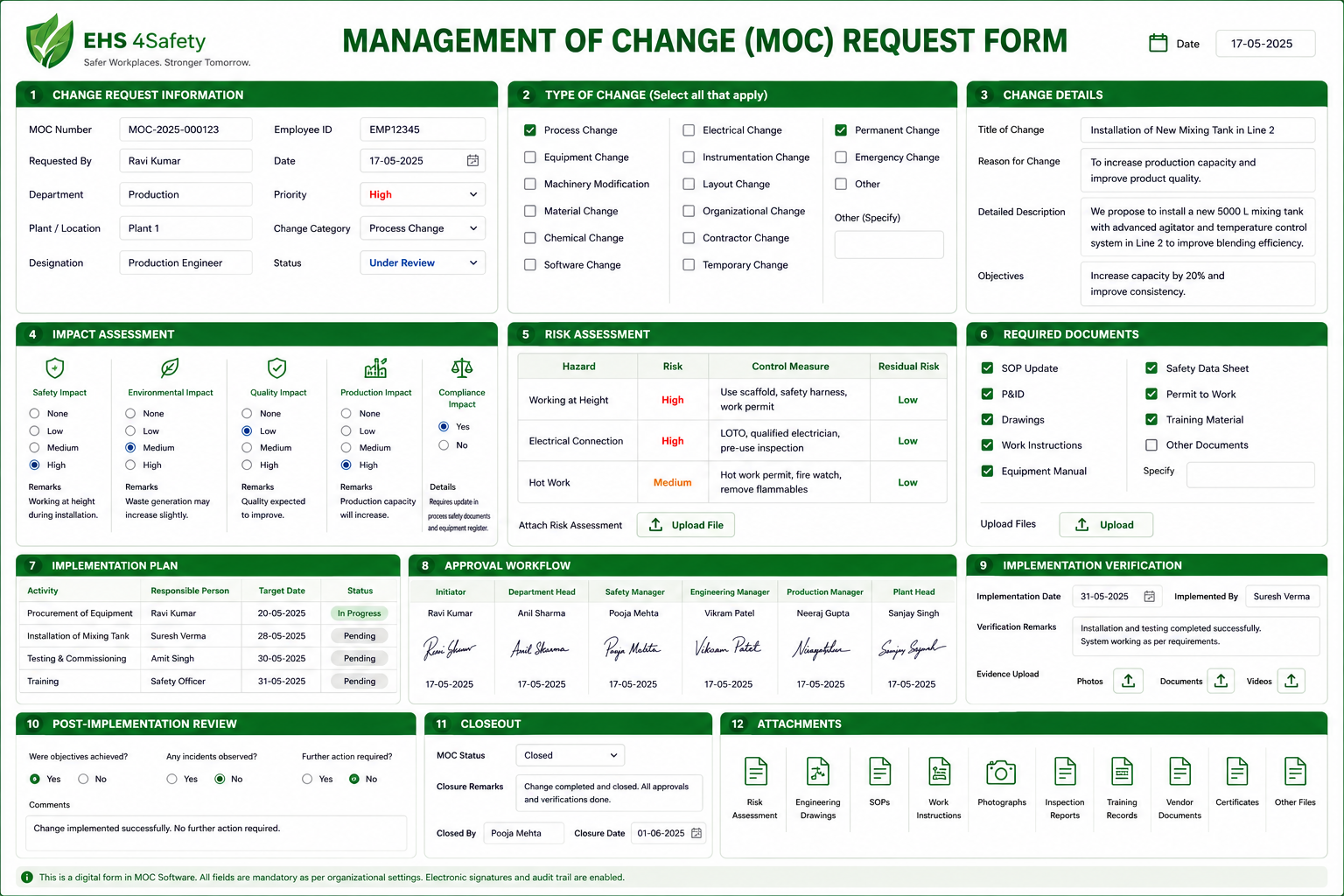
The Change Management Workflow
Most management of change software platforms are structured around a common sequence of stages.
Change Request Initiation
A formal submission through the platform captures the proposed modification, operational justification, affected equipment or process areas, and requester urgency. Digital intake forms standardize this data, eliminating the inconsistency common in paper-based submissions.
Initial Screening
The request is reviewed to confirm it qualifies as an MOC item rather than a replacement in kind, assigned a risk tier, and directed to reviewers with relevant technical expertise.
Risk Assessment
Reviewers work through structured hazard evaluation templates built into the platform, incorporating What-If analysis, checklist-based hazard identification, or HAZOP-style review depending on risk category. Findings and risk scores are captured within the same record rather than external documents.
Cross-Functional Review
MOC software routes each request to all functions with a stake in the outcome, including engineering, maintenance, operations, EHS, and quality assurance. Automated task assignments and escalation reminders prevent requests from stalling between stages.
Approval / Rejection
Designated approvers reach a final determination based on risk assessment findings and reviewer input. The platform enforces the required approval hierarchy, ensuring high-risk changes require authorization from personnel with appropriate technical authority.
Implementation, Verification, and Closeout
Approved changes are executed per the implementation plan, with the platform tracking task completion in real time. Following execution, verification confirms the change was implemented as approved. The record is formally closed once all verification requirements and associated documentation are complete. Organizations that include a post-implementation review stage configure the platform to hold the record open until that review is conducted, typically 30 to 90 days after the change becomes operational.
How MOC Software Improves Safety
The relationship between inadequate change management and industrial incidents is thoroughly documented in process safety literature. MOC software addresses recurring failure modes with structural controls rather than reliance on individual vigilance.
- Enforced risk evaluation: The platform requires a completed risk assessment before any change advances to approval, removing the option to bypass evaluation under schedule pressure.
- Cross-functional hazard identification: Systematic routing to all affected departments surfaces risks that a single reviewer may not recognize from their own technical perspective.
- Procedure and training currency: The software flags when a change requires updates to operating procedures, safety data sheets, or training programs, reducing the likelihood that personnel work from outdated documentation.
- Consistent escalation: Configurable approval hierarchies ensure changes meeting a defined risk threshold require authorization from personnel with appropriate expertise and authority.
- Longitudinal trend analysis: A centralized change history enables EHS leadership to identify recurring hazard categories and change-related near misses that indicate systemic issues warranting broader intervention.
Action Tracking
Risk assessments rarely conclude with an unconditional approval. Reviewers typically identify conditions requiring attention before or alongside implementation: equipment inspection, procedure revision, personnel training, or interim safeguards. These mitigation actions carry value only when someone verifies they have been completed.
Action tracking within MOC software assigns each identified action to the change record, designates an owner and target completion date, and maintains visibility on status until verified closed. The system can be configured to hold a change at closeout until all associated actions are confirmed complete, eliminating the gap where identified risks are documented but never confirmed resolved. Every action remains linked to its originating change record, providing a complete picture for auditors and incident investigators.
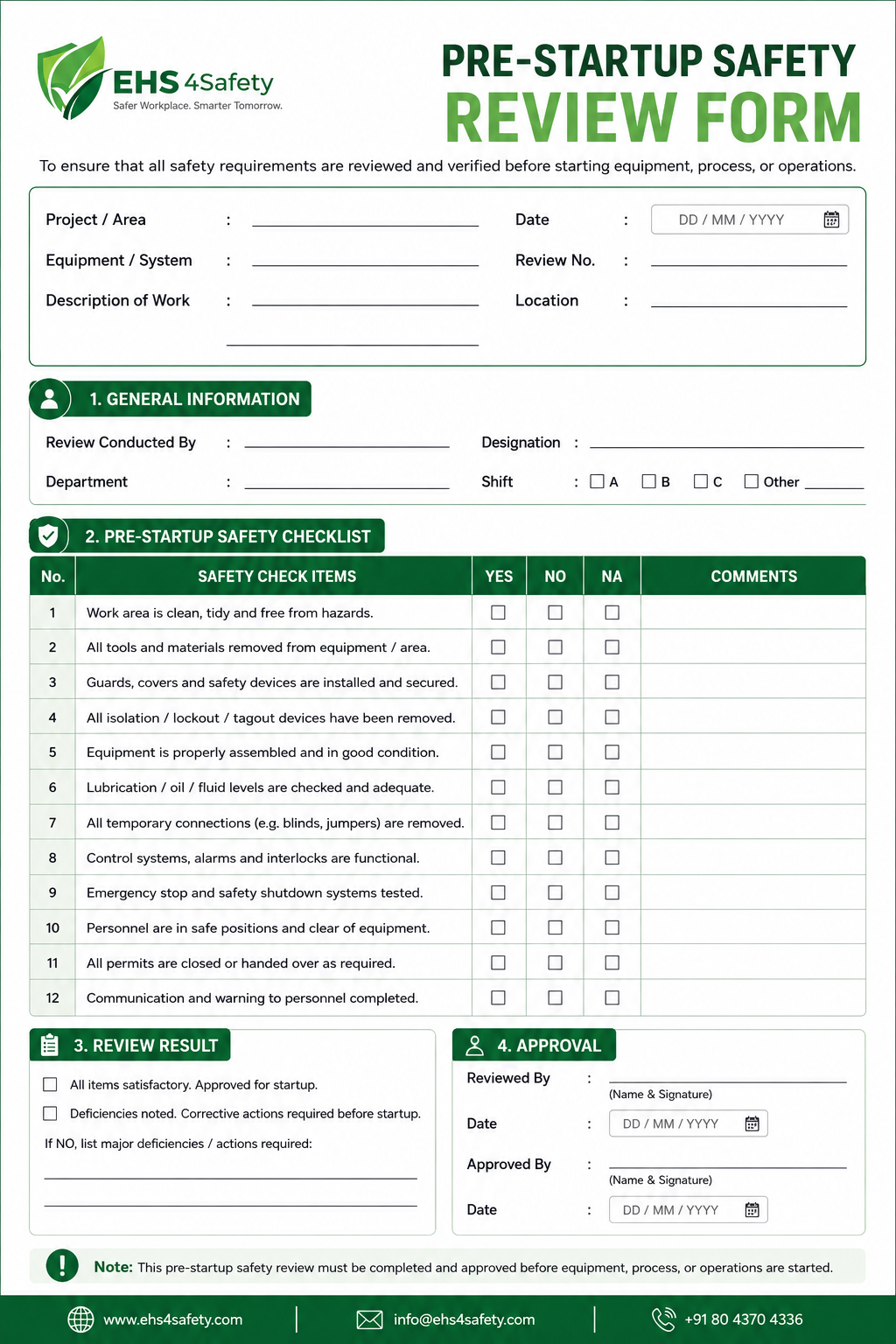
Pre-Startup Safety Review
When a change involves new or significantly modified equipment, a pre-startup safety review confirms that the physical installation matches the approved design, safety systems are functional, procedures have been updated, and affected personnel are trained before the equipment enters service. Under OSHA’s Process Safety Management standard, this review is a specific regulatory requirement for covered processes.
MOC software embeds the pre-startup safety review as a formal workflow stage with a structured checklist and sign-off requirements assigned to qualified personnel. The platform holds the change at this stage until every checklist item is resolved and documented, establishing a defined hold point before startup. When the PSSR is embedded in the same record as the change request, risk assessment, and approval history, every piece of associated documentation is accessible in one location during regulatory inspection.
Regulatory Compliance
Several regulatory frameworks require a documented MOC process or expect organizations to demonstrate that modifications are evaluated before implementation. The table below outlines key requirements and how management of change software supports compliance.
| Regulation | Key MOC Requirements | How MOC Software Supports Compliance |
|---|---|---|
| OSHA 29 CFR 1910.119 (Process Safety Management) | Written MOC procedure required for all non-replacement-in-kind changes. Affected employees and contractors must be trained before startup. MOC records must be retained and available for regulatory inspection. | Enforces a documented workflow for every covered change. Captures training completion within the closeout stage. Maintains a permanent, time-stamped record per change. |
| ISO 45001 (OH&S Management Systems) | OH&S implications of new processes or activities must be assessed before implementation. Risks from planned changes must be managed. Documented information must demonstrate consistent application of change controls. | Integrates structured risk assessment into every change request. Routes changes to OH&S reviewers based on configured workflow. Generates audit-ready records for ISO certification reviews. |
| EU Directive 2012/18/EU (Seveso III) | Safety management systems must include procedures for controlling modifications to installations and processes. Competent authorities must be notified of modifications with major accident implications. Change documentation must be retained as part of the facility safety report. | Captures and evaluates every modification before implementation. Escalates high-risk changes for authority notification. Produces documentation that satisfies competent authority inspection requirements. |
Industries That Benefit Most
- Manufacturing: Controls modifications to production lines, raw material specifications, and equipment configurations, preventing quality deviations and safety incidents tied to undocumented changes.
- Oil and Gas: Supports process safety management programs for onshore and offshore operators managing pressurized systems and hazardous fluid handling equipment.
- Chemical Processing: Ensures formulation changes, equipment upgrades, and parameter adjustments are evaluated against process safety and environmental requirements before approval.
- Construction: Manages design changes, subcontractor substitutions, and site condition variances that introduce new risk exposures on active project sites.
- Pharmaceuticals and Life Sciences: Satisfies GMP change control obligations requiring documented evidence that modifications do not compromise product quality or patient safety.
- Power Generation and Utilities: Supports multi-disciplinary review and documentation requirements for modifications to generation equipment, control systems, and grid infrastructure.
Implementation Best Practices
- Define scope before go-live. Establish explicitly what qualifies as a change versus a replacement in kind to prevent the system from being overburdened with low-risk items or bypassed for genuine changes.
- Design the workflow with cross-functional input from operations, maintenance, engineering, and EHS. A process that reflects how the organization actually manages change is more likely to be followed consistently.
- Calibrate approval requirements to risk level. Low-risk modifications should move efficiently. High-risk changes should face proportionate scrutiny. Uniform treatment across all change types erodes confidence in the program.
- Train both requesters and reviewers prior to go-live. The accuracy of platform records depends entirely on consistent, informed use across the organization.
- Integrate with existing EHS, CMMS, and document control systems wherever feasible to avoid duplicate data entry and ensure change records remain linked to related incident, asset, and procedure data.
- Monitor program performance through the platform’s reporting tools using defined KPIs including approval cycle time, action item closure rates, and post-implementation review completion.
Conclusion
Uncontrolled change is among the most consistently cited contributing factors in industrial incidents. Management of change software gives organizations the infrastructure to evaluate, document, and control modifications before they introduce risk, replacing manual processes that depend on individual diligence with a system that enforces accountability at every stage of the change lifecycle.
Investing in management of change software is a direct and measurable investment in workforce safety and long-term compliance performance. For organizations operating in high-hazard environments, a systematic approach to change control is not discretionary. The question is whether that approach is supported by a platform capable of making it work consistently at scale.