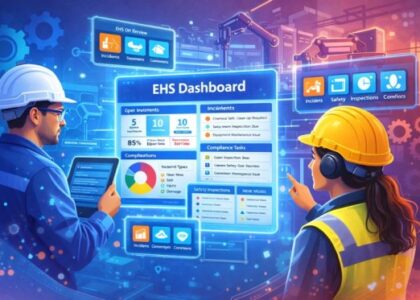
Inspection management software for manufacturing has become essential as factories handle a growing number of safety and operational checks every day. In a typical manufacturing plant, inspections happen constantly—equipment is checked before shifts, fire safety systems are reviewed weekly, chemical storage is audited monthly, and compliance walkthroughs are conducted regularly throughout the year.
In fact, a mid-sized manufacturing facility in India can easily carry out hundreds of inspections every month. Despite this high volume, many safety managers still struggle to confirm whether every inspection is completed on time, properly documented, and followed by corrective actions. The root cause is not a lack of effort, but outdated processes. Many organizations still rely on paper checklists, spreadsheets, and scattered communication tools like WhatsApp. As a result, inspection data becomes inconsistent, delayed, and difficult to track. Issues may be recorded but not resolved, and visibility across the entire inspection process remains limited.
This is where a structured digital approach makes the difference. Instead of managing inspections manually, organizations are now turning to centralized systems that bring consistency, accountability, and real-time visibility to every inspection activity.
What Is Inspection Management Software?
Inspection management software is a centralized digital solution that helps organizations plan, schedule, perform, document, and monitor workplace inspections and safety audits. It replaces traditional methods such as paper checklists, manual tracking, and scattered spreadsheets with structured workflows, mobile data collection, automated task assignment, and real-time reporting.
In an EHS environment, this system supports a wide range of inspection activities. These include daily equipment checks, routine safety inspections, and formal annual audits such as ISO assessments. More than just digitizing forms, a modern inspection platform improves the entire process. It integrates features like evidence capture, risk evaluation, corrective action tracking (CAPA), audit trails, and data analytics.
As a result, inspections move beyond simple record-keeping. They become a proactive tool for identifying risks and preventing incidents before they occur. Unlike paper-based systems that only document past events, digital inspection management enables organizations to take timely action and improve overall safety performance.
Why Inspection Management Software for Manufacturing Is a Critical Priority for Indian Manufacturers
Several forces are making digital inspection management an urgent strategic priority not a future consideration.
Factory Inspectorates No Longer Accept Paper Logbooks
State factory inspections across Maharashtra, Tamil Nadu, Gujarat, Karnataka, and Telangana are tightening enforcement. During site visits, regulators now demand digitally traceable inspection records, searchable histories, timestamped evidence, corrective action closure proof. Facilities that cannot produce clean documentation instantly are facing show-cause notices, improvement orders, and in serious cases, temporary production shutdowns.
Global OEM Customers Demand Digital Inspection Evidence
Indian automotive, aerospace, and electronics manufacturers supplying to global OEMs face annual EHS and quality audits that require evidence, not verbal assurances. Complete digital inspection records, CAPA closure rates, and trend analysis reports need to be available instantly in a format an international auditor can review. Paper files do not pass that test in 2024 or beyond.
ISO 45001 Certification Auditors Are Raising the Bar
Clause 9.1 and Clause 9.2 of ISO 45001 require systematic, documented inspection and audit programs with evidence of analysis and continual improvement. Certification auditors are now scrutinizing inspection completion rates, CAPA closure timelines, and how inspection data feeds management reviews. Paper-based programs consistently struggle to provide credible, complete answers during certification audits.
Every Missed Inspection Is a Hazard That Goes Undetected
The cost of an undetected equipment failure, chemical storage violation, or electrical hazard identified during an inspection before it causes harm is a fraction of the cost of the incident, production stoppage, regulatory citation, and insurance claim that follows after it does. The return on investment from systematic digital inspection management is not theoretical, it is directly measurable in avoided incident costs alone.
Core Features of Best-in-Class Inspection Management Software
When evaluating Inspection Management Software for Manufacturing, these are the key features.
Customizable Digital Inspection Templates
Every inspection type pre-shift equipment checks, fire safety rounds, chemical storage audits, contractor verifications, housekeeping walks, requires a different question set, response format, scoring logic, and escalation rule. Additionally, the system allow safety managers to build and modify templates without IT dependency, with conditional logic so that answering No automatically triggers a corrective action requirement.
Mobile Inspection App with Offline Support
Inspectors are on the plant floor, in the warehouse, or at a remote construction site not at a desk. A mobile safety inspection app for iOS and Android that supports offline completion, with data synchronizing automatically when connectivity resumes, is non-negotiable for manufacturing environments. The app must work while wearing gloves, in low-light conditions, and for workers who are not highly technical, which means large touch targets, simple navigation, and regional language support.
Automated Inspection Scheduling and Escalation Alerts
The platform must support recurring inspection schedules, daily, weekly, monthly, quarterly — assigned to specific individuals or roles, with automatic reminders before due dates and immediate escalation alerts when inspections are overdue. When an automated alert fires, inspections happen. When reminders depend on human memory, they do not. This single feature alone dramatically improves on-time inspection completion rates in most manufacturing operations.
Closed-Loop CAPA Workflow
Finding a hazard is only the beginning. The defining feature of inspection management software that actually improves safety is what happens after a finding is recorded. It should also allow automatically generate a corrective action task from every finding, assign it to a named responsible person with a due date, send escalation alerts if the action is not closed on time, require photographic evidence of completion, and store the full action history in an audit-ready trail. Without a closed-loop CAPA system, safety inspections become paperwork exercises that document problems without eliminating them.
Photo and Video Evidence Capture
A written description of a hazard “oil leak near Machine 7” is far less useful than a photograph with a timestamp, inspector name, and GPS location tag attached. Photo and video evidence captured within the digital inspection form creates an unambiguous record of the finding, clearly communicates the problem to the responsible person, and provides legally defensible documentation during regulatory inquiries or insurance investigations.
Real-Time Safety Inspection Analytics Dashboard
Safety managers and plant heads need inspection data in context, not raw records but intelligence. Which work areas have the highest recurring non-conformance rates? Which inspection types are consistently completed late? Which corrective actions are aging beyond their due dates? A real-time analytics dashboard that answers these questions without manual report compilation converts inspection management software from a compliance tool into a genuine safety performance improvement system.
Full Audit Trail and Compliance Record Management
Every inspection completed, every finding recorded, every corrective action assigned and closed, all stored with a tamper-proof audit trail showing who did what and when. This is the foundation of audit readiness for ISO certifications, regulatory inspections, customer safety audits, and internal governance reviews. Without a complete digital audit trail, audit preparation consumes days of manual document retrieval that a digital system makes instant.
How AI Is Transforming Inspection Management in Manufacturing
Inspection Management Software for Manufacturing is evolving with AI capabilities that go beyond digitization
AI-Powered PPE Compliance Monitoring
Instead of relying on periodic manual PPE compliance checks, AI cameras integrated with the inspection management platform continuously monitor production areas and automatically log non-compliance events in real time. PPE verification becomes a 24/7 automated detection process, identifying violations instantly, alerting supervisors immediately, and building an evidence-based compliance record without any manual inspection effort.
IoT Sensor-Triggered Inspection Alerts
When inspection management software integrates with IoT sensors on machinery and equipment, the system automatically generates inspection tasks when sensor readings indicate potential issues, elevated vibration levels triggering a bearing inspection request, abnormal temperature readings prompting an electrical safety check, pressure deviations initiating a process safety inspection. This moves inspection scheduling from fixed time-based routines to condition-based intelligence driven by actual equipment behaviour.
AI Pattern Recognition Across Inspection Data
Machine learning applied to accumulated inspection finding databases identifies correlations that human reviewers cannot detect, specific equipment models showing disproportionate failure rates, recurring housekeeping non-conformances concentrated in particular shift patterns, environmental compliance deviations correlating with specific production runs. This intelligence enables safety managers to direct inspection resources toward the highest-risk areas rather than treating all assets and locations equally.
Inspection management software is built on this convergence of EHS compliance management and Industry 4.0 digital intelligence giving Indian manufacturers a platform that delivers genuine operational safety intelligence, not just digital records.
Industry Applications of Inspection Management Software for Manufacturing
Automotive Manufacturing
Daily pre-start checks on presses, robotic cells, and lifting equipment. Weekly chemical storage audits for paints and solvents. Contractor supervision inspections during maintenance shutdowns. Quarterly compliance audits against ISO 45001 and IATF 16949. All across large, noisy plant floors where offline mobile capability and regional language support are essential for frontline adoption.
Chemical and Process Industries
Process area inspections against HAZOP control recommendations. Functional checks of pressure relief devices and emergency shutdown systems. Integrity monitoring of secondary containment. Scheduled testing of toxic gas and fire detection equipment. All require systematic documentation to meet MSIHC Rules and ISO 14001 requirements where a missed inspection can have catastrophic consequences.
Construction
Scaffold inspections before every work session. Excavation edge protection checks before workers enter. Crane and lifting equipment pre-use inspections. Contractor tool and equipment verification. All requiring a mobile-first inspection solution that operates across large outdoor sites with variable connectivity, where conditions change daily as the project progresses.
Oil and Gas
Pressure vessel and piping inspection tracking. Flare system and pressure relief valve functional testing. Fire and gas detection system checks. All managed in line with API standards and Process Safety Management requirements, with tight integration between inspection management and permit-to-work workflows, since most inspection activities on process equipment require active work permits.
Aerospace and Defence
Every inspection, every finding, and every corrective action must be traceable to specific components, work orders, and personnel with no gaps in the audit trail. AS9100 compliance and DGCA-linked regulatory oversight demand inspection management discipline that only purpose-built digital systems can reliably deliver at the evidence standards aerospace customers require.
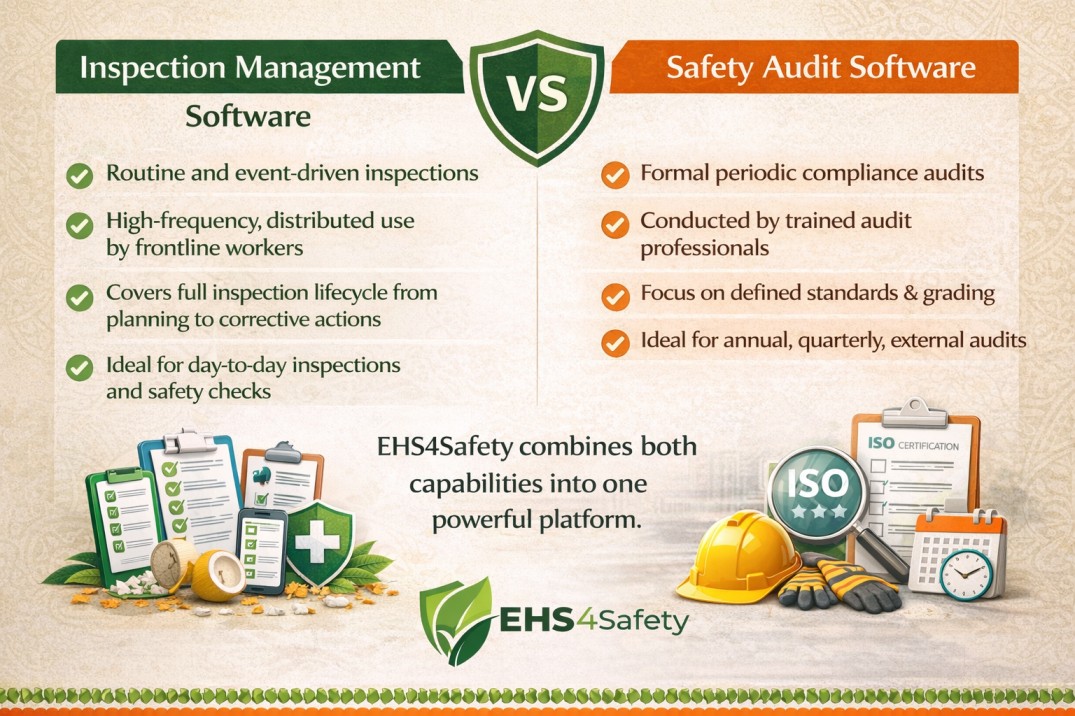
Inspection Management Software vs Safety Audit Software
Every Missed Inspection Is a Risk You Did Not Have to Take
The gap between what your inspection program is supposed to achieve and what it actually delivers under a paper-based system costs your organization every single day in undetected hazards, unclosed corrective actions, failed audits, regulatory citations, and preventable incidents that follow from each of these failures.
With regulatory enforcement intensifying, customer audit standards tightening, and AI-powered digital inspection tools now affordable for Indian manufacturing operations of every size, there is no credible argument for maintaining a paper-based inspection program.
The question is not whether to digitize your Inspection Management Software for Manufacturing. It is which platform will serve your specific operation best and how quickly you can implement it.EHS4Safety is ready to show you exactly how it works in your facility, with a free personalized demo configured for your industry and your inspection types.