Introduction
Manufacturing environments involve constant interaction between people, machines, energy sources, and processes. A HIRA Matrix is one of the most practical tools available to safety teams for making sense of that complexity and turning it into a structured, defensible risk assessment. Understanding how a HIRA Matrix works, and how it fits into a broader hazard identification and risk assessment program, matters for anyone responsible for plant safety, from EHS managers to production supervisors.
This article explains what HIRA and a HIRA Matrix actually are, how likelihood and severity are scored, how the matrix supports control selection, and how digital tools, including AI-assisted workflows, are changing how organizations build and maintain risk assessments.
What Is a HIRA Matrix?
Hazard Identification and Risk Assessment (HIRA). It is the overall process of identifying hazards in a workplace, evaluating the risk associated with each one, and determining what controls are needed to manage that risk to an acceptable level.
A HIRA Matrix is the visual and scoring tool used within that process. It typically combines two scales, likelihood and severity, into a grid that produces a risk score or risk level for each identified hazard. The matrix does not replace professional judgment. It structures that judgment so results are consistent across departments, shifts, and assessors.
HIRA describes the process. The HIRA Matrix is the instrument used inside that process to rate and prioritize risk. Treating the two as identical often leads to confusion during audits, since an auditor may ask how hazards were identified separately from how they were scored.
Components of a HIRA Matrix
A functional HIRA risk matrix generally includes the following elements:
- Activity – Task or work being performed.
- Hazard – Hazard associated with the activity.
- Consequence – Potential harm if the hazard occurs.
- Controls – Existing measures already in place.
- Likelihood – Chance of the hazard occurring.
- Severity – Level of potential harm or injury.
- Risk Score – Overall risk calculated from likelihood and severity.
- Recommendations – Additional controls needed to reduce risk.
- Residual Risk – Remaining risk after controls are applied.
Likelihood is not simply a guess about whether something might happen. It should reflect exposure frequency, task conditions, the condition of equipment, the level of human interaction involved, and any credible failure scenario, not only whether an incident has occurred before. A hazard with no history of an incident can still carry high likelihood if exposure is frequent and safeguards are inconsistent.
Severity reflects the worst credible outcome for that specific task, considering injury type, potential for multiple casualties, and recovery time, rather than an average or best-case outcome.
How HIRA Matrix Works
- Hazard – Identify the potential source of injury, illness, damage, or loss associated with the activity.
- Identification – Determine how the hazard is identified through workplace inspections, observations, measurements, task analysis, or other assessment methods.
- Severity – Evaluate how serious the potential consequence could be if the hazard results in an incident, from minor injury to fatality or major loss.
- Occurrence – Assess how likely or frequently the hazardous event could occur based on exposure, work conditions, and available evidence.
- Rating – Combine the severity and occurrence values to determine the overall risk rating and establish its priority.
- Controls – Identify existing controls and determine whether additional measures are needed to eliminate or reduce the hazard.
- Implementation – Define the specific actions required to put the recommended controls into practice and ensure they are effectively applied.
- Responsibility – Assign a responsible person or role to ensure the controls are implemented, maintained, and reviewed when necessary.
How HIRA Matrix Is Used in Risk Assessment
In practice, a HIRA risk assessment begins with breaking a job or process into discrete tasks. Each task is examined for hazards related to mechanical energy, electrical energy, chemical exposure, ergonomics, environmental conditions, and human factors.
For each hazard identified, existing controls are reviewed before likelihood and severity are rated. This sequencing matters. Rating risk before accounting for current controls produces an inflated score that does not reflect real conditions on the floor, while rating risk after controls without acknowledging their limitations can understate residual exposure.
Risk scoring produced through this process feeds directly into prioritization. Hazards with the highest scores are addressed first, often through a formal action tracking system so that recommended controls are not simply documented and forgotten. This is where workplace risk assessment becomes a living management tool rather than a static file.
Hierarchy of Controls
Once a hazard has been scored, the next question is which control measure is appropriate. The hierarchy of controls provides that structure, ranked from most to least effective:
- Elimination – Remove the hazard entirely.
- Substitution – Replace it with a safer alternative.
- Engineering – Use physical controls to isolate the hazard.
- Administrative – Apply procedures, permits, and safe work practices.
- PPE – Protect workers from remaining hazards with suitable personal protective equipment.
A common mistake is defaulting to PPE or a procedure change when an engineering control, such as fixed guarding or an interlock, is achievable. PPE relies on consistent human behavior and correct use every time, while engineering controls remove the exposure regardless of individual compliance on a given day.
After a control is selected and implemented, the hazard should be rescored to reflect residual risk. If residual risk remains unacceptable, additional layers of control are needed rather than accepting the outcome as final.
HIRA Matrix Example: Risk Assessment in a Manufacturing Plant
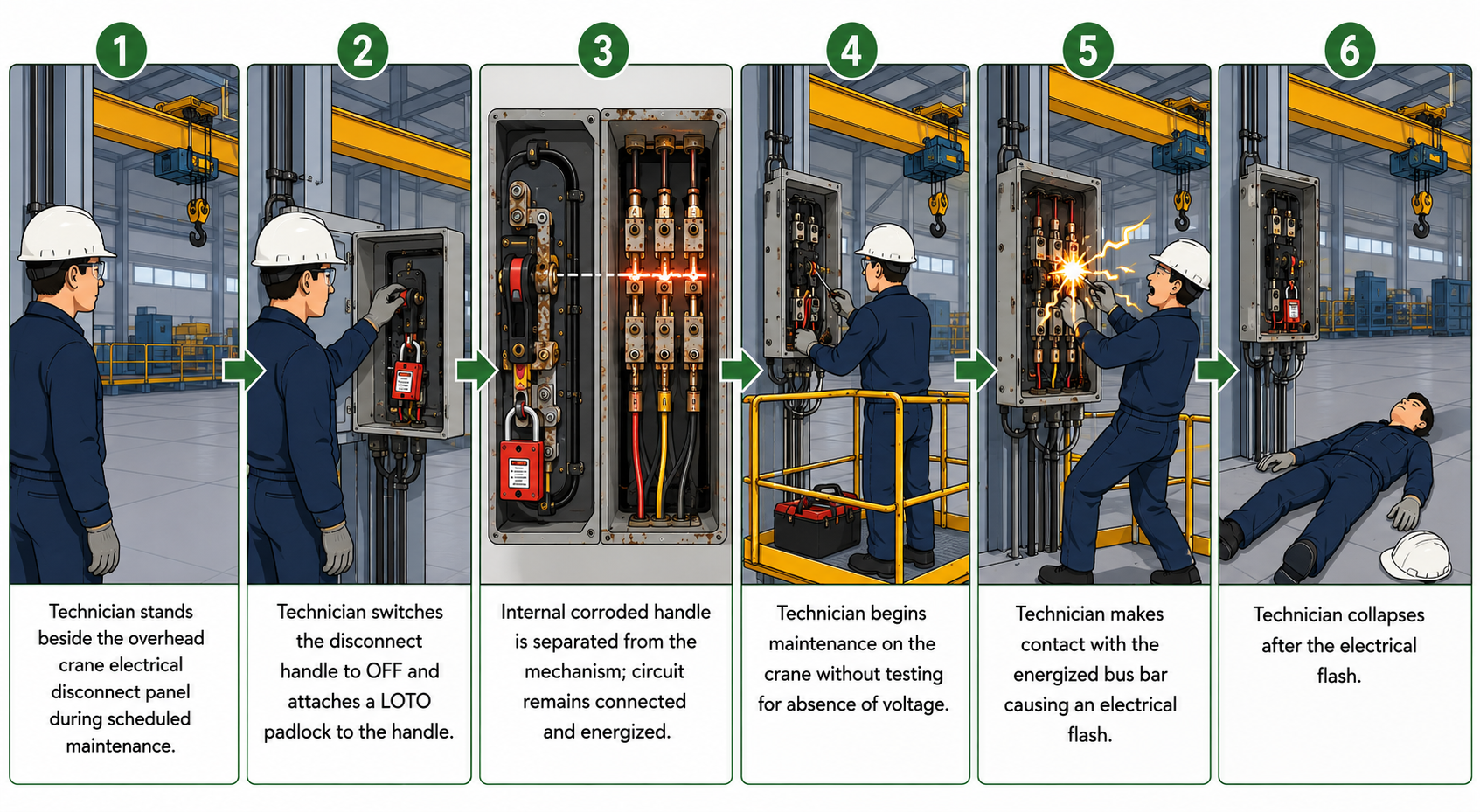
During scheduled maintenance of an overhead crane, a millwright turned the electrical disconnect switch to the OFF position and applied his personal lock. However, the disconnect’s external lever had become corroded and separated from the internal switching mechanism, meaning the lock appeared to isolate the crane while the electrical circuit remained energized. The worker did not independently verify that the equipment was actually de-energized before beginning the work. While performing maintenance, he came into contact with the still-energized bus bar and suffered a fatal electrical injury. The case demonstrates why applying a lock alone is not enough; verification of zero energy is a critical step before maintenance begins. Official OSHA Case Study, Overhead Crane Servicing and Maintenance
What Was the Hazard?
Electrical contact during maintenance on equipment where the isolation device was assumed, rather than verified, to be functioning correctly.
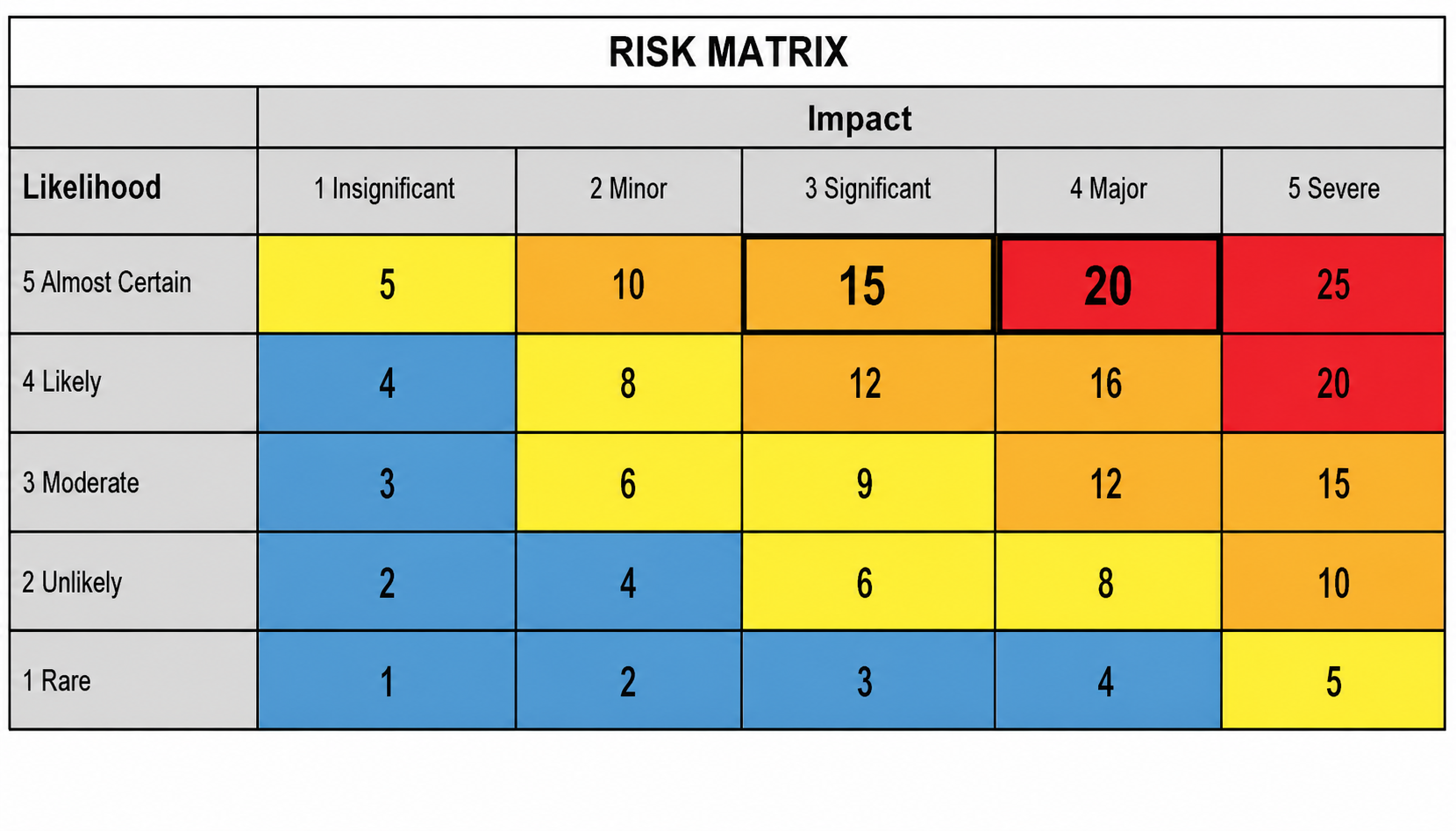
A HIRA Matrix could have helped prevent this incident by identifying electrical energy, faulty isolation, and failure to verify de-energization as critical hazards before maintenance began. The assessment would have highlighted that simply applying a lock to the disconnect was not sufficient and that the isolation device itself needed to be inspected and the absence of voltage independently verified. By assigning a high or extreme risk rating and specifying zero-energy verification, proper electrical testing, and qualified personnel as additional controls, the HIRA could have ensured that the crane was confirmed safe before the technician came into contact with the electrical components.
How Would the HIRA Change After Controls?
Initial risk, rated high or extreme due to unverified isolation, would be reduced to a lower residual risk once mandatory verification testing and disconnect hardware inspection were added and confirmed functional.
How AI Can Create a HIRA Matrix From a Job Description
Job Description – AI analyzes the task or job description provided.
Activity Identification – Breaks the job into specific activities or work steps.
Hazard Identification – Identifies potential hazards associated with each activity.
Consequence Assessment – Determines the possible consequences of each hazard.
Control Identification – Identifies existing controls and suggests additional controls.
Risk Rating – Suggests likelihood and severity ratings for each hazard.
Risk Classification – Calculates the risk score and assigns a risk level.
HIRA Generation – Organizes the findings into a structured HIRA Matrix.
Example: A maintenance technician’s job description may include isolating machinery, removing guards, inspecting moving components, performing electrical maintenance, replacing damaged parts, and restarting equipment. AI can analyze these activities and identify hazards such as electrical shock, stored energy, unexpected startup, moving parts, and pinch points. It can then map the hazards to their consequences, existing controls, likelihood, severity, risk level, and recommended controls, creating an initial HIRA Matrix that the EHS professional can review and validate against actual site conditions.
Common Mistakes When Using a HIRA Matrix
- Missed Hazards – Failing to identify all hazards associated with the activity.
- Low Priority – Not taking the HIRA process seriously during assessment.
- Limited Ownership – Assuming HIRA can only be performed by the safety officer.
- Incident-Based Scoring – Rating likelihood only based on whether an incident has occurred before.
- Uncontrolled Scoring – Rating risk before considering existing controls.
- PPE First – Choosing PPE as the primary control when engineering controls are possible.
- No Reassessment – Failing to evaluate residual risk after controls are implemented.
- Compliance Focus – Treating HIRA as paperwork instead of an active risk management tool.
- Outdated Assessment – Failing to update the HIRA after process, equipment, or shift changes.
Digital Risk Assessment Software
- Centralization – Manage HIRA assessments across multiple lines, shifts, and facilities from one platform.
- Templates – Use configurable HIRA Matrix templates for consistent risk assessment.
- AI Identification – Use AI to analyze job descriptions or tasks and identify potential hazards and risk factors.
- AI Assessment – AI can suggest consequences, likelihood, severity, and suitable controls to create an initial risk assessment.
- Scoring – Apply structured risk scoring to standardize risk evaluation.
- Tracking – Connect corrective and preventive actions directly to identified hazards.
- Approvals – Route assessments to the appropriate reviewer before activation.
- Dashboards – Monitor open risks, completed actions, and residual risk levels.
- Integration – Connect HIRA with Permit to Work and LOTO so identified controls carry directly into work execution.
- Continuous Updates – AI and digital workflows can help flag when assessments may need review after changes in processes, equipment, or work conditions.
Best Practices for HIRA Matrix Implementation
- Involve operators and maintenance staff who perform the task, not only supervisors, during hazard identification
- Rate likelihood using exposure frequency and equipment condition, not incident history alone
- Reassess residual risk after every control change
- Review HIRA records after any process, equipment, or personnel change
- Use digital records to track recurring hazard patterns across shifts and lines
Conclusion
A HIRA Matrix gives manufacturing organizations a structured way to identify hazards, rate risk consistently, and prioritize which controls need attention first. Its value depends on disciplined use, including accurate likelihood and severity ratings, correct application of the hierarchy of controls, and consistent reassessment of residual risk after changes are made.
AI-assisted tools can speed up the early stages of a HIRA risk assessment, and digital platforms can centralize records and close the loop on corrective actions, but neither replaces the judgment of a trained EHS professional who understands the actual conditions on the plant floor. Used correctly, a HIRA Matrix remains one of the most reliable tools available for turning hazard awareness into measurable risk reduction.