Every workplace incident leaves evidence about how a system failed. Root cause analysis in EHS is the discipline of following that evidence past the obvious trigger, such as a slipped hand or a skipped step, to the underlying conditions that allowed the event to happen.
In practice, root cause analysis in EHS is a structured investigation approach for determining why an injury, illness, environmental release, or near miss occurred so that corrective actions address the source of the problem instead of its symptoms. Organizations that treat investigations as paperwork tend to see the same events return under new names. Those that treat them as a learning process steadily remove hazards from their operations.
Understanding Root Cause Analysis in EHS
Root cause analysis in EHS separates causation into three layers. The immediate cause is the action or condition that directly produced the event, such as an operator stepping into a forklift path. Contributing factors are the circumstances that made that action more likely, including poor lighting, production pressure, or unclear traffic markings. The root cause is the deepest system-level failure that, if corrected, would prevent this event and others like it. In this example, it might be the absence of a pedestrian segregation review when the warehouse layout changed.
The method applies across the full EHS spectrum. Safety teams use it for injuries and near misses, health teams for exposure events and occupational illness, and environmental teams for spills, permit exceedances, and emissions deviations. The tools differ, but the logic stays consistent: keep asking why until the answer points to something the organization can control and change.
Why Root Cause Analysis in EHS Matters for Teams
A well-run investigation changes how an organization manages risk, not only how it closes a single case. Three benefits stand out.
- Prevents recurrence: Fixing the immediate cause removes one instance of a problem, while fixing the root cause removes the conditions that produce it. A guard replaced after a machinery injury protects one machine, but a revised change-management process protects every machine on the site.
- Moves the organization from reactive to proactive: Each completed analysis surfaces weaknesses in procedures, design, supervision, or training that exist elsewhere in the business. Teams can then address those weaknesses before they produce an incident, which shifts effort from response to prevention.
- Strengthens safety culture: When investigations focus on system failures rather than individual blame, workers become more willing to report hazards and near misses. That openness gives EHS teams better information, and better information leads to better decisions.
When Should You Conduct a Root Cause Analysis?
Not every event needs a full investigation. Applying the same depth to a minor first-aid case and a serious injury wastes effort and slows the cases that matter. A practical approach is to define clear triggers in the management system and scale the method to the potential severity, not only the actual outcome. Four triggers deserve particular attention.
- Repeat incident: A second or third occurrence of the same event type means earlier corrective actions did not reach the real cause. Repeats are also a prompt to review whether those earlier actions were actually completed and verified.
- Near miss: An event that caused no harm but could easily have caused a serious injury or fatality often carries more learning value than a minor injury. The absence of harm was a matter of chance, so the conditions that allowed the event are still in place. Investigating high-potential near misses lets teams correct those conditions before someone is hurt.
- Ergonomic issue: Musculoskeletal problems usually develop gradually and involve workstation design, task frequency, force, and posture together. Root cause analysis in EHS helps separate these factors so that fixes target the right one, instead of defaulting to a generic lifting-technique reminder.
- Repeat illness: When the same type of work-related health complaint appears across a team, department, or site, the pattern signals a systemic cause. Recurring skin reactions linked to one process, repeated respiratory complaints in one area, or several cases of heat-related illness on the same shift justify a deeper look than any single case would.
Common Root Cause Analysis Methods Used in EHS
No single technique fits every investigation. Experienced teams choose a method based on the complexity of the event, the evidence available, and the time they have. The following six cover most situations.
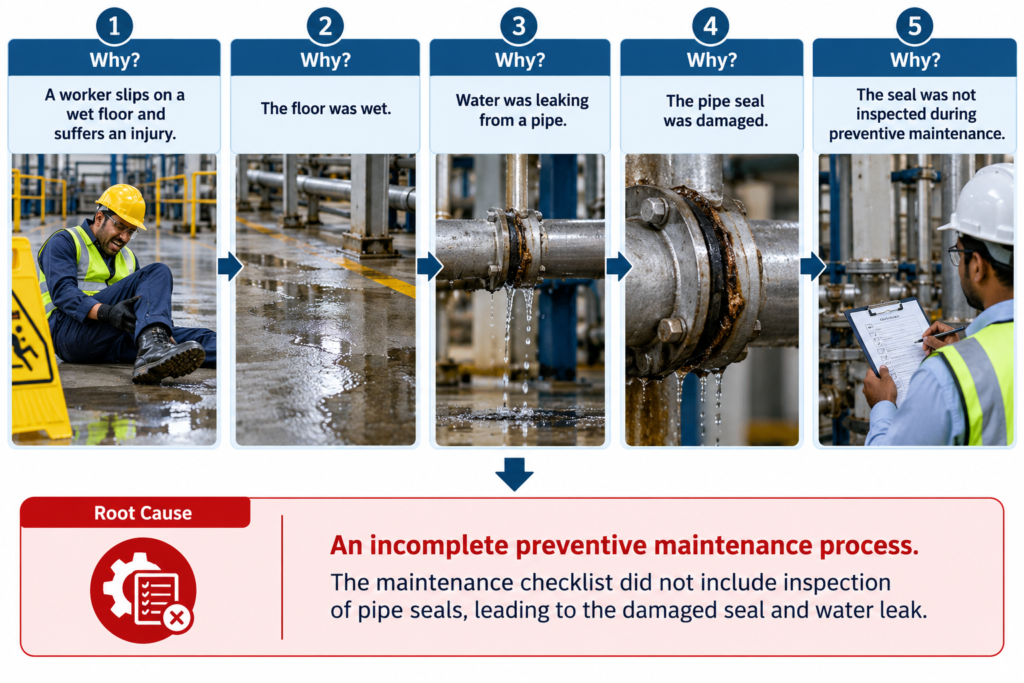
- 5 Whys: This technique asks why repeatedly, usually five times, until the answer reaches a process or system failure. It works well for straightforward events with a single causal chain, though it can oversimplify complex incidents if the investigator stops at the first convenient answer.
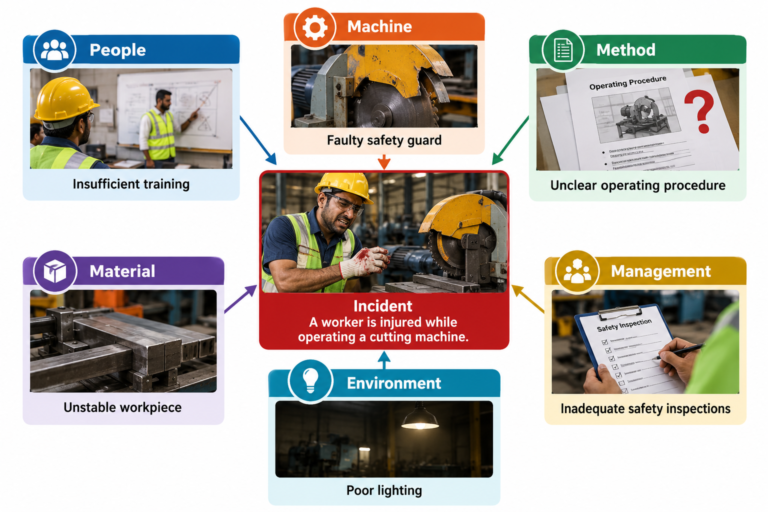
- Fishbone (Ishikawa) Diagram: The fishbone organizes possible causes into categories such as people, methods, machines, materials, environment, and management. It suits group sessions because it encourages broad thinking and shows how several factors combine.
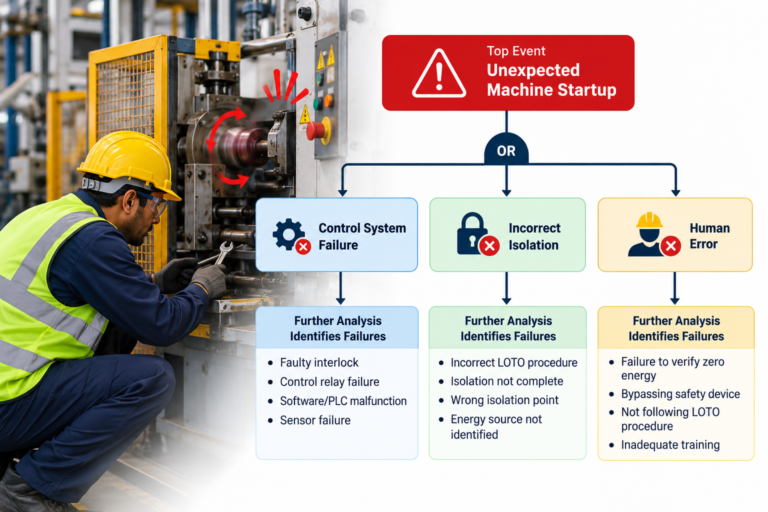
- Fault Tree Analysis: This top-down method starts with the undesired event and maps the combinations of failures that could produce it using logic gates. It is well suited to high-consequence events and process safety, where the interaction between equipment failures and human actions matters.
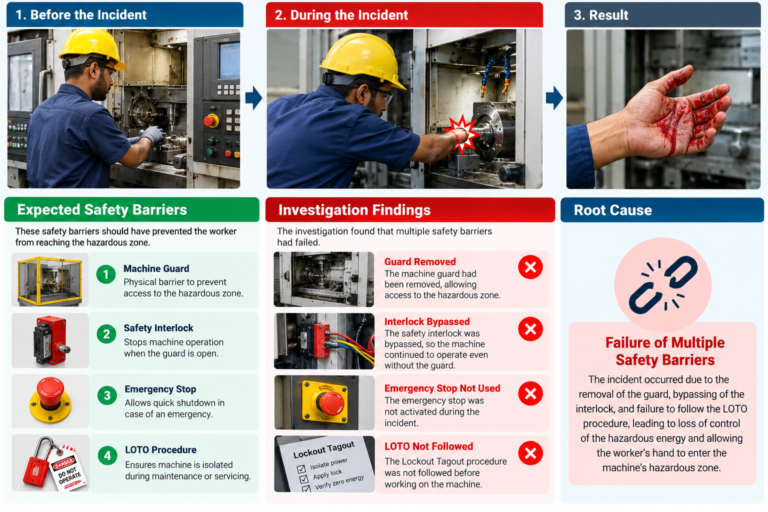
- Barrier Analysis: Barrier analysis examines the defenses that should have prevented harm, including guards, alarms, procedures, and permits, and asks which failed, which were missing, and why. It is especially useful for understanding why a known hazard still reached a worker.
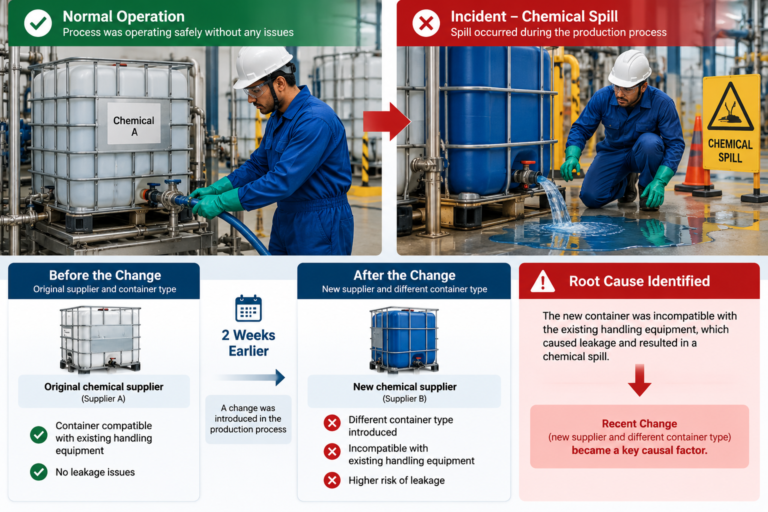
- Change Analysis: This approach compares the conditions when the process worked normally with the conditions when the event occurred. Differences in equipment, materials, people, procedures, or schedules often point directly to the cause.
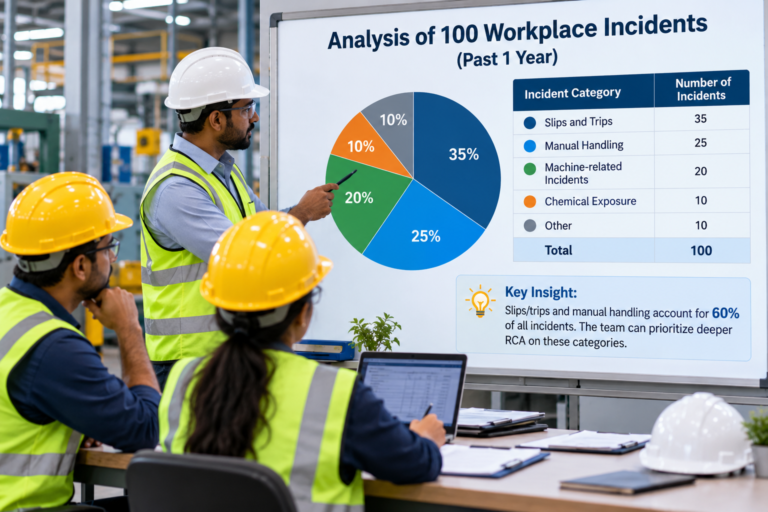
- Pareto Analysis: Pareto analysis ranks causes or event categories by frequency or impact, based on the 80/20 principle, which suggests that roughly 80 percent of outcomes come from 20 percent of causes. It helps EHS teams decide where root cause analysis in EHS will deliver the greatest return across a portfolio of incidents.
Common Mistakes That Weaken Root Cause Analysis
Even experienced teams fall into patterns that reduce the value of an investigation. Recognizing them is the first step toward avoiding them.
- Stopping at human error: Concluding that a worker made a mistake explains what happened but not why it was possible. A useful investigation asks what in the task design, tools, supervision, or environment made the error likely or made its consequences severe.
- Weak evidence collection: Conclusions drawn from memory and assumption are fragile. Strong analysis relies on interviews with several witnesses, physical evidence, photographs, maintenance records, training files, and process data collected as soon as possible after the event.
- Actions that rely on retraining alone: Retraining is easy to assign and easy to close, but it rarely changes the underlying conditions. Corrective actions are stronger when they eliminate the hazard, substitute a safer method, or add engineering controls, in line with the hierarchy of controls.
- No effectiveness check: An action marked complete is not the same as an action that worked. Teams should define in advance how they will verify results, for example by monitoring recurrence or related leading indicators over a set period.
- Disconnected data: When incident records, audit findings, inspection results, and corrective actions sit in separate spreadsheets or systems, patterns stay hidden. Investigators then analyze each event in isolation and miss the wider trend.
- Missing the contributing factors: Most serious events involve several causes working together. Focusing on a single cause leaves the other conditions in place, and the event can return through a different route.
- Failing to get to the real root cause: The first plausible explanation is rarely the deepest one. A reliable test is to ask whether fixing the identified cause would genuinely prevent recurrence, and if the honest answer is uncertain, the analysis needs to go further.
Regulatory and Standards Alignment
Good practice in root cause analysis in EHS also supports compliance. Several regulations and standards either require investigation and corrective action or reward organizations that do it well.
| Regulation / Standard | Scope | What it requires or expects | Link to root cause analysis in EHS |
|---|---|---|---|
| OSHA 29 CFR 1904 | Recording and reporting of occupational injuries and illnesses in the United States | Does not prescribe an analysis method. Employers must keep accurate records of work-related injuries and illnesses. | Accurate records give investigators the data needed to find patterns, and OSHA expects employers to learn from recorded events. Process safety rules such as 29 CFR 1910.119 go further by requiring incident investigations that identify root causes. |
|
ISO 45001 (Clause 10.2) | Occupational health and safety management systems: incident, nonconformity, and corrective action | Organizations must review events, determine their causes, and evaluate whether similar events exist or could occur elsewhere. The effectiveness of corrective actions must also be reviewed. | Directly requires cause determination and verification of results, which are core steps of a structured investigation. |
|
ISO 14001 (Clause 10.2) | Environmental management systems; nonconformity and corrective action | When a nonconformity occurs, the organization must determine its causes, implement corrective action, and confirm that the action was effective. | Parallels ISO 45001 for environmental events such as spills, permit exceedances, and emissions deviations. |
| EU Seveso III | Establishments handling dangerous substances in quantities that create major-accident hazards | Operators must report accidents, analyze them, and apply lessons learned. | Makes structured root cause analysis in EHS central to demonstrating control of major hazards. |
Documenting the method, the evidence, and the follow-up for each investigation gives auditors and regulators a clear record that the organization acts on what it finds.
The Role of Software in Root Cause Analysis
Spreadsheets and email can support a small number of investigations, but they struggle as volume and complexity grow. Dedicated EHS software gives root cause analysis in EHS a consistent structure and connects it to the rest of the safety management system.
- Structured investigation workflows: Guided forms walk investigators through evidence collection, cause identification, and approval steps in a consistent order. This reduces variation between investigators and makes sure no stage is skipped under time pressure.
- Linked CAPA tracking: When corrective and preventive actions are tied directly to the investigation that produced them, ownership, deadlines, and verification stay visible. Managers can see which actions are overdue and whether completed actions achieved their purpose.
- Trend and pattern analysis: Centralized data allows teams to compare causes across sites, departments, shifts, and event types. Patterns that no single investigation would reveal, such as a recurring contributing factor in one process, become visible through reporting and dashboards.
- AI-assisted analysis: Newer tools can suggest likely causal factors from event descriptions, flag similar past incidents, and highlight gaps in an investigation. These capabilities support the investigator’s judgment rather than replacing it, and they help teams work faster without lowering the quality of analysis.
Conclusion
Root cause analysis in EHS turns incidents into information. By looking beyond the immediate trigger, choosing methods that fit the event, gathering solid evidence, and verifying that corrective actions work, organizations reduce repeat events and build trust in their safety systems. The practice also aligns directly with the expectations of OSHA, ISO 45001, ISO 14001, and Seveso III.
The most effective programs combine disciplined technique with connected data. When investigations, actions, and trends live in one system, teams spend less time chasing records and more time preventing the next event. Strengthening root cause analysis in EHS is a practical, measurable step toward a safer and more resilient workplace.